CBSE Class 12 Physics 2024 Paper with Worked Solutions
CBSEPhysics2024 Previous Year Paper
Paper code: 55/5/1 · 2024Practise the complete English-language CBSE Class 12 Physics 2024 main examination paper, set 55/5/1. The file pairs the original questions, options and diagrams with worked explanations, including all printed internal choices.
This set is one of the year's papers. See every set from 2024, grouped by series.
What this year-wise paper contains
This resource is organised around one complete board paper, rather than as a chapter-wise question bank. The cover identifies the examination as CBSE Class 12 Physics, gives a duration of 3 hours and lists 70 maximum marks. The set code matters when comparing your work with the explanations: use the question wording and numbering from 55/5/1 rather than assuming another 2024 set is identical.
The cover provides a question-number index. The worked explanations separate the formula or principle, the concept behind it and the steps used to apply it. That structure lets you locate a specific gap: you might recognise a formula but overlook the assumption that makes it usable, or understand the principle but struggle to express it mathematically.

Physics 2024 | Class 12 | Previous Year Paper | Code 55/5/1
In the StudentCurio app
The complete CBSE Class 12 Physics 2024 examination paper, set 55/5/1, with worked solutions. It covers questions across the syllabus and helps students practise board-exam questions and review solution methods.
How to attempt the paper before reading the solutions
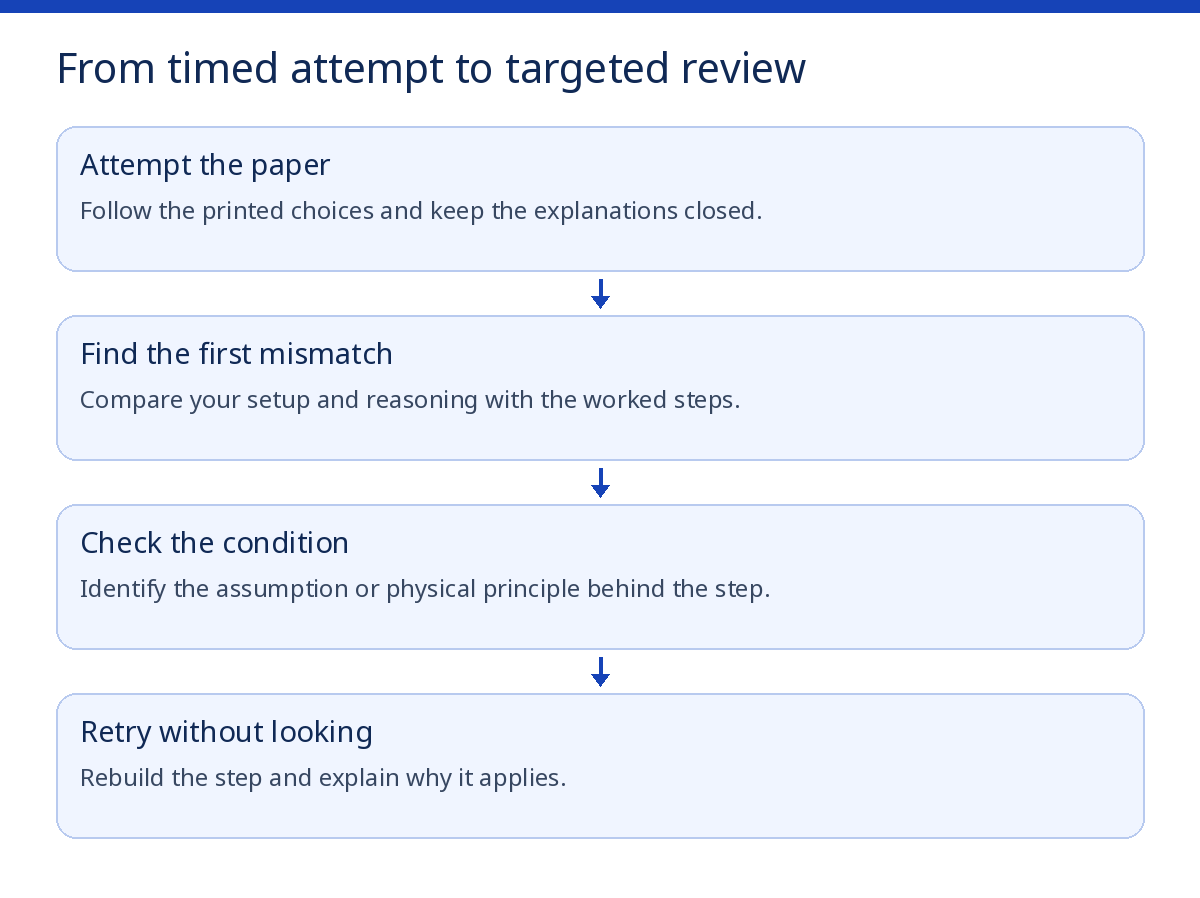
For a timed attempt, use the stated three hours and follow the instructions and choices printed in the paper. Keep the explanations closed while you work. If an item uses a diagram or graph, inspect its labels and axes before writing an equation; the visual may tell you which direction, quantity or comparison matters. For numerical work, leave your setup and units visible so you can later tell whether a mistake began with the physics or the arithmetic.
Treat an internal choice differently during review than during the timed attempt. Follow the printed choice during the attempt. Afterwards, try the alternative independently before looking it up. Because the resource includes explanations for both alternatives, you can check whether your chosen branch reflected stronger understanding or simply a more familiar question format.
A useful connection: separate magnitudes from directions
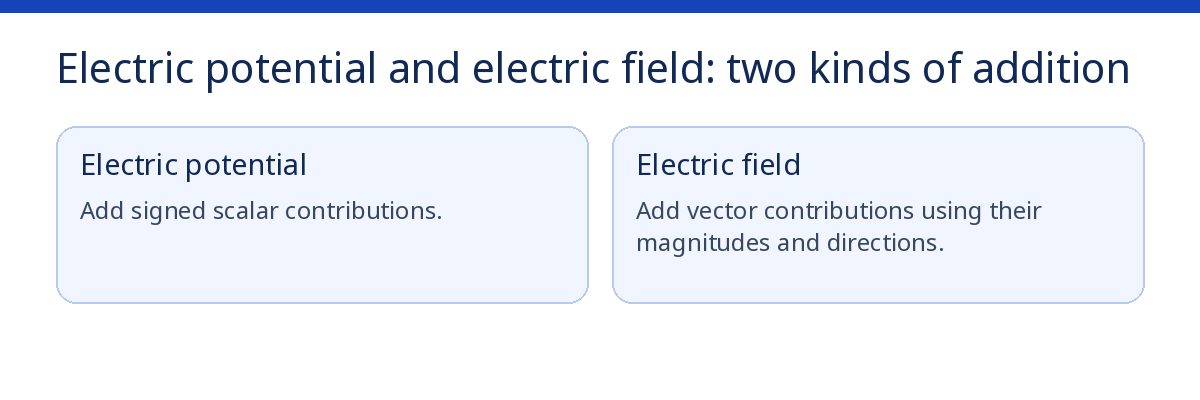
The electrostatics material illustrates why electric potential and electric field require different reasoning. Potential is a scalar, so contributions are added with their signs. Field is a vector, so you must account for direction as well as magnitude. When you see a symmetric charge arrangement, establish which quantities are equal and decide separately whether the scalar contributions cancel and whether the vectors cancel. Neither conclusion automatically gives you the other.
Direction matters again in magnetism. The magnetic force on a moving point charge is perpendicular to its instantaneous velocity whenever the force is nonzero. That is why the magnetic force does no work on the charge, even though it can alter the direction of motion. In a statement-and-reason item, test each statement first, then ask whether the reason actually explains the statement.
When the circuit and magnetic formulas apply
The current electricity explanations use different quantities that stay fixed. In the battery model , the same emf is used when comparing separate load measurements of the same battery modelled with a fixed internal resistance. In a galvanometer converted to a voltmeter by a series resistor, it is the instrument's full-scale current that stays fixed when the voltage range changes. Identifying the invariant first helps you choose the right equation instead of treating both comparisons as interchangeable.
The magnetic-force treatment also distinguishes a conductor's length from its displacement. For a bent conductor carrying steady current in a uniform magnetic field, the net force uses the displacement vector from the start to the end, oriented along the current, rather than the total length of the bends. Do not assume that shortcut holds if the field varies along the conductor.
Reading optics diagrams and photoelectric graphs
The optics material gives you two different tasks: recognising a viewing condition and tracking what changes in an interference pattern. For a compound microscope in normal adjustment, the final image is at infinity for a relaxed eye. When reviewing the magnification, distinguish the reported magnitude from a signed value that conveys orientation. In double-slit interference, compare fringe spacings at fixed screen distance and slit separation by using the wavelength in the medium, not the wavelength in air.
For a photoelectric graph, distinguish the threshold-frequency intercept from the stopping potential read at a chosen frequency. One concerns the onset of emission; the other reflects the maximum kinetic energy of emitted electrons at that frequency. Keeping those readings separate helps you explain a comparison without treating every feature of the graph as the same physical quantity.
Quick self-check: explain a step before redoing it
The worked entries also cover hydrogen energy levels, the interaction between nucleons and donor doping in semiconductors. Each is a chance to check the meaning of a symbol before manipulating it. In the hydrogen model, can you keep kinetic, potential and total energy distinct? On a potential-energy curve, would you inspect the height or the slope to reason about force? In the semiconductor treatment, can you distinguish a carrier concentration in the doped sample from the intrinsic carrier concentration?
When reviewing your attempt, find the first step where your reasoning diverges from the explanation. Write down what you missed, whether it was a condition, a graph reading, a sign or an algebraic step. Then close the explanation and reconstruct that part of the method. The useful check is whether you can justify the step without relying on the printed option or final line.
Spotted an error? Report a correction. Practise this in the app: notes, formula sheets and mind maps.













































































































































































Loading comments…