CBSE Class 12 Physics 2024: Paper 55/2/1 With Solutions
CBSEPhysics2024 Previous Year Paper
Paper code: 55/2/1 · 2024Use the complete English-language 2024 CBSE Class 12 Physics main-examination paper for a three-hour, 70-mark practice attempt. Then use the worked solutions to check not just your answers, but also your choice of principle, assumptions and reasoning.
This set is one of the year's papers. See every set from 2024, grouped by series.
What the five sections ask you to do
This is a year-wise previous paper, not a chapter worksheet. Set 55/2/1 contains 33 questions, and the file retains the original English questions, options and diagrams. The mix of question types lets you practise recognising a concept in one place and explaining or applying it in another.
- Section A: Questions 1–16 are worth one mark each. Questions 13–16 use the assertion–reason format.
- Section B: Questions 17–21 are very short answers worth two marks each.
- Section C: Questions 22–28 are short answers worth three marks each.
- Section D: Questions 29 and 30 are case studies worth four marks each.
- Section E: Questions 31–33 are long answers worth five marks each.
All questions are compulsory, but some have internal choices outside Section A. Choose between the alternatives where an “OR” appears; it does not let you skip the question or substitute a different one.

Physics 2024 | Class 12 | Previous Year Paper | Code 55/2/1
In the StudentCurio app
The complete 2024 CBSE Class 12 Physics paper, set 55/2/1, includes 33 questions and worked solutions across topics such as optics, electromagnetism, semiconductors, electrostatics and atomic physics. It helps students practise the full board-exam format and review solution methods.
Use the question paper before opening the solutions
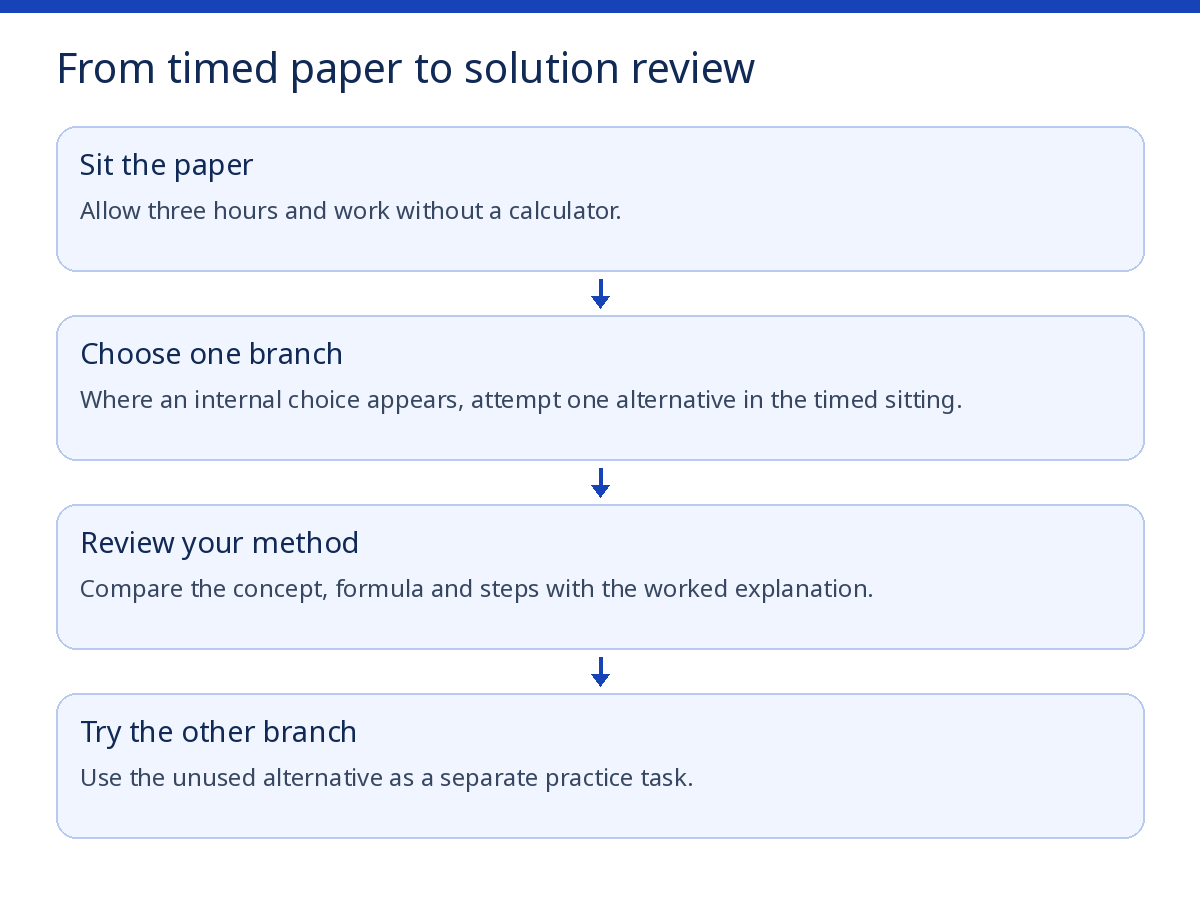
For a board-style attempt, set aside three uninterrupted hours and work without a calculator, as the paper requires. Attempt only one branch of each internal choice during the timed sitting. Save the unused branches for later: the resource includes worked explanations for all printed alternatives, so those branches give you a second way to check your understanding without immediately repeating a question.
The file links question numbers to the worked solutions and provides links back to the questions. After the attempt, compare your work with the explanations in their three parts: formula used, concept used and explanation in steps. If your approach differs, look first for the point where the reasoning diverges. A wrong starting assumption calls for a different kind of revision from an arithmetic slip near the end.
Read the physical conditions before choosing a formula
The electricity and magnetism questions move between current in conductors, branch circuits, induction, transformers and charged-particle motion. The useful distinction is between a relation you recognise and one that applies to the situation drawn or described. In a circuit problem, mark your assumed current directions before writing equations. A negative result relative to an assumed direction is information about the direction of flow, not by itself evidence that the equations are wrong.
In magnetism, identify the relevant direction before working with magnitudes. For flux through a flat loop in a uniform field, the angle in the dot product is measured from the normal to the loop, not from its plane. For induction, distinguish the flux through one turn from the flux linkage of the coil. That distinction helps you see where the turn count belongs in the model.
Keep the conditions in each optics model separate
The paper includes refraction, interference, diffraction and optical instruments. They all concern light, but they do not use the same starting assumptions. In the refraction case study, the critical angle belongs to a particular pair of media and is defined for light travelling from the higher-index medium towards the lower-index one. In the separate lens question, the surrounding liquid is part of the optical system; a focal length quoted in air cannot simply be carried over unchanged.
The long-answer alternatives ask for different representations. An interference or diffraction comparison concerns the distribution of intensity across a screen. A microscope ray diagram instead traces image formation through lenses. When revising the instruments, read the specified final-image condition before choosing a magnifying-power expression. The paper treats a final image at the least distance of distinct vision and a final image at infinity as distinct conditions.
Follow the reasoning in modern physics and electronics
In the modern-physics questions, first identify what kind of energy or momentum the question is about. Photoemission distinguishes photon energy from the energy needed to release an electron, while an atomic transition links radiation to the difference between two energy levels. The matter-wave graph adds a separate modelling issue: the de Broglie relation connects wavelength with momentum, but an expression that converts momentum to kinetic energy for a non-relativistic massive particle cannot simply be carried over to a photon.
The semiconductor questions also shift between levels of explanation. Doping is about how impurities change the availability of charge carriers. Junction bias is about what happens at the junction under an applied voltage. The rectifier question moves from the device to the circuit: use the circuit diagram to account for the output waveform rather than treating the waveform as a separate sketch to memorise.
Quick self-check for case studies and long answers
The case studies use two settings: a cell with internal resistance and light at a boundary between media. In the cell passage, ask whether the circuit is open or delivering current before deciding whether you are discussing emf or terminal potential difference. In the optics passage, check whether an angle belongs to the incident, reflected or refracted ray. A labelled sketch can keep those quantities distinct before you read the options.
For a longer response, ask: Have I stated the condition that makes the derivation valid? For instance, the paper's small-dipole potential question specifies a distance much larger than the dipole's size. If the prompt also asks for a diagram, graph or justification, check that your response supplies it rather than stopping at an expression.
This guide leaves out Q4's transcribed option units and Q20's mass data; neither is needed to review the underlying concepts.
Spotted an error? Report a correction. Practise this in the app: notes, formula sheets and mind maps.













































































































































































Loading comments…