CBSE Class 12 Physics 2024: Set 55/1/3 Paper Guide
CBSEPhysics2024 Previous Year Paper
Paper code: 55/1/3 · 2024Practise the full CBSE Class 12 Physics 2024 main-examination paper, set 55/1/3, in its original English version. This guide explains the five-section format and shows how to use the worked solutions to check your choice of model, reasoning and presentation.
This set is one of the year's papers. See every set from 2024, grouped by series.
How the 70-mark board paper is organised
This year-wise previous paper brings together 33 questions from one CBSE Class 12 Physics sitting. The time allowed was three hours, and calculators were not permitted. The file retains the original English questions, options and diagrams, so use the printed pages when a question depends on a figure or on the way a symbol is displayed.
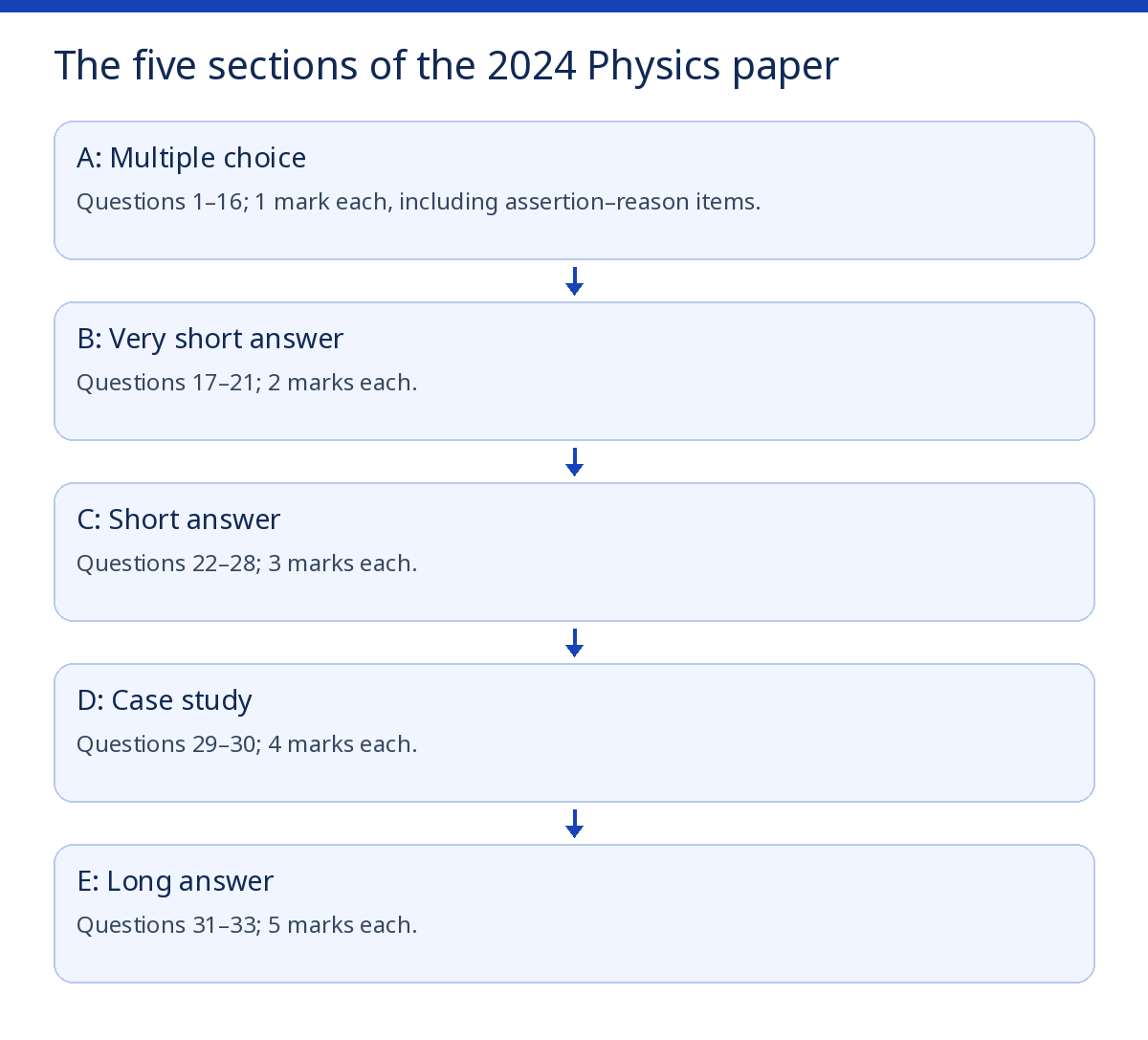
- Section A: Questions 1–16 carry one mark each and include assertion–reason items.
- Section B: Questions 17–21 are very short answers worth two marks each.
- Section C: Questions 22–28 are short answers worth three marks each.
- Section D: Questions 29–30 are case studies worth four marks each.
- Section E: Questions 31–33 are long answers worth five marks each.
All questions are compulsory, but some offer an internal choice. There is no overall choice and no internal choice in Section A. An internal choice lets you select a printed alternative within a question; it does not let you skip a question number.

Physics 2024 | Class 12 | Previous Year Paper | Code 55/1/3
In the StudentCurio app
The complete CBSE Class 12 Physics 2024 paper, set 55/1/3, with worked solutions. It covers questions across the exam syllabus, helping students practise the full board paper and review solution steps.
Electricity and magnetism: identify what is held fixed
The paper moves from electric fields and current density to galvanometer conversion, magnetic forces, capacitance and dipoles. These topics reward different first steps. With a field or force, decide whether direction is part of the result before working with magnitudes. With a circuit, identify how the components are connected before choosing a current or voltage relation.
Good to remember: The capacitor question explicitly keeps the charge fixed as the plates are separated. An energy relation must therefore be used with that constraint, rather than treating the voltage as fixed. Similarly, one dipole derivation explicitly places the observation point much farther from the centre than the half-separation of the charges. That condition belongs with the approximation, not just with the diagram.
This guide omits the capacitor’s printed charge value and the wire-force question’s signed options because those details are unclear in the extracted text.
Alternating current: separate the model from the device
The AC questions cover resistance and reactance as frequency changes, voltage across components in a series LCR circuit, and the impedance of a series resistor–capacitor circuit. For the graph task, label the axes and identify the component represented by each curve. In circuit reasoning, distinguish impedance, which describes the circuit’s overall opposition to alternating current, from the reactance of an individual component. When considering component voltages, account for phase rather than adding voltage magnitudes as ordinary scalars.
The transformer alternative combines a labelled diagram, a working principle, real energy losses and a numerical task. Keep an ideal transformer relation separate from a discussion of real losses. Also distinguish a rise in voltage from a rise in power: voltage alone is not enough to compare power at the input and output.
Optics: choose a ray or wave description
The optics questions use mirrors, refraction, lenses and prisms as well as reflected wavefronts and interference. For an image calculation, keep the sign convention consistent from the diagram through to the interpretation of the result. For a prism graph, label the angle of incidence and the angle of deviation separately. A wavefront construction calls for different labels from an image diagram: show the front and the direction of propagation distinctly.
When the lens-power rule applies: The case passage gives the algebraic sum of individual lens powers for lenses in contact. For a focal length expressed in metres, gives power in dioptres using the signed focal length. Check the contact condition and the units before using the rule; the passage does not give that same rule for lenses separated by a distance.
From modern physics concepts to a diode case study
Matter waves, photoelectric emission, hydrogen spectra and nuclear density appear in different question formats. Start by naming the quantity the question compares. In particular, a photon and a material particle are not described by the same energy–momentum relation. In the assertion–reason items, judge each statement independently before deciding whether the reason explains the assertion, then use the codes printed in this paper.
The second case study links diode bias to rectification. Read the passage alongside the circuit or waveform where one is given. Keep two questions distinct: which way the diode is biased during part of the input cycle, and what output is measured across the load. The case passage distinguishes half-wave and full-wave rectification by whether the circuit uses one or both input half-cycles.
Use the worked solutions after a timed attempt
Attempt the paper without opening the solutions, using the three-hour limit and the no-calculator rule. Where an internal choice is printed, select one branch during the timed sitting. Save the unattempted branch for review: it provides another task from the same paper without changing what you completed under exam conditions.
The file has a question-number index and presents explanations under formula used, concept used and explanation in steps. On review, look beyond whether your final response matches. Find the first point where your reasoning diverges: the physical assumption, the equation, the diagram or the calculation. Then return to the original question and write that part again without looking at the explanation. For a long answer, check each requested part separately; a numerical result does not replace a derivation, graph or labelled diagram asked for alongside it.
Spotted an error? Report a correction. Practise this in the app: notes, formula sheets and mind maps.













































































































































































Loading comments…