CBSE Class 12 Physics 2024 Paper (55/3/3) with Solutions
CBSEPhysics2024 Previous Year Paper
Paper code: 55/3/3 · 2024Practise the complete English-language 2024 CBSE Class 12 Physics main examination paper under its three-hour, 70-mark conditions. Then use the worked solutions to check not just your final answers, but also the assumptions, diagrams and reasoning behind them.
This set is one of the year's papers. See every set from 2024, grouped by series.
How the 2024 paper is organised
This is a year-wise previous paper, not a chapter-wise question bank. It preserves the original English questions, options and diagrams for paper code 55/3/3. The paper has 33 questions across five sections, and calculators are not allowed.
- Section A: Questions 1–16 carry one mark each. These are multiple-choice questions, including assertion–reason items.
- Sections B and C: Questions 17–21 are two-mark very short answers; questions 22–28 are three-mark short answers.
- Sections D and E: Questions 29–30 are four-mark case studies; questions 31–33 are five-mark long answers.
There is no overall choice. Where an internal choice is printed, attempt one alternative in that slot during a timed attempt. Section A has no internal choices. The worked explanations include the printed alternatives, so you can revisit the branch you skipped after the attempt.

Physics 2024 | Class 12 | Previous Year Paper | Code 55/3/3
In the StudentCurio app
Complete CBSE Class 12 Physics board examination paper for 2024, code 55/3/3, with worked solutions. It covers topics across the syllabus, including optics, electrostatics, current electricity, electromagnetism, semiconductors, atomic and nuclear physics, and helps students practise the board exam and review solution methods.
Good to remember: field, potential and force
The parallel-plate case study links three ideas that are easy to confuse: electric potential, electric field and force on a charge. Potential is a scalar; the field has a direction. In the uniform-field region described in the case, the potential changes at a constant rate along the axis normal to the plates. The field points towards decreasing potential, while the force on a negative charge points opposite to the field.
The long-answer electrostatics questions use different setups, including a parallel-plate capacitor with a dielectric and a charged conducting spherical shell. When reviewing a derivation, identify the geometry, the material and the region being considered before selecting a relation. In a shell problem, an argument for the interior is not automatically an argument for the exterior.
When the rate of flux change matters
The paper approaches current electricity through resistance, relaxation time, current density and the balance condition of a Wheatstone bridge. For the bridge, zero current through the galvanometer is the balance condition; it does not mean that current stops in the other branches. A labelled circuit shows which branch the condition refers to.
Electromagnetic induction makes a different distinction. The instantaneous induced emf depends on the rate of change of magnetic flux linkage. For a closed circuit of fixed resistance under the resistive model used in the paper, the net charge transferred over an interval instead depends on the net change in flux linkage. When comparing these prompts, first decide whether the question asks for a value at an instant or a quantity accumulated over an interval.
Optics: trace rays or compare waves?
The optics questions call for two kinds of representation. In ray optics, a telescope in normal adjustment is a specific arrangement in which the final image is at infinity. That condition determines which relation to use for the lens separation. In the prism question, a ray diagram helps distinguish the angles measured from the surface normals from the overall deviation. These labels also make it easier to interpret the requested graph of deviation against incidence.
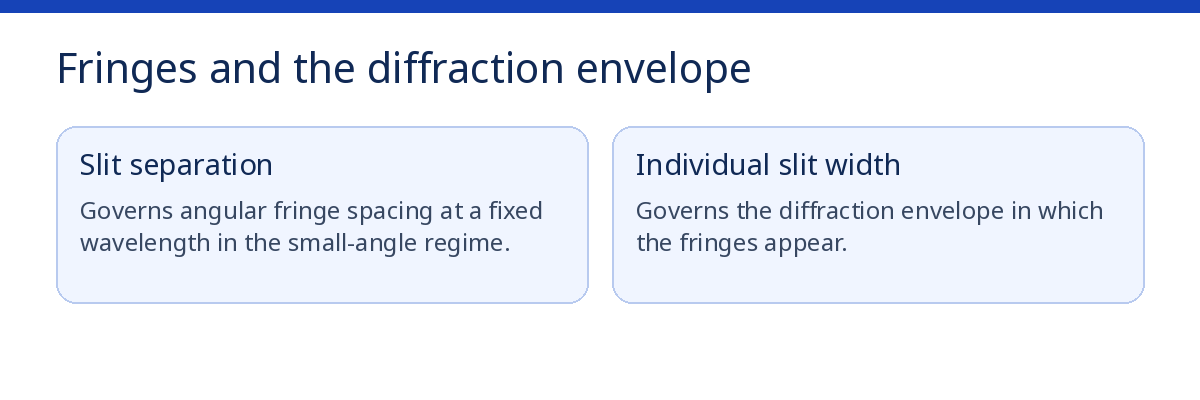
In wave optics, a stable interference pattern requires a constant phase difference between the contributing waves. The two-slit case study combines interference fringes with a diffraction envelope: slit separation governs the angular spacing of the fringes for a given wavelength in the small-angle regime, while the finite width of each slit governs the envelope. Keep width and separation distinct when reading what changes and what stays fixed.
Quick self-check: distinguish the energy quantities
The paper moves between photoemission, matter waves, the Bohr model, nuclear binding and semiconductors. The word energy does different work in each. In photoemission, the work function sets the minimum photon energy needed to release an electron. In matter-wave questions, wavelength is related to momentum; expressing it through the familiar square-root dependence on kinetic energy assumes nonrelativistic motion. A nuclear separation question instead concerns the energy needed to break a bound nucleus into its constituents.
Before comparing semiconductor explanations, ask yourself: does the energy refer to the gap between the valence and conduction bands, or to the smaller energy needed to free an electron from a donor level? Then check whether the question calls for an energy-band diagram or for a circuit and a current–voltage characteristic. They represent different properties.
Review the first step where your reasoning diverges
Attempt the question paper before opening the worked solutions. On review, use the file’s Formula used, Concept used and Explanation in steps labels to locate the first difference between your approach and the worked method. If you chose the right relation but lost a sign, check your direction convention. If the relation itself was unsuitable, identify the condition you overlooked. For assertion–reason items, judge the truth of each statement separately before deciding whether the reason explains the assertion.
Two wording-dependent items are left out of this guide’s walkthrough: the proton-work item can be read as asking about external work or net work, and the rotating-loop item depends on the initial orientation of its magnetic moment. No answer option is endorsed for either item. For exact signs, units and superscripts, refer to the original question pages rather than a text extraction.
Spotted an error? Report a correction. Practise this in the app: notes, formula sheets and mind maps.













































































































































































Loading comments…