CBSE Class 12 Physics 2024 Previous Year Paper: Set 55/2/2
CBSEPhysics2024 Previous Year Paper
Paper code: 55/2/2 · 2024Practise with the full English-language CBSE Class 12 Physics 2024 main examination paper, set 55/2/2. Use its worked solutions after your attempt to check not just your answers, but also the conditions, diagrams and reasoning behind them.
This set is one of the year's papers. See every set from 2024, grouped by series.
Know the format before you start
This year-wise resource pairs the full question paper with worked solutions. The original English questions, options and diagrams are retained, and the question-number index lets you jump to a specific explanation. The paper allows three hours, carries 70 marks and does not permit calculators.
The 33 questions are divided into five sections. Section A has 16 one-mark objective questions, including assertion–reason items. Sections B and C contain five two-mark very short answers and seven three-mark short answers, respectively. Section D has two four-mark case studies, and Section E has three five-mark long answers. There is no overall choice: all numbered questions are compulsory, with internal choices in some questions outside Section A. For a timed attempt, answer only one branch wherever an internal choice is printed. The resource provides explanations for both branches, so you can use the other one later for revision.

Physics 2024 | Class 12 | Previous Year Paper | Code 55/2/2
In the StudentCurio app
The 2024 CBSE Class 12 Physics paper, set 55/2/2, includes questions and worked solutions across topics such as optics, electrostatics, current electricity, magnetism, nuclear physics and semiconductors. It helps students practise the board-paper format and review solution methods.
Ray and wave optics: Start with the right model
The optics questions move between lenses in different media, image formation in optical instruments, Young’s double-slit interference and single-slit diffraction. The critical-angle case study adds another kind of reading task: you have to interpret the interface and the direction of the ray before deciding which relation applies. In a ray diagram, mark the normal first. Angles of incidence and refraction are measured from the normal, not from the surface.
For wave optics, distinguish path difference from phase difference. Path difference is a length; phase difference describes where the waves are in their cycles relative to each other. When comparing interference and diffraction, first identify what is superposing: waves from the two slits in Young’s experiment, or contributions from different parts of one slit in single-slit diffraction. That distinction gives you a physical basis for discussing the intensity patterns.
When the cell-voltage relation applies
The current electricity questions test several levels of explanation, from distinguishing electron drift from the rapid establishment of current to finding branch currents in a circuit. In the branch-current problem, mark an assumed direction for each unknown before writing equations. A negative result then means the actual current runs opposite to your assumed direction; it is not a negative current magnitude.
The cell case study distinguishes emf from terminal potential difference. With no current drawn, the terminal voltage equals the emf. For a cell delivering current, the model with internal resistance gives , where is the discharge current and is the internal resistance. The minus sign belongs to that discharge convention, so identify what the cell is doing before writing the relation. In electrostatics, make a similar check on assumptions: a far-field dipole expression requires the observation distance to be much larger than the charge separation.
Magnetism and induction: Read the axes first
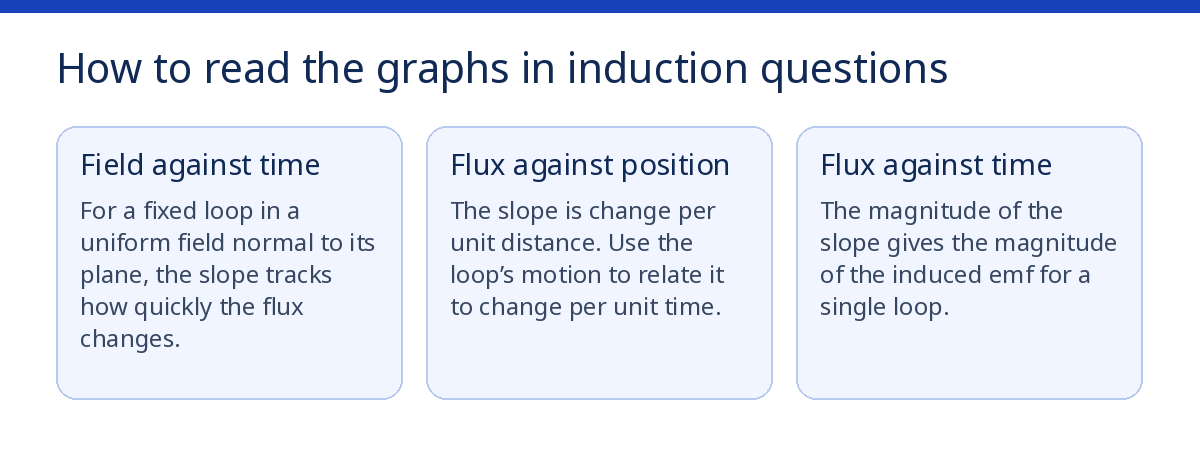
This set asks you to reason from both a magnetic-field–time graph and the geometry of a loop moving through a field region. These are not interchangeable tasks. For a fixed loop in a spatially uniform field normal to its plane, a changing field changes the flux. For a loop entering or leaving a bounded field region, the flux can change because the area overlapping the region changes, even though the field inside it is steady.
Faraday’s law relates induced emf to the rate of change of flux with time, not to the flux itself. If a graph shows flux against position, its slope describes change per unit distance; the loop’s motion is needed to connect that slope to change per unit time. The paper also covers ideal transformers and series LCR circuits. When reviewing them, keep the models distinct: ideal transformer reasoning assumes negligible losses and flux leakage, while minimum impedance at resonance is a result for the series circuit.
Modern physics and semiconductors: Keep the conditions visible
The paper includes photoelectric emission, atomic transitions, matter waves, nuclear reactions and nuclear forces. These questions use energy in different ways. In photoelectric emission, the photon must supply at least the work function before emission can occur. In a nuclear reaction, the difference between the total initial and final rest masses determines whether energy is released or must be supplied. In matter-wave comparisons, read what is held fixed: equal accelerating potential differences and equal kinetic energies are different starting conditions.
The semiconductor questions move from doping and energy levels to junction bias and full-wave rectification. Keep doping and biasing separate in your notes: doping introduces impurity energy levels, whereas biasing applies a voltage across a junction. For a rectifier explanation, check that the circuit diagram, the description of conduction and the input and output waveforms agree.
Quick self-check before opening a solution
The worked explanations separate the formula, the concept and the reasoning steps. Before opening one, ask: What physical condition made my method applicable? If I drew a graph, what does each axis represent? If I used a sign convention, did I keep it throughout? Compare your reasoning with the explanation at the first step where the two differ, rather than judging your method from the final result alone.
For a long answer, check each requested component separately. A correct calculation does not replace a labelled diagram or a derivation when the question asks for one. Then try the unused internal choice without looking at its explanation. This guide omits individual numerical examples and options where the extracted text does not reliably preserve unit prefixes or mathematical symbols; consult the printed page when checking those details.
Spotted an error? Report a correction. Practise this in the app: notes, formula sheets and mind maps.













































































































































































Loading comments…