CBSE Class 12 Physics 2024 Previous Year Paper Guide
CBSEPhysics2024 Previous Year Paper
Paper code: 55/1/1 · 2024Practise with the full English version of the 2024 CBSE Class 12 Physics main examination, set 55/1/1. Use the worked solutions to review not just your final answers, but also the choice of formula, the reasoning and the steps that connect them.
This set is one of the year's papers. See every set from 2024, grouped by series.
What the 2024 paper asks you to do
This year-wise resource pairs a three-hour, 70-mark paper with worked solutions. It contains 33 questions across five sections. Section A has 16 one-mark questions, including assertion–reason items. Sections B and C contain very short answers worth two marks each and short answers worth three marks each. Section D has two four-mark case studies, and Section E has three five-mark long-answer questions.
There is no overall choice: attempt every question number, but follow the printed alternatives where an internal choice is given. Section A has no internal choice. The solutions cover the printed alternatives, so you can try the branch you skipped after the timed attempt. Calculators are not allowed; use the constants printed on the question paper where needed.

Physics 2024 | Class 12 | Previous Year Paper | Code 55/1/1
In the StudentCurio app
Complete CBSE Class 12 Physics 2024 examination paper with worked solutions, covering topics across electricity, magnetism, optics and modern physics. Useful for board-exam practice and reviewing solution methods.
Use the worked solutions to pinpoint a mistake
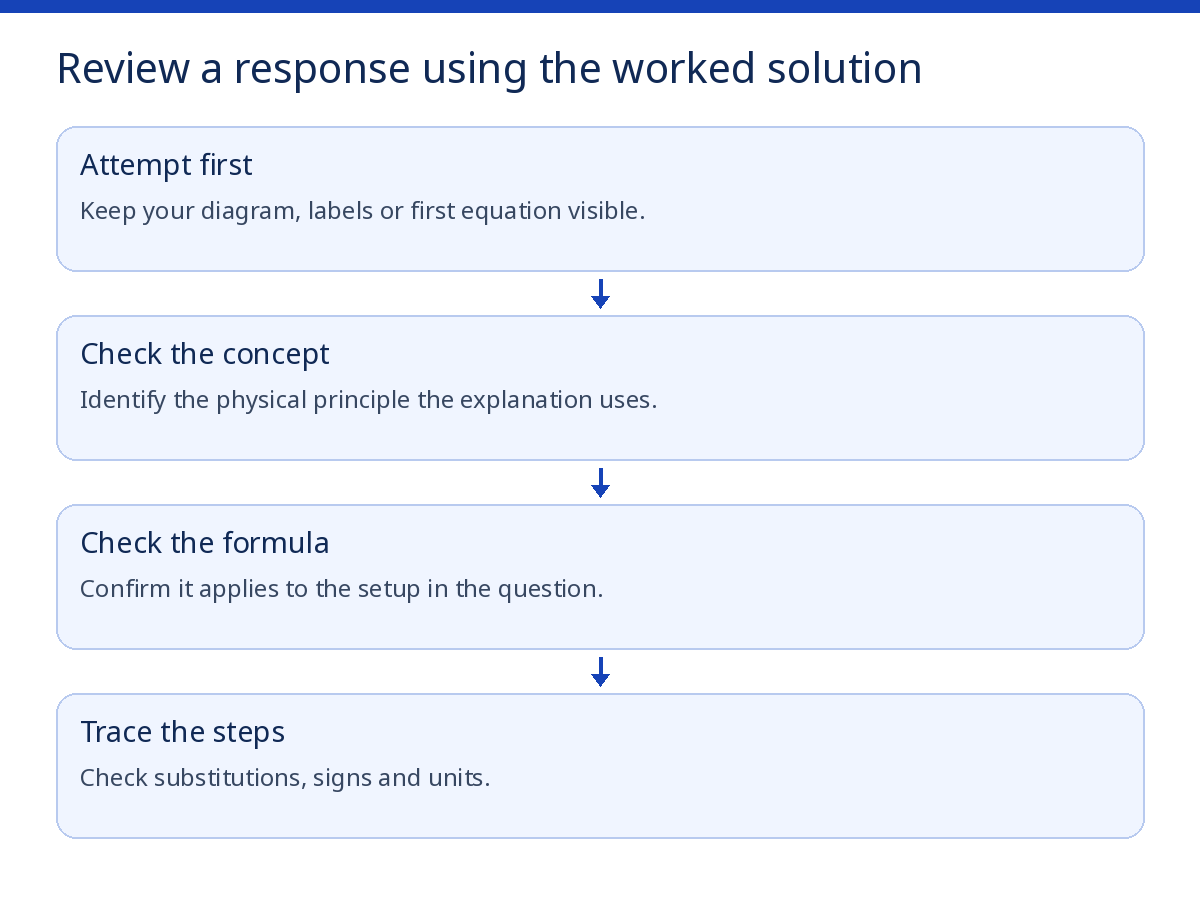
Start in the question-paper portion and finish your attempt before opening the explanations. Keep your setup visible even if you get stuck: a circuit label, a sign convention or a first equation gives you something specific to compare. The file links question numbers to solutions and provides a route back to the original question, so you can check the wording or diagram without losing your place.
Each explanation separates the formula used, the concept used and the steps. Read those parts separately. If you used the same formula but reached a different result, check the substitution and units. If you chose a different formula, first ask whether you were describing the same physical situation. That distinction tells you whether to revise the concept or the calculation.
Electricity and magnetism: label the setup first
The paper moves between electric fields and flux, capacitor energy, circuit potential differences, galvanometer conversion and magnetic forces. In an electrostatic flux problem, distinguish the field at a surface from the net flux through a closed surface. The flux depends on the field component normal to each part of the surface. In the cube problem, the stated field varies with position, so inspect where each face lies rather than assuming that opposite faces give equal contributions.
A circuit diagram carries a different kind of information: it determines which components share terminals and which potential differences are being compared. Mark the terminal order before calculating a voltage. For a magnetic-force problem, mark current or particle velocity separately from the field direction. A correct force magnitude cannot compensate for a direction obtained from the wrong vector order.
When the series resonance rule applies
The paper treats capacitive reactance, series AC circuits, average power and transformers. In a series LCR circuit driven by a sinusoidal source, resonance occurs when inductive and capacitive reactances are equal. Their contributions to the net reactance cancel; the resistance does not disappear. This distinction helps explain why deriving a resonance condition and finding average power are different tasks, even when they use the same circuit.
The transformer alternative tests a different distinction. An ideal transformer relates the voltage ratio to the turns ratio and conserves power; an increase in voltage does not mean an increase in power. When reviewing that branch, separate the ideal voltage and current relationships from the explanation of energy losses in a real transformer.
Optics: check the geometry before the formula
The optics questions use several representations: image position and magnification for a mirror, lens curvature and power, a prism deviation graph, and a reflected wavefront construction. For mirror calculations, choose a sign convention before substituting distances and use it consistently when interpreting the image. For lens power, use the signed focal length in metres to express power in dioptres. The case study uses the sum of individual lens powers for lenses in contact; do not assume that the same sum applies unchanged to separated lenses.
In the longer optics questions, the drawing or graph is part of the reasoning. On a prism graph, distinguish the angle of incidence on the horizontal axis from the deviation being plotted. In a wavefront construction, remember that a ray indicates a direction normal to the wavefront, not a line along it.
Modern physics and the diode case study
Modern physics in the paper includes hydrogen spectra, photoelectric emission, matter waves and nuclear density. Before choosing an equation, identify what the question gives you and what it asks you to compare. In a spectral transition, the photon energy corresponds to the difference between atomic energy levels, not the energy of either level alone. In a matter-wave question, the relation uses momentum; if energy is given instead, the relation between energy and momentum depends on whether you are dealing with a photon or a massive particle.
The rectifier case study shifts from particles and energy levels to circuit behaviour. Use the stated diode orientation to track forward and reverse bias, then distinguish the behaviour of an individual diode from the output of the whole circuit. This guide leaves out the ambiguously worded photoelectric assertion–reason item and does not transcribe numerical options or constants with unclear signs or exponents in the extracted text.
Spotted an error? Report a correction. Practise this in the app: notes, formula sheets and mind maps.













































































































































































Loading comments…