CBSE Class 12 Physics 2023 Previous Year Paper With Solutions
CBSEPhysics2023 Previous Year Paper
Paper code: 55/4/2 · 2023Practise the full 2023 CBSE Class 12 Physics main examination paper (55/4/2), then use the worked solutions to check your reasoning. This guide explains the five-section format and shows what to look for when reviewing graphs, circuits, diagrams and case-based questions.
This set is one of the year's papers. See every set from 2023, grouped by series.
What this 2023 paper contains
This year-wise resource is the English version of the 2023 main examination paper, set 55/4/2. It contains the full paper rather than a selection organised by chapter. The original questions, options and diagrams are retained, and the worked explanations cover the printed internal choices. The question-number links let you go directly to the explanation for a particular item after attempting it.
The paper carries 70 marks and allows three hours, without a calculator. Those conditions make it useful for a timed board-exam attempt. The worked solutions serve a different purpose: their formula, concept and step-by-step explanations let you distinguish choosing the wrong principle from making an error while applying the right one.

Physics 2023 | Class 12 | Previous Year Paper | Code 55/4/2
In the StudentCurio app
Complete 2023 CBSE Class 12 Physics question paper with worked solutions, covering questions across multiple chapters and formats. It helps students practise the board exam and review solution methods.
How the five sections and internal choices work
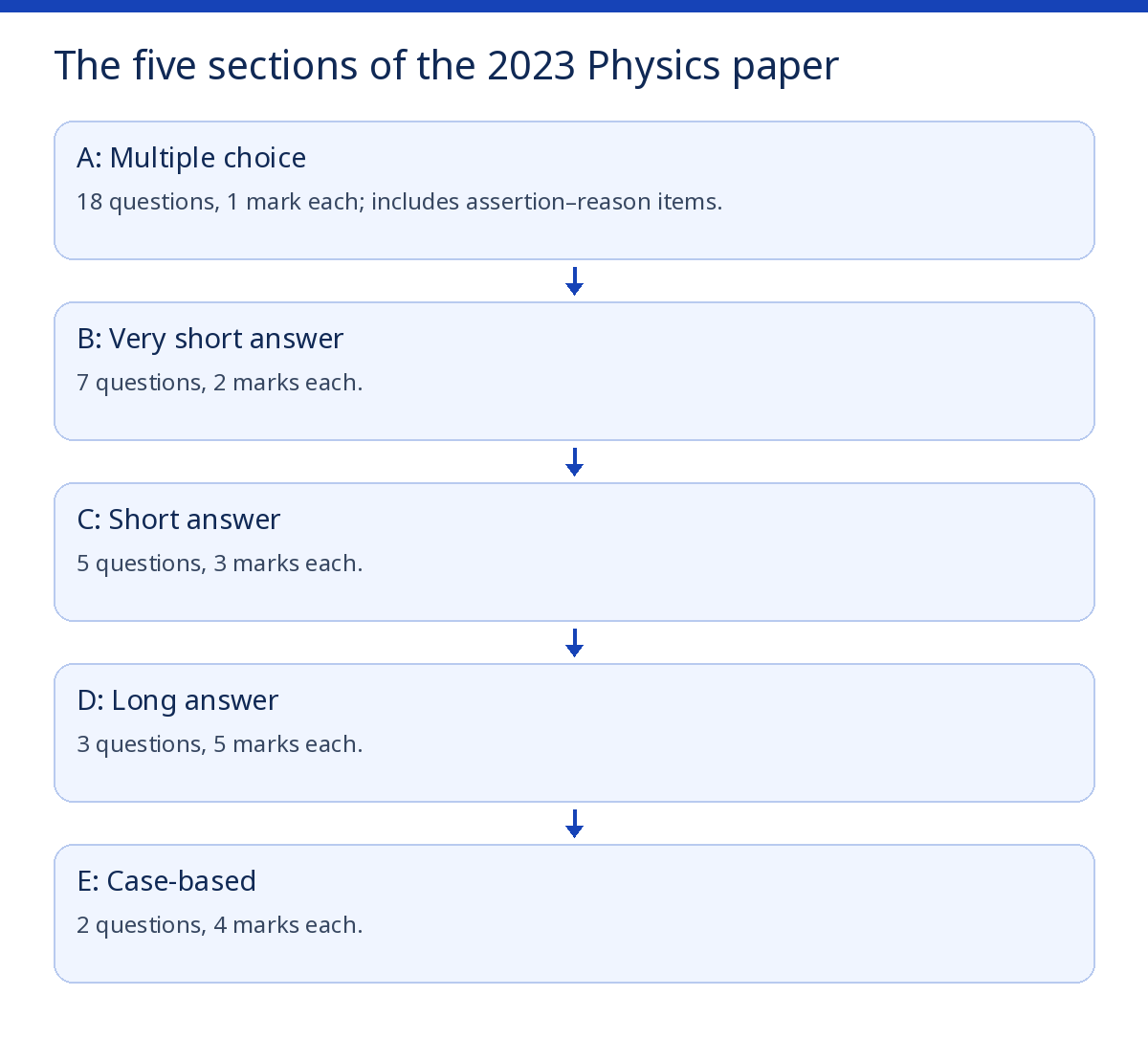
Section A contains questions 1–18, worth one mark each, and includes the assertion–reason questions. Section B has seven very short-answer questions worth two marks each. Section C has five short-answer questions worth three marks each. Section D has three long-answer questions worth five marks each. Section E closes the paper with two case-based questions worth four marks each.
All 35 questions are compulsory, but that does not mean answering both sides of an OR. The paper offers no overall choice: where an alternative is printed, choose one of the alternatives as directed. Section E illustrates why it matters to read the layout carefully: the choice sits within the case, so it does not replace the other subparts. During review, you can attempt the alternative you left out without changing the record of your timed attempt.
Graphs and circuits: what to identify first
The paper uses graphs and circuit figures across several topics, including current versus time, photoelectron data, diode biasing and current electricity. Before calculating, identify the quantities on the axes or trace the connections in the circuit. A graph against reciprocal wavelength, for instance, is not a graph against wavelength itself. In a circuit, the drawing establishes the connections and polarities; the component labels alone do not tell you how the circuit behaves.
Section C also asks about voltage drops in a series AC circuit. Common mistake: treating the magnitudes of the component voltages as ordinary numbers to add. When those voltages are out of phase, their magnitudes alone are not enough to determine the supply voltage. When reviewing the explanation, look for where it accounts for phase rather than comparing only the numerical values.
Optics: choose the model before the equation
The optics questions range from double-slit interference and single-slit diffraction to ray diagrams for a telescope, lenses, an optical fibre and a prism. In wave optics, distinguish slit separation from slit width before selecting a relation: the former sets the fringe spacing in the standard double-slit arrangement, while the latter controls the width of the single-slit diffraction envelope. This distinction is useful when a question brings both patterns into the same setup.
In ray optics, use the diagram to establish what the calculation represents. For two lenses in sequence, the image formed by the first lens determines the object for the second; the second object distance must be measured from that second lens. In the lens case study, notice when the surrounding medium changes. The lens material alone does not determine the focal length because the relevant refractive index is relative to the surrounding medium.
Electrostatics and induction: check the conditions
Electrostatics appears in several forms: potential energy of a charge system, equilibrium after conductors are connected, fields for symmetric charge distributions, and a case study involving field, potential and a dipole. These are not interchangeable quantities. A field graph and a potential graph require different reasoning, even when both are describing effects of static charge. When tackling the conducting-shell graph, identify the regions separated by the surface before you start sketching.
Good to remember: magnetic flux can change even when the magnetic field is steady. In the moving-loop question, the loop travels towards a region of uniform magnetic field, so the overlap between the loop and that region matters. In fixed-loop induction questions, a changing source current can instead change the field through the loop. Identifying what changes gives you a starting point before you consider the direction of the induced current.
Review the method, not just the final line
Try the paper before opening the worked solutions. For an assertion–reason item, judge each statement on its own, then check whether the reason explains the assertion if both are true. For a longer response, compare your diagram, physical model and intermediate steps with the explanation. A matching final value does not show that the setup was sound, just as an arithmetic slip does not mean the underlying concept needs to be relearned.
Quick self-check: Can you point to the part of a figure, graph or question that justified your first step? If not, return to the question before rereading the calculation. This guide leaves out the disputed stopping-potential options, the nuclear mass-defect example with unrealistic data, and the mirror item with ambiguous wording. It also does not reproduce the constants table, whose text extraction drops signs and symbols; read it from the paper page.
Spotted an error? Report a correction. Practise this in the app: notes, formula sheets and mind maps.













































































































































































Loading comments…