CBSE Class 12 Physics 2023 Previous Year Paper Guide
CBSEPhysics2023 Previous Year Paper
Paper code: 55/3/1 · 2023Use the full English-language 2023 CBSE Class 12 Physics main-examination paper, code 55/3/1, for a timed attempt. Then use the worked solutions to check whether your reasoning, diagrams and calculations support your answers.
This set is one of the year's papers. See every set from 2023, grouped by series.
How the 70-mark paper is organised
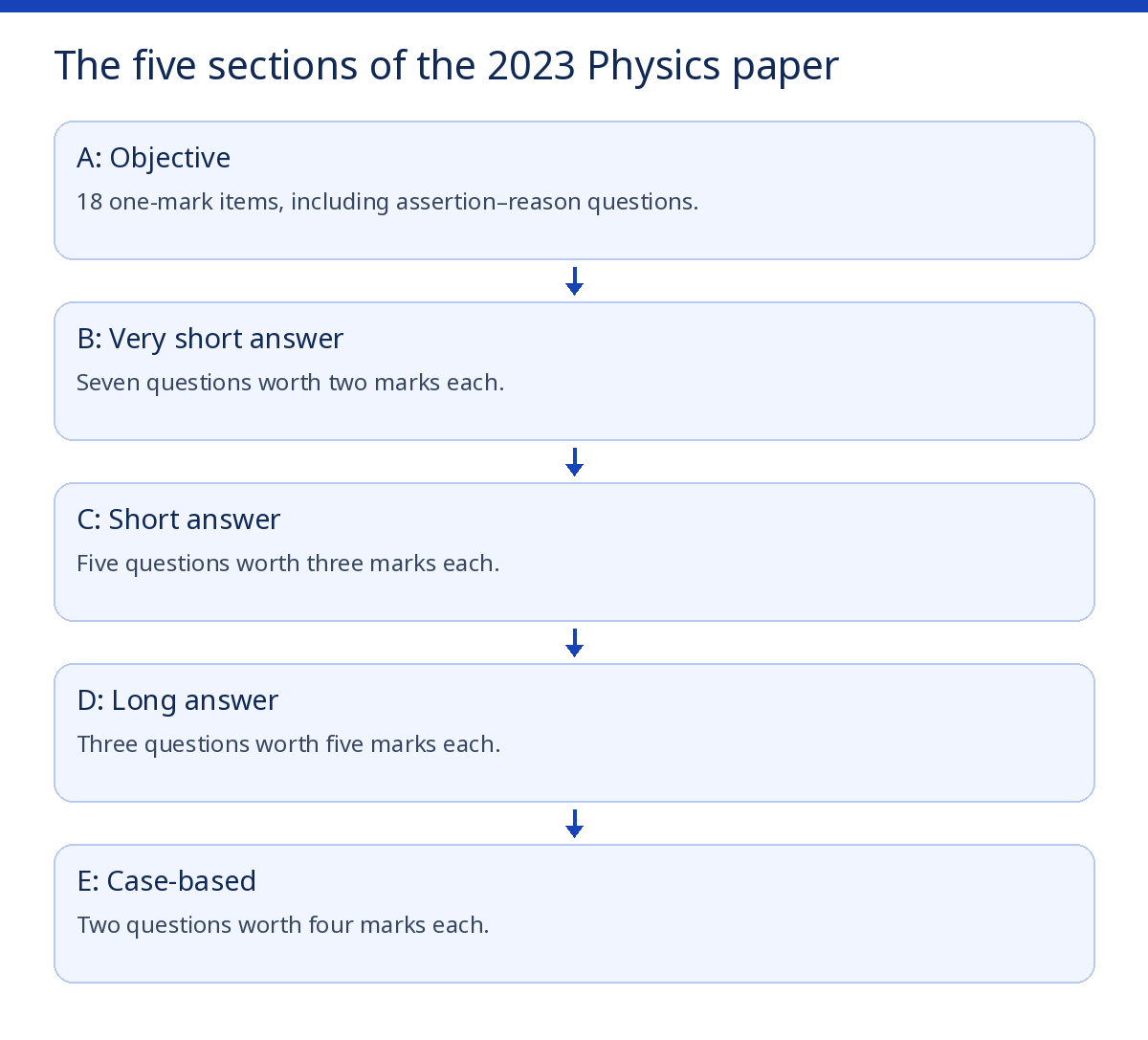
This is a year-wise paper, not a chapter-wise question bank. It contains 35 questions across five sections, with three hours allowed and no calculator. Section A has 18 one-mark questions, including three assertion–reason items. Section B has seven two-mark very short answers, Section C has five three-mark short answers, and Section D has three five-mark long answers. Section E has two four-mark case-based questions.
All questions are compulsory, but that does not mean you must answer both sides of an OR. There is no overall choice to skip a question; internal alternatives appear in two questions each in Sections B, C and E, and in all three questions in Section D. For a timed attempt, answer only the required branch. When reviewing the paper, try the unused branch separately: the file includes explanations for the printed internal choices.

Physics 2023 | Class 12 | Previous Year Paper | Code 55/3/1
In the StudentCurio app
Complete CBSE Class 12 Physics paper from 2023 with worked solutions, spanning topics including electrostatics, magnetism, optics, modern physics and electronic devices. Helps students practise the board-exam format and review solution methods.
Electrostatics and current electricity: start with the model
The paper moves from short questions on fields and charge transport to longer tasks involving electric flux, capacitance and electrostatic potential energy. The longer prompts ask you to move between definitions, diagrams and applications. When using Gauss’s law, distinguish the law itself, which relates net flux through a closed surface to enclosed charge, from the symmetry argument that can make the law useful for finding an electric field. For flux calculations, mark the outward normals before deciding which field components contribute.
In current electricity, distinguish total current through a cross-section from current density. For the conductor question, note which quantity is changed and which factors are held constant before linking potential difference, electric field and drift. That makes it easier to check the reasoning rather than just the final scaling.
Common mistake: using an AC rule without checking the signal
The paper includes frequency-dependent reactance, an RMS question based on a piecewise voltage signal, and longer alternatives on a capacitor or a series LCR circuit. The familiar peak-to-RMS relation for a sinusoid applies to that waveform; it is not a general shortcut for a periodic signal. For an unfamiliar waveform, the definition is the safer starting point: square the voltage, average it over a complete period, then take the square root. Also distinguish reactance from the impedance of the entire circuit.
The magnetic-field questions require a different check: identify the geometry before selecting a field expression. An observation point outside a straight wire, the centre of a loop and a point on its axis are different settings. The galvanometer alternative asks you to explain the instrument’s design as well as its operating principle.
Optics: decide what the diagram needs to show
The optics questions span wavefronts, refraction at an interface, image formation, prisms and single-slit diffraction. These do not all call for the same representation. A ray diagram shows the path of light or the construction of an image; a diffraction-pattern sketch shows how intensity varies across the observation region. For a critical-angle problem, establish the direction of travel first: total internal reflection is possible only from the higher-index medium towards the lower-index medium.
When reviewing lens or prism work, check the diagram against the quantities named in the question. In lens calculations, use one sign convention consistently and distinguish image position from image height. In the prism derivation, keep the prism angle distinct from the angle of minimum deviation.
Modern physics and electronic devices: read the quantities
The modern-physics prompts include a stopping-potential graph, photoelectron energy, matter waves, nuclear binding and scattering. Start graph questions by naming the quantity and unit on each axis; only then interpret the slope or the shape. In a photoelectric calculation, put photon energy and work function in the same energy unit before subtracting. In nuclear questions, distinguish binding energy per nucleon from total binding energy, and mass number from proton number.
The electronics questions connect carrier concentrations, junction behaviour and rectification. Keep the roles of diffusion and drift in forming the depletion region separate from what an applied bias does to an existing junction. When comparing half-wave and full-wave rectification, examine which portions of the input cycle contribute to the output.
Case-based questions: connect each part to the setup
Section E gives one case about an electron beam between plates and another about single-slit diffraction. For the beam case, use the figure to identify the direction of entry and the relevant distances before setting up the motion. Notice when a subpart refers to the original setup and when an alternative introduces a different field condition.
For the diffraction case, identify what each subpart asks you to describe: the central maximum, a minimum, or a comparison with another wave phenomenon. Treat the passage as context for separate tasks, not as an invitation to write one long explanation. In each case, the printed internal choice is in the final subpart.
Quick self-check before opening the worked solutions
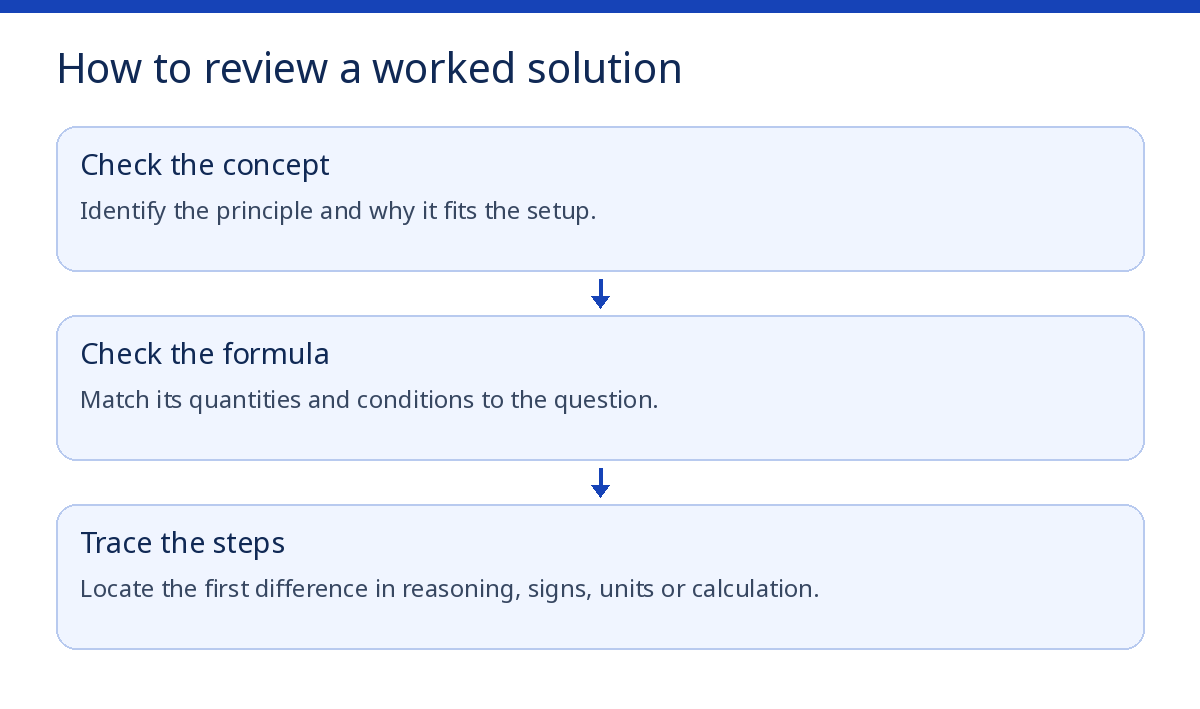
Can you name the principle you used, state why it applies here and point to the line or diagram that supports your conclusion? The solution pages separate formula used, concept used and explanation in steps. Use those labels to diagnose your first mismatch. If your principle was sound but the answer differs, inspect the substitution, units or signs before assuming the whole method was wrong. For assertion–reason items, judge each statement independently before deciding whether the reason explains the assertion.
If copied text drops a symbol, check the original PDF page before using the expression. This guide leaves out the suggested answer to Question 5 because it relies on a directional assumption, and the answer-option comparison for Question 12 because the supplied text is incomplete and the displayed result does not match the listed option.
Spotted an error? Report a correction. Practise this in the app: notes, formula sheets and mind maps.













































































































































































Loading comments…