CBSE Class 12 Physics 2023 Paper: Set 55/5/2 and Solutions
CBSEPhysics2023 Previous Year Paper
Paper code: 55/5/2 · 2023Practise the complete 2023 CBSE Class 12 Physics main examination paper, set 55/5/2, under its original three-hour time limit. Then use the worked solutions to check not just your results, but whether you chose the right principle and applied it under the right conditions.
This set is one of the year's papers. See every set from 2023, grouped by series.
What this year-wise paper contains
This is the English version of the 2023 CBSE Class 12 Physics main examination, with a maximum of 70 marks. The file retains the original questions, options and diagrams, so you can practise interpreting the paper as printed. The worked explanations cover the printed internal choices as well. Follow the paper’s directions on choices during a timed attempt, then return to the alternatives for additional practice.
The solution pages separate the formula, the concept and the explanation in steps. That distinction makes it easier to tell whether you forgot a relation or misunderstood why it applied. Use the question-number links on the opening page to review specific responses after attempting the paper.

Physics 2023 | Class 12 | Previous Year Paper | Code 55/5/2
In the StudentCurio app
The complete 2023 CBSE Class 12 Physics paper, set 55/5/2, with worked solutions across topics including electricity, magnetism, optics, atomic and nuclear physics, and semiconductors. It helps students practise the full board-exam format and review solution methods.
Electricity: Read the geometry before choosing a rule
In electrostatics, Gauss’s law gives the total electric flux through a closed surface from the net charge it encloses. It does not, by itself, tell you how that flux is distributed across individual faces. To justify an equal share, check whether the charge arrangement and surface geometry make the faces equivalent by symmetry. Enclosing the same charge does not automatically make every face equivalent.
In circuits, the corresponding first step is to identify the nodes. Components are in parallel when they share the same two nodes, not merely because the drawing puts them side by side. In a balanced resistor bridge, the middle nodes are at equal potential, so the branch between them carries no current. Establish that condition before simplifying the network.
When induction and AC shortcuts apply
Faraday’s law relates induced emf to the rate of change of magnetic flux. The shortened magnitude expression applies when the field is uniform over the coil, remains perpendicular to its plane and varies while the coil area stays fixed. If the orientation changes, track the flux rather than using that expression automatically. The flux angle is measured from the normal to the coil, not from the plane.
Direction also matters when reviewing magnetic torque. The loop’s magnetic moment points along its normal, and torque comes from a cross product with the field. For alternating current, keep the stated circuit element in view: the quarter-cycle current lag applies to an ideal inductor in sinusoidal steady state, not to every circuit containing an inductor.
Wave optics: Separate angles from screen distances
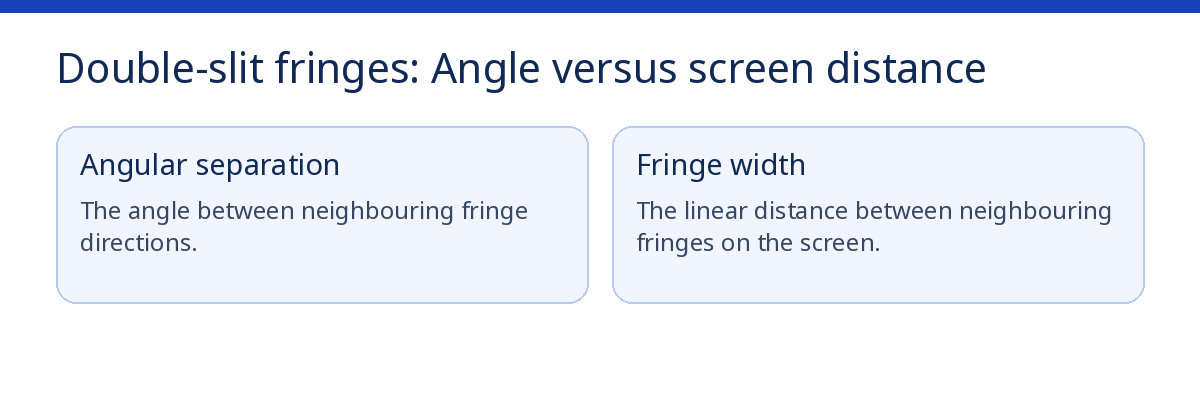
The double-slit material distinguishes angular separation from fringe width. For small angles, neighbouring fringes have angular separation approximately , while their linear spacing on a distant screen is . Here is the wavelength, is the slit separation and is the distance to the screen. One quantity describes a direction from the slits; the other describes a distance measured on the screen.
When checking your reasoning, write down what the question asks you to compare and which quantities are held fixed. A sketch with two fringe directions and a screen can help you see why an angle and the distance projected onto that screen are not interchangeable.
A useful connection: Photon energy, graphs and atomic levels
The relation connects photon energy to frequency or to vacuum wavelength. In hydrogen emission, the energy carried by the photon is the difference between the initial higher energy and the final lower energy. Compare energy gaps rather than differences between the level numbers: the levels in the Bohr model are not evenly spaced.
The photoelectric material tests another use of the same relation. Before identifying a slope, check whether the horizontal axis shows wavelength or inverse wavelength. A relation that is linear in inverse wavelength is not linear in wavelength. The paper also covers the approximate independence of nuclear density from mass number. The numerical density comparison is omitted here because the worked passage gives a mass ratio inconsistent with the mass numbers it lists.
Semiconductors: Equilibrium is a balance, not a standstill
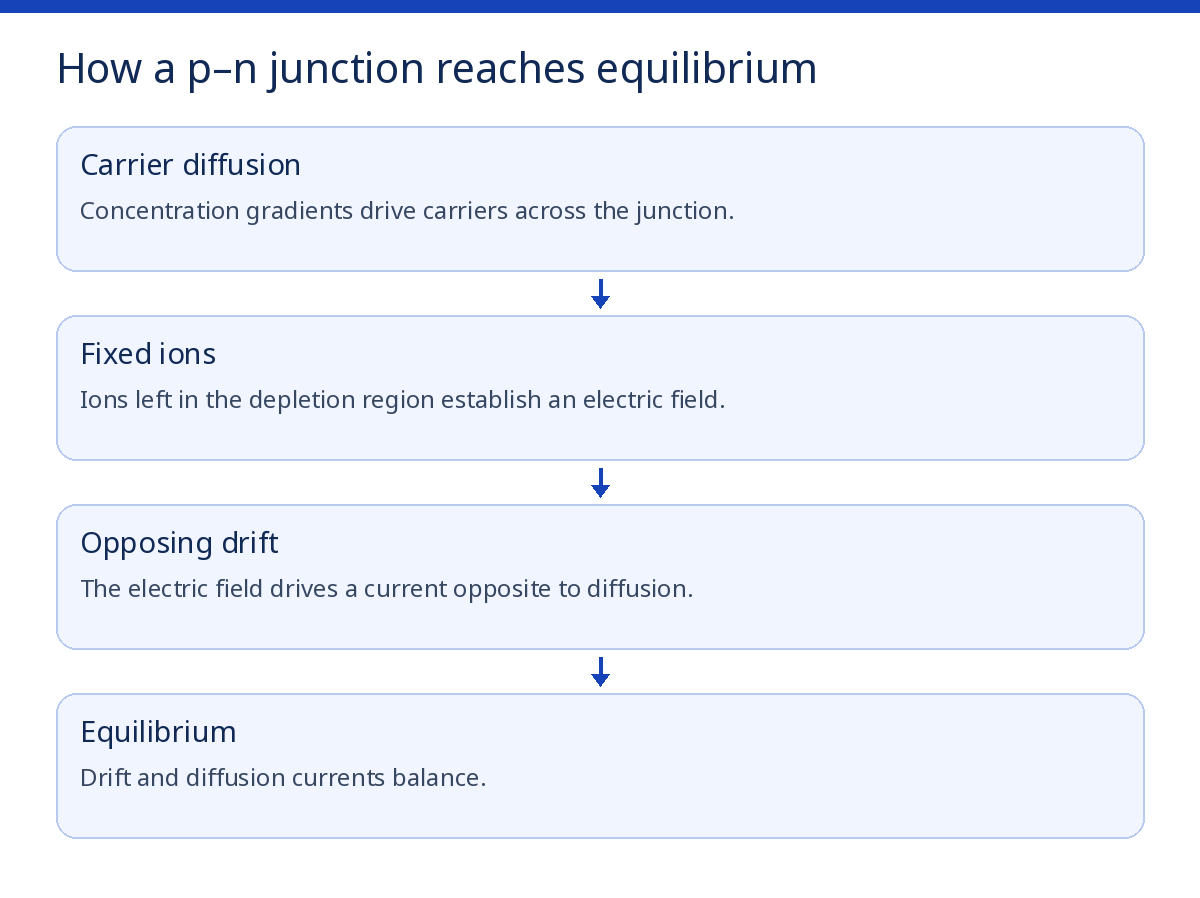
The semiconductor material distinguishes the formation of a p–n junction from its equilibrium state. Carrier concentration gradients drive diffusion. As carriers diffuse across the junction, they leave behind fixed ions in the depletion region. The resulting electric field drives a drift current that opposes the diffusion current. At equilibrium, the two currents balance; zero net current does not mean that both contributions vanish.
A separate band-model explanation concerns why an insulator conducts poorly. A large energy gap between the valence and conduction bands means ordinary thermal excitation produces few carriers in the conduction band. Keep the explanations distinct: one concerns opposing currents at a junction, while the other concerns the energy needed to access conducting states.
Before you move on: Turn the solutions into a second attempt
Attempt the paper without opening the solutions. Mark responses where you were unsure of a diagram, graph axis, sign or formula condition, even if you reached a plausible result. Afterward, open the worked page and first compare the concept used with your own reasoning. If the concept matches, examine the steps to locate the first difference, such as a misread connection or a quantity expressed in the wrong units.
For a question with an internal choice, try the alternative after reviewing your first attempt. Use it to practise selecting a method without a worked explanation in view. Then return to one flagged response and write a sentence naming the physical condition that justifies your method. That checks something a matching final result cannot: whether you know why the method applies.
Spotted an error? Report a correction. Practise this in the app: notes, formula sheets and mind maps.













































































































































































Loading comments…