CBSE Class 12 Physics 2023 Previous Year Paper with Solutions
CBSEPhysics2023 Previous Year Paper
Paper code: 55/5/3 · 2023Practise with the full English version of the 2023 CBSE Class 12 Physics main examination, paper code 55/5/3. Use the worked solutions to check not just your final answers, but also how you read diagrams, select formulas and explain your reasoning.
This set is one of the year's papers. See every set from 2023, grouped by series.
What this year-wise paper includes
This resource is organised around one complete CBSE Class 12 board paper, rather than a set of questions grouped by chapter. The original examination allowed 3 hours and carried 70 marks. The file retains the English questions, options and diagrams, and the worked explanations cover the printed internal choices. The question-number index lets you go directly to an item you want to revisit.
The paper brings together topics such as electrostatics, magnetism, electromagnetic induction, wave optics, atomic and nuclear physics, and semiconductors. That mix makes it useful for practising a skill that chapter-wise exercises often take care of for you: deciding which concept applies before you start calculating.

Physics 2023 | Class 12 | Previous Year Paper | Code 55/5/3
In the StudentCurio app
Complete CBSE Class 12 Physics paper code 55/5/3 from 2023, with worked solutions covering questions across multiple chapters. Helps students practise board-exam questions and review solution methods.
Take a timed attempt before opening the solutions
For a board-style attempt, set aside the printed three hours and work from the question paper without consulting the explanations. Follow the paper’s instructions on internal choices. Save the alternatives you did not attempt for later revision; they are useful extra practice, but doing both during the timed run changes the task you are trying to simulate.
On your rough sheet, distinguish questions you left unfinished from questions you finished but were unsure about. An unfinished response may point to a slow setup or a missing concept. An uncertain response gives you something different to check: whether your result followed from a sound argument or from a plausible-looking option.
Check the geometry before using a field formula
The field and induction explanations show why a diagram is part of the data. For an electric dipole in a uniform field, the dipole moment uses the full separation of the charges, and the torque angle is measured between the dipole moment and the field. For a current loop, the magnetic moment lies along the normal to the loop plane. An angle marked between the field and the plane is therefore not automatically the angle to use in the torque expression.
The normal also matters in induction. The shortcut applies when the coil has fixed area and orientation and the uniform magnetic field remains perpendicular to its plane while its magnitude changes. If the orientation changes, reason from the change in magnetic flux rather than treating the field magnitude as the only changing quantity.
In wave optics, separate angles from distances
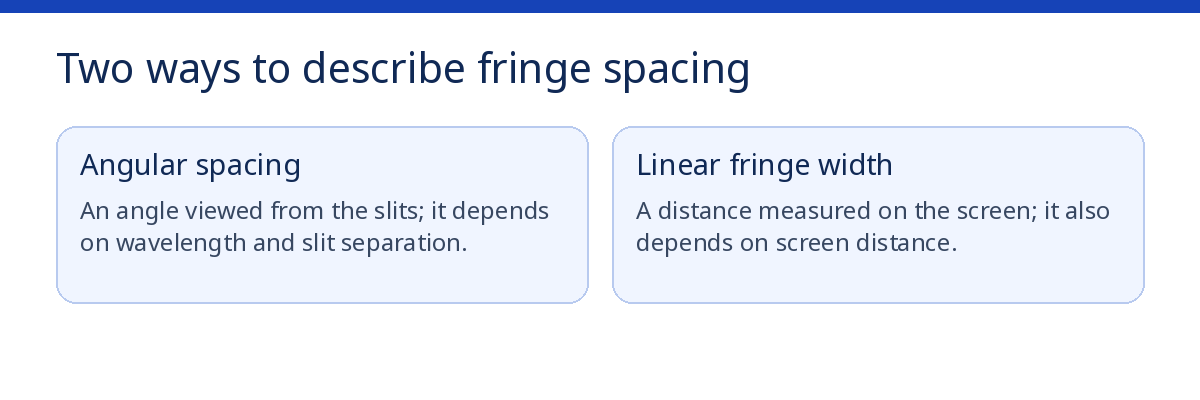
When reviewing interference, identify what the question measures before reaching for a fringe formula. Angular spacing describes the angle between successive fringes as seen from the slits; linear fringe width is the spacing measured on the screen. In the small-angle double-slit treatment, the angular spacing is approximately , while the linear spacing is , where is the slit separation and is the screen distance. The extra factor of has a geometric meaning: the same angular interval can span different distances on different screens.
A question about bright fringes coinciding calls for a different starting point. At a fixed observation point in an unchanged setup, compare the path-difference conditions for the two wavelengths rather than treating the fringe numbers as distances.
Read circuit connections and energy levels on their own terms
In a capacitor network, trace the connections before combining values. Capacitors in parallel share the same pair of nodes and therefore the same potential difference. A series pair has an intermediate junction with no other branch attached. A drawing can place two components side by side without making them electrically parallel, so check the nodes rather than the layout.
In atomic and semiconductor questions, a similar reading habit is to name the two states involved before choosing an energy relation. For photon emission from a hydrogen atom, the photon energy is the positive difference between the initial higher level and the final lower level. In a doped semiconductor, the energy from a donor level to the conduction band is not the same as the full gap between the valence and conduction bands. Both are energy differences, but they describe different transitions.
Find where your reasoning first diverged
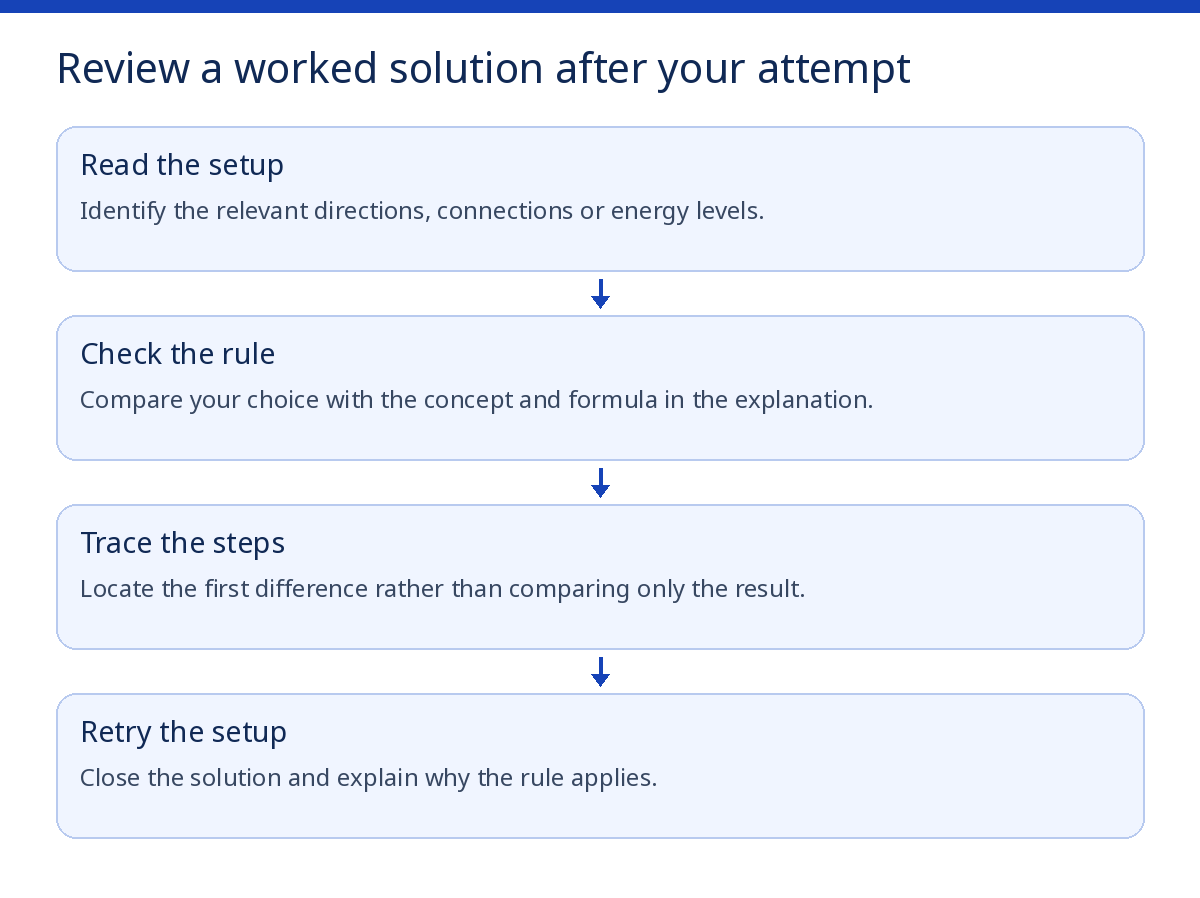
The worked solutions separate the formula used, the concept used and the explanation in steps. Compare them with your own work in that order only if the setup agrees; otherwise, start with the concept. A correct formula cannot fix a misread diagram, and a correct numerical result does not show that you used the right reasoning. In an assertion–reason question, judge each statement separately before deciding whether the reason explains the assertion.
Two worked items are omitted from this guide: the midpoint magnetic-field item, whose explanation flags missing direction information and a mismatch with the printed options, and the nuclear-density example, whose stated numerical mass ratio does not match the mass numbers given. Neither is needed to use the rest of the paper for revision.
Quick self-check: explain the step before the calculation
After reviewing an uncertain response, close the solution and state what makes the chosen rule applicable. Can you identify the two directions that define an angle, the nodes that define a circuit connection, or the two levels that define an energy gap? Then redo the setup without looking. If you can remember the final expression but cannot explain what its quantities represent in the question, revisit the diagram or wording before repeating the algebra.
Spotted an error? Report a correction. Practise this in the app: notes, formula sheets and mind maps.













































































































































































Loading comments…