CBSE Class 12 Physics 2022 Term 2 Previous Year Paper
CBSEPhysics2022 Previous Year Paper
Paper code: 55/1/3 · 2022Practise with the complete English-language CBSE Class 12 Physics 2022 Term 2 main examination paper (55/1/3), then use the worked solutions to check your reasoning. The guide below explains what to look for in the paper’s graphs, diagrams, derivations and calculations.
This set is one of the year's papers. See every set from 2022, grouped by series.
Use the paper and solutions as two separate passes
This year-wise file pairs the full question paper with worked solutions. The original English questions, options and diagrams are retained, and the explanations cover the printed internal choices. The paper carried 35 marks and had a two-hour time limit. Use those limits if you want to simulate this particular examination; they describe the 2022 Term 2 paper, not a general format for every CBSE Physics paper.
On your first pass, keep the solutions closed and follow the paper’s instructions on internal choice. On your second pass, use the question-number links to review your attempts. The solutions separate the formula, concept and reasoning steps. That structure helps you tell whether a mistake came from choosing the wrong principle, overlooking a condition or carrying out the calculation incorrectly.

Physics 2022 | Class 12 | Previous Year Paper | Code 55/1/3
In the StudentCurio app
Complete CBSE Class 12 Physics Term 2 main examination paper for 2022 with worked solutions. It covers questions across atomic models, semiconductors, optics, photoelectric effect, matter waves and nuclear physics.
Atomic models and photoelectric graphs: read the evidence
The scattering material links an observed distribution to a model of the atom. Small deflections are common, while large deflections are rare. The first observation supports the picture of an atom that is mostly empty space; the second points to positive charge and nearly all the mass being concentrated in a small nucleus. When reviewing a graph, distinguish what the counts show directly from what the atomic model infers.
The photoelectric material asks you to distinguish the stopping-potential intercept from the saturation-current plateau. At fixed frequency above threshold, increasing intensity raises the saturation current without changing the stopping potential. A frequency comparison is different: higher frequency increases the magnitude of the stopping potential for the same emitting surface. Equal plateaus in the idealised frequency comparison assume equal electron emission rates; equal radiant intensity alone does not guarantee that.
Semiconductors: track mobile carriers and fixed ions
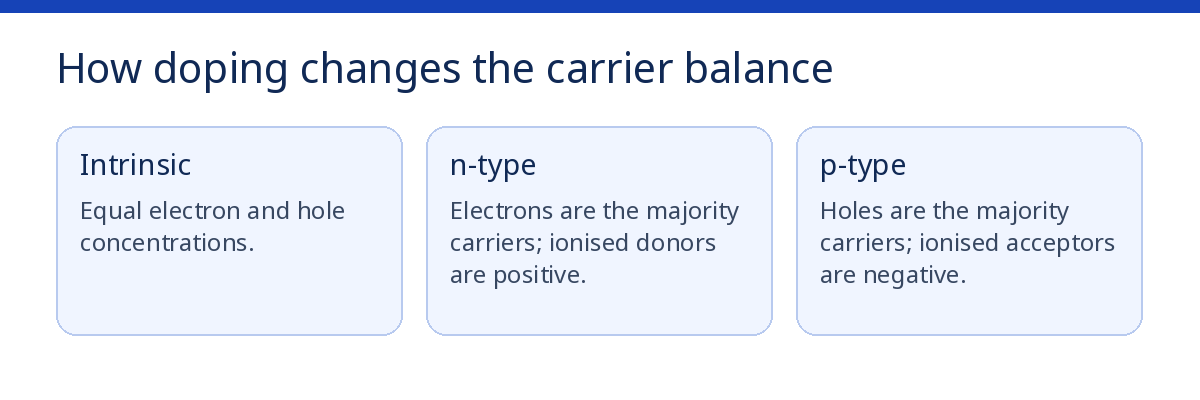
The semiconductor questions connect carrier populations, energy-level diagrams and LED operation. An intrinsic semiconductor has equal electron and hole concentrations. Doping makes one mobile carrier type more abundant, but it does not leave the crystal with a net charge: ionised dopants balance the change in mobile charge.
Read the impurity-level diagrams by following where an electron starts and where it goes. A donor level lies just below the conduction band, so a donor electron can enter that band without crossing the full band gap. An acceptor level lies just above the valence band; an electron entering it from the valence band leaves a mobile hole. In an LED, the process to track is radiative recombination: forward bias supplies electrons and holes to the junction region, where recombination can produce light.
Optics diagrams: explain the geometry before using a formula
The Huygens construction for reflection is worth reviewing with the diagram beside the explanation. The incident disturbance and the reflected wavelet travel in the same medium, so they cover equal distances in the same interval. Identify those lengths before comparing the angles. This makes the diagram a justification of the law of reflection rather than an illustration added after the result.
Prism questions also reward careful diagram reading. The general deviation relation comes from the turns at both faces; the symmetric path is the additional condition used at minimum deviation. When reviewing immersion, distinguish the refractive index of the prism material from its index relative to the surrounding medium. For the contact-lens material, keep the signs of the individual powers when adding them; adding magnitudes loses the distinction between converging and diverging contributions.
Common mistakes in diffraction and interference
Do not treat the single-slit minima rule as a rule for secondary maxima. The minima identify dark positions, while the secondary maxima lie between consecutive minima. The half-order placement used to estimate a secondary maximum is an approximation, not an exact position. Marking that distinction in your working shows why the two kinds of position cannot be handled interchangeably.
In the interference material, check for a fixed phase difference as well as equal frequency before expecting a stable pattern. Also identify whether a spacing is measured on the screen or expressed as an angle. In the usual small-angle double-slit geometry, changing the screen distance changes the linear fringe spacing but not the angular spacing. Labelling the quantity you are comparing prevents an otherwise correct rule from being applied to the wrong measurement.
When the modern-physics formulas apply
The closest-approach calculation uses a head-on alpha-particle encounter. In that model, the initial kinetic energy becomes electrostatic potential energy at the turning point. For an off-centre encounter, the geometry matters, so do not carry over the head-on result without checking the stated setup.
In the matter-wave calculation, the de Broglie relation gives momentum from wavelength. Converting that momentum into speed or kinetic energy with classical expressions is a separate step, valid when the electron’s speed is small compared with the speed of light. In the nuclear calculation, take the initial mass minus the final mass to determine the sign of the energy release. If you use atomic masses, check that the electron counts cancel before using the mass difference directly.
Quick self-check before retrying an internal choice
Choose an alternative you did not attempt and try it before opening its explanation. Ask: What tells me whether this is a graph interpretation, a geometric argument or a calculation? Which condition lets me take the first step, and where does that condition appear in the question or diagram? After comparing your reasoning with the solution, close the file and restate the condition in your own words. That is a better check of understanding than recognising the final result on the page.
Spotted an error? Report a correction. Practise this in the app: notes, formula sheets and mind maps.













































































































































































Loading comments…