CBSE Class 12 Physics 2022 Term 2 Paper with Solutions
CBSEPhysics2022 Previous Year Paper
Paper code: 55/2/3 · 2022Practise with the full English version of the CBSE Class 12 Physics 2022 Term 2 main examination paper (55/2/3). Then use the worked solutions to check how you chose a principle, set up a calculation or turned a diagram into an explanation.
This set is one of the year's papers. See every set from 2022, grouped by series.
What this year-wise paper contains
This file pairs the original question paper with worked explanations. It retains the English questions, options and diagrams, and the explanations cover the printed internal choices as well. The paper is organised by year, not by chapter: a single sitting takes you from semiconductors and optics to electromagnetic waves, matter waves, atoms and nuclei. Use it to practise switching between topics without a chapter heading telling you which principle to apply.
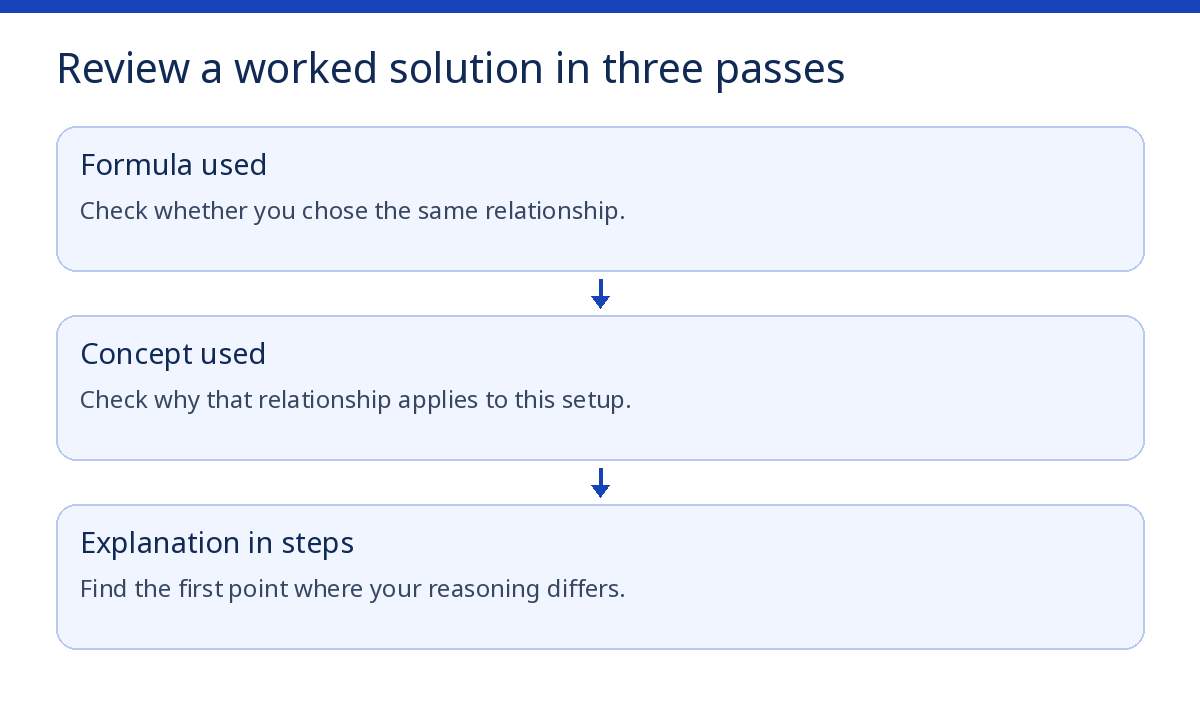
The solutions are organised under Formula used, Concept used and Explanation in steps. Those labels give you three different checks. You may remember the right equation but not know why it applies, or choose the right principle and still make an error when using it. After an attempt, compare your first step with the solution before looking at the final line.

Physics 2022 | Class 12 | Previous Year Paper | Code 55/2/3
In the StudentCurio app
CBSE Class 12 Physics Term 2 main examination paper for 2022 (series 55/2/3), with worked solutions covering questions from multiple chapters. Helps students practise exam-style questions and review solution methods.
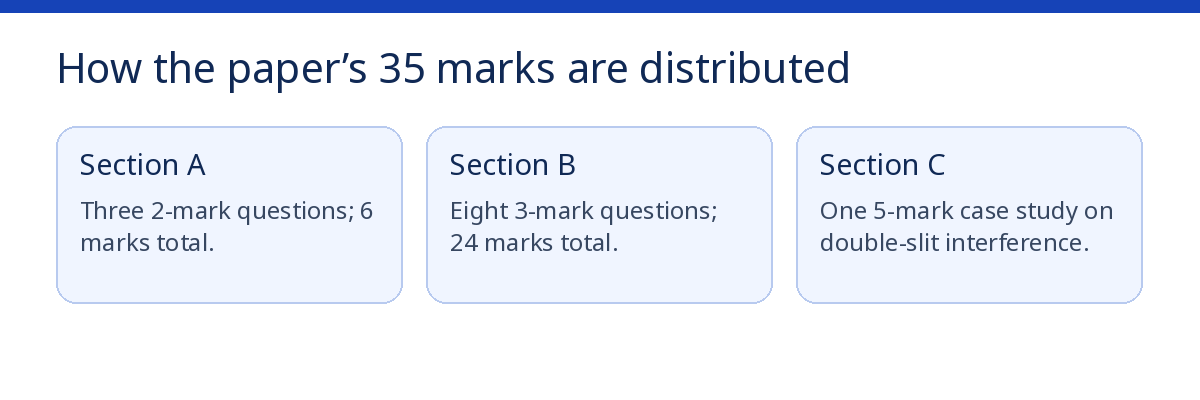
How the 35 marks are organised
The paper allows two hours and contains 12 compulsory questions. Section A has three questions of two marks each. Section B has eight questions of three marks each. Section C contains one five-mark case study based on Young’s double-slit experiment. This is the format of this Term 2 paper, not a statement about the pattern of other CBSE examinations.
There is no overall choice. Where an internal choice is printed, attempt only one alternative in a timed sitting. The instructions permit log tables if needed but do not permit a calculator. When you review the paper later, attempt the alternative you left out as a separate exercise. For example, the telescope and diffraction alternatives both involve optics, but one tests image formation and angular magnification, while the other tests how to read and describe an intensity distribution.
What graphs and circuits need to show
The semiconductor questions use three different representations. The solar-cell question asks you to connect features of a current–voltage graph to circuit conditions. The p–n junction question asks for a physical explanation of how a depletion region forms. The full-wave rectifier question uses a circuit diagram and input and output waveforms. Treat these as different tasks: interpreting a graph, explaining a mechanism and tracing what happens in a circuit.
In the depletion explanation, keep mobile charge carriers separate from the fixed ions left exposed near the junction. Diffusion and recombination reduce the mobile carrier population there; the exposed ions account for the junction field. For the rectifier, check whether your circuit explanation accounts for both input half-cycles and whether the waveform agrees with the direction of current you marked through the load. A recognisable sketch is not a substitute for that link.
Before using an optics formula, check the geometry
The lens question changes the shape of the lens while keeping the object distance fixed. In review, check that you carried over only the quantity the question keeps unchanged. Under the Cartesian sign convention, a real object in front of a lens has when the positive axis points in the direction of incident light. Use the signs of image distance and magnification to check whether your written description of the image agrees with your calculation.
For prism refraction, measure angles from the normal to each face, not from the face itself. A critical angle exists for a ray travelling from a higher refractive index to a lower one; at that angle, the refracted ray makes a right angle with the normal. For the telescope alternative, distinguish the objective’s intermediate image from the final image seen through the eyepiece. The normal-adjustment condition concerns where that final image forms.
Quick self-check: What is held constant?
The de Broglie question compares an alpha particle and a proton under three different conditions. Start with and ask what each condition tells you about momentum. Equal speed, equal kinetic energy and acceleration through the same potential difference are not interchangeable. In particular, the kinetic energy gained in acceleration depends on the particle’s charge. The usual momentum expressions in terms of speed or kinetic energy here are nonrelativistic; the expression in terms of accelerating voltage also assumes the particle starts from rest.
Apply the same habit to the atomic and nuclear questions: name the quantity before using the equation. A hydrogen spectral line corresponds to an energy difference between levels, not the energy of just one level. A nuclear reaction’s value instead compares the total rest energy before and after the reaction. With initial minus final rest energy, a negative means that energy must be supplied.
Case-study review: Fringe spacing is not brightness
The case study uses Young’s double-slit setup to connect superposition, coherence and the fringe pattern on a screen. When reviewing interference, keep three questions separate: whether the fringes remain stable, how far apart they are and how bright they are. A change to one feature does not, by itself, establish what happens to the others. Fringe width is measured between consecutive bright fringes or consecutive dark fringes, not from a bright fringe to its neighbouring dark fringe.
This guide leaves out numerical readings from the prism sketch, the hydrogen line-count answer and individual case-study options. The prism sketch should not be used as a scale drawing, the line count needs a distinction between one atom’s cascade and all possible transitions, and some symbols in the extracted case-study text are incomplete. Refer to the original PDF page for printed notation and diagrams rather than reconstructing them from the text extract.
Spotted an error? Report a correction. Practise this in the app: notes, formula sheets and mind maps.













































































































































































Loading comments…