CBSE Class 12 Physics 2022 Term 2 Previous Year Paper
CBSEPhysics2022 Previous Year Paper
Paper code: 55/3/3 · 2022This full, year-wise paper pairs the English version of the 2022 CBSE Class 12 Physics Term 2 exam with worked solutions. Use it to practise switching between ray diagrams, wave models, energy calculations and explanations of semiconductor behaviour.
This set is one of the year's papers. See every set from 2022, grouped by series.
What’s in the 2022 Term 2 paper?
This is the CBSE Class 12 Physics main examination paper for Term 2, code 55/3/3, with a printed duration of 2 hours and a maximum of 35 marks. The file retains the original English questions, options and diagrams. It is organised by exam year rather than by chapter, so you encounter the topics in the order they appeared in the paper.
The cover links to individual questions, and the worked explanations cover the printed internal choices. The explanations separate the relationship used, the underlying concept and the reasoning steps. That structure is particularly useful when you remember a formula but are unsure why it applies: compare the concept with your own reasoning before looking at the calculation. Use the printed time and marks as conditions for this paper, not as a template for another exam year.

Physics 2022 | Class 12 | Previous Year Paper | Code 55/3/3
In the StudentCurio app
A worked CBSE Class 12 Physics Term 2 paper with questions and solutions spanning optics, photoelectric effect, atomic and nuclear physics, and semiconductors. It helps students practise exam-style questions across multiple chapters.
Ray optics: start with the path of light
The ray-optics material moves between prism interfaces, image formation and the compound microscope. For total internal reflection, first check which medium the ray is leaving: it must be travelling from a higher to a lower refractive index. Then compare the angle of incidence, measured from the normal, with the critical angle. Total internal reflection requires a strictly greater angle; equality is the limiting case, not total internal reflection.
In a compound microscope, distinguish the intermediate image formed by the objective from the final virtual image viewed through the eyepiece. The eyepiece relation applies when the final image is at infinity, with representing the least distance of distinct vision. This guide omits the numerical glass-sphere example because the worked explanation assumes a refractive index the source does not specify.
Common mix-up: fringe position and angular width
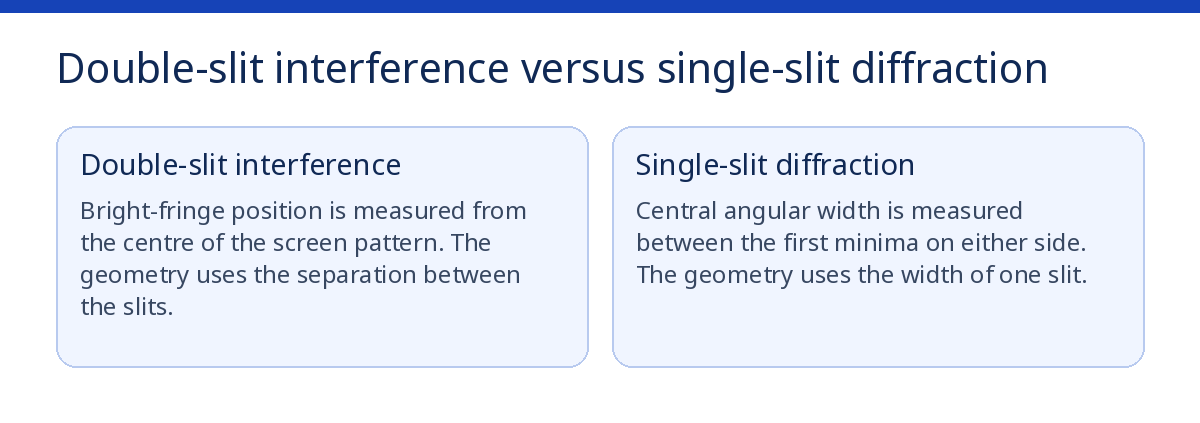
The paper includes both Young’s double-slit interference and single-slit diffraction. For sustained interference fringes, the two sources must have the same frequency and maintain a constant relative phase. In the small-angle double-slit model, the position of a bright fringe relative to the centre is , where is the slit separation and is the screen distance. With two wavelengths in the same setup, look for equality of fringe positions rather than equality of fringe orders.
In single-slit diffraction, is the width of one slit, not the separation between two slits. The full angular width of the central maximum is approximately at small angles. Moving the screen changes the linear width on it, not the angular width. The paper also tests electromagnetic-spectrum applications, which call for connecting a spectral band to a device rather than analysing a fringe pattern.
Photoelectric effect: separate threshold, energy and collection
The paper treats photoelectric emission both conceptually and through energy calculations. In the ordinary one-photon model, compare the incident photon energy with the surface work function . The threshold frequency marks the minimum frequency for emission from that surface. If the photon energy is below the work function, a negative value from indicates that emission does not occur in this model; it is not a negative kinetic energy.
Above threshold, raising intensity at fixed frequency can increase the number of electrons emitted, but it does not increase their maximum kinetic energy. A collecting voltage affects how many emitted electrons reach the collector. When relating maximum kinetic energy to the stopping potential, distinguish the positive magnitude from the sign of the applied retarding voltage.
Atomic and nuclear physics: identify what each quantity describes
The nuclear questions link classification, size and experimental evidence. Isotopes share the same atomic number, whereas isobars share the same mass number but have different atomic numbers. Before deciding what two nuclei have in common, separate proton number from nucleon number . The approximate nuclear-radius relation uses the total nucleon count, so it describes a size trend rather than identifying the element.
The neutron-discovery material asks what recoil observations imply about the incoming particle. The key is to compare possible explanations using both energy and momentum conservation. A separate atomic-scale question gives practice in distinguishing radius from diameter before forming a volume ratio. For spherical volumes, it is the cube of the radius ratio that gives the volume ratio, not the radius ratio itself.
A useful connection: from doped material to a working solar cell
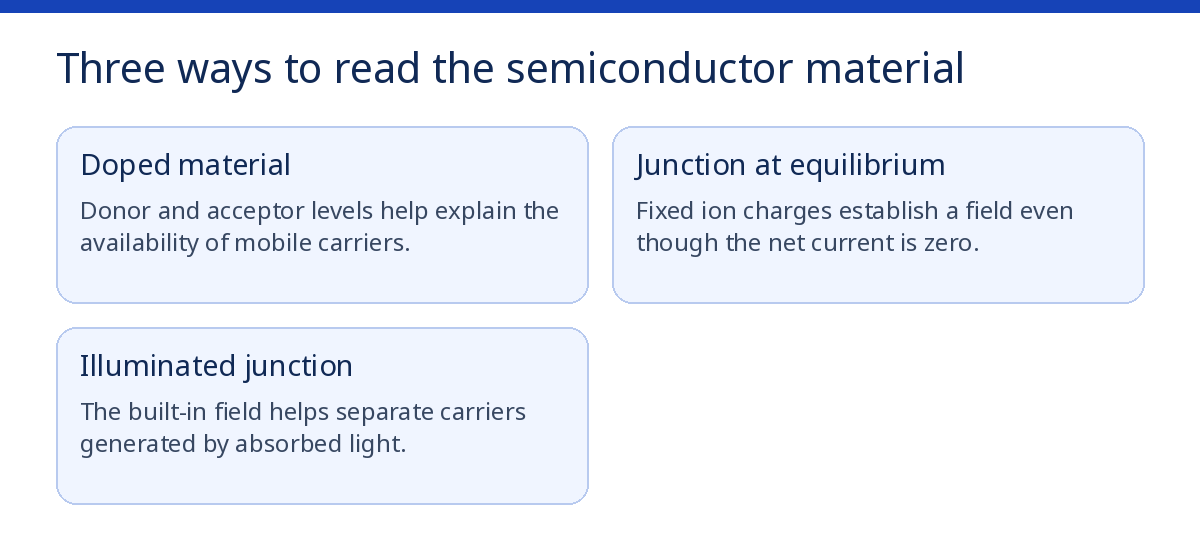
The semiconductor material connects three levels of explanation: energy bands in doped germanium, charge redistribution at a p–n junction, and electrical output from an illuminated junction. In a band diagram, a donor level lies just below the conduction band, whereas an acceptor level lies just above the valence band. These positions explain why producing mobile carriers need not require excitation across the full band gap.
At the junction, distinguish mobile electrons and holes from the fixed ion charges left in the depletion region. At equilibrium, drift and diffusion balance; zero net current does not mean there is no built-in field. That distinction carries over to the solar cell: the field can separate carriers created by absorbed light, and the contacts allow the cell to deliver power when a load is connected.
Quick self-check after a timed attempt
Attempt the question pages before opening the worked explanations. For a timed run, make one choice wherever the paper offers an internal alternative; afterwards, use the other branch to see whether you can switch concepts without relying on the first question’s setup. Compare the diagrams as well as the algebra, especially where a normal, a sign convention or an image position determines the next step.
Before moving on from a correction, ask: Could I state the condition that made my method valid? For a numerical result, also check whether your final quantity is the one requested: an angle rather than a screen distance, for example, or a voltage rather than an energy. This turns the worked file into a check on how you chose your method, not just whether you reached the printed result.
Spotted an error? Report a correction. Practise this in the app: notes, formula sheets and mind maps.













































































































































































Loading comments…