CBSE Class 12 Physics 2022 Term 2 Previous Year Paper
CBSEPhysics2022 Previous Year Paper
Paper code: 55/3/2 · 2022Practise with the full 2022 CBSE Class 12 Physics Term 2 paper, then use the worked solutions to review how you chose a model, used a diagram or justified an assumption.
This set is one of the year's papers. See every set from 2022, grouped by series.
What this 2022 paper contains
This year-wise PDF contains the English version of the CBSE Class 12 Physics main examination, Term 2, paper code 55/3/2. The printed duration is two hours and the maximum is 35 marks. These details describe the 2022 paper, not the format of a current CBSE examination.
The file retains the original questions, options and diagrams. The worked explanations cover the printed internal choices and separate the formula or principle used from the reasoning steps. The paper spans semiconductor electronics, the photoelectric effect, atomic and nuclear physics, electromagnetic waves, and wave and ray optics. It is a full paper for that term, not a chapter worksheet or a checklist of the entire Class 12 syllabus.

Physics 2022 | Class 12 | Previous Year Paper | Code 55/3/2
In the StudentCurio app
A complete worked CBSE Class 12 Physics Term 2 paper from 2022, with questions and solutions spanning semiconductors, photoelectric effect, atomic physics and optics. Useful for exam practice and reviewing solution methods.
Use the paper in two passes
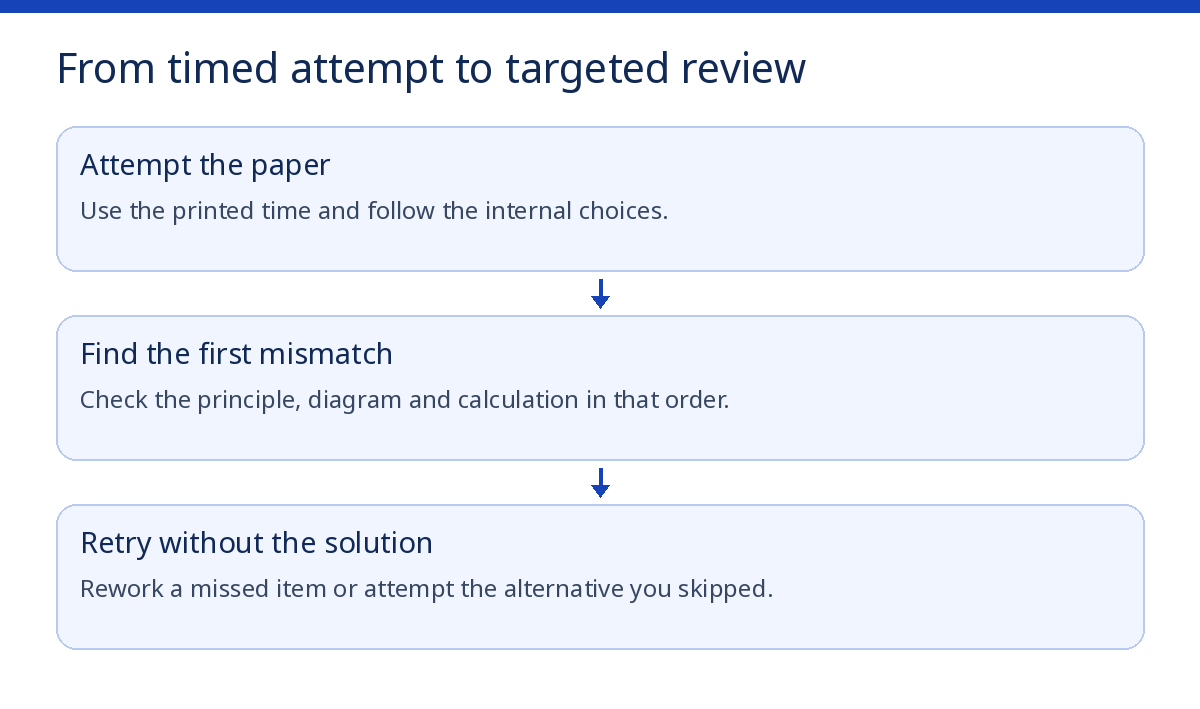
For a timed attempt, use the printed two hours and keep the solution pages closed. Follow the paper’s internal choices as printed rather than trying both alternatives during that attempt. In a later review, try the alternative you skipped. Having explanations for both branches makes it possible to check whether your choice reflected stronger understanding or simply greater familiarity with one topic.
When you open a worked solution, compare the concept used with your own reasoning before checking the arithmetic. If your diagram was right but the equation was wrong, revisit the conditions for that equation. If the method was sound but the result differed, inspect the units, signs and substitutions. Keep those two kinds of error separate: one calls for revisiting the model, the other for checking how you applied it.
Semiconductors: separate junction effects from band effects
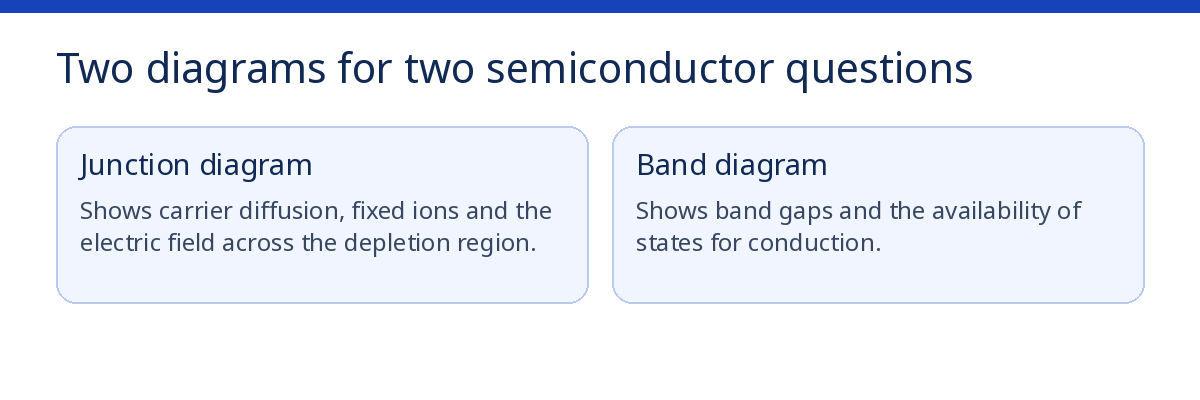
The semiconductor material uses two different pictures. A junction diagram explains what happens when electrons and holes diffuse across a p–n boundary: recombination leaves fixed ions exposed, creating a depletion region and a field. At equilibrium, zero net current means that drift and diffusion currents balance, not that both processes have stopped.
A band diagram instead explains why conductors, semiconductors and insulators differ in conduction. In an ordinary intrinsic semiconductor, heating generates more electron–hole pairs; the increase in carrier density normally outweighs the reduction in mobility. The photodiode material adds a measurement context. When comparing photocurrents to infer light intensity, keep the reverse bias and wavelength fixed and work below breakdown. That way, the comparison does not also change the detector’s operating conditions.
Photoelectric effect: check the threshold first
In the ordinary one-photon model, the threshold frequency is set by the surface work function: . Before using , check whether the photon energy reaches the work function. A negative difference is not a negative kinetic energy for an emitted electron; it means the photon does not have enough energy to eject one in this model.
Keep three ideas separate when reading a question: whether the photon can cause emission, how illumination affects the number of electrons emitted once the threshold is met, and how the collecting potential affects the number that reach the collector. In a numerical attempt, express photon energy and work function in the same unit before subtracting. Frequency, intensity and collecting potential are not interchangeable explanations.
Atomic and nuclear physics: choose the model before the equation
The paper moves between nuclear labels, the Bohr model and electrostatic scattering. For nuclear labels, note which quantity stays fixed: atomic number identifies the element, while mass number counts protons and neutrons together. A comparison based only on mass numbers leaves out the proton count, which is needed to decide whether nuclei belong to the same element.
The hydrogen discussion uses Bohr’s stationary-orbit model, combining quantised angular momentum with the Coulomb force that supplies centripetal acceleration. The closest-approach material uses energy conservation instead. Its simple turning-point argument assumes a head-on encounter and treats the target nucleus as fixed. Do not carry that argument unchanged into a non-head-on encounter, where motion need not stop at the point of closest approach.
Wave optics: check what the setup holds fixed
For reflection and refraction at a stationary boundary, frequency is unchanged. Use to connect a change in wave speed to a change in wavelength rather than treating all three quantities as independent. In the usual double-slit arrangement with a distant screen and small observation angles, uses the wavelength in the medium, the slit-to-screen distance and the slit separation. Before comparing fringe widths, identify which of these quantities the question varies and which it holds fixed.
When comparing interference with single-slit diffraction, look at fringe spacing, relative brightness and the width of the central maximum. For sustained two-source interference, a common frequency is not enough on its own: the sources must maintain a constant phase difference.
Ray optics: read the diagram before trusting a result
At each prism face, mark the normal and identify the medium the ray is leaving. Total internal reflection is possible only when the ray travels from higher to lower refractive index and strikes the boundary at an angle greater than the critical angle, measured from the normal. For lenses, mark the object relative to the focal point before deciding what kind of image to expect. For a compound microscope, keep the objective’s intermediate image distinct from the eyepiece’s final image, and check the assumed final-image position before choosing an eyepiece magnification formula.
This guide omits the glass-sphere example’s numerical image position because the worked passage notes that no numerical glass index is given. It also leaves out the microscope option key and focuses on the optical principles used to review the question.
Spotted an error? Report a correction. Practise this in the app: notes, formula sheets and mind maps.













































































































































































Loading comments…