Class 12 Physics: NCERT Solutions for Nuclei
CBSEPhysicsNuclear Physics
This CBSE Class 12 Physics resource provides worked NCERT exercises from Chapter 13, Nuclei. Use it to see how isotope data, mass differences and decay rates lead to different calculations, and to check where your own setup differs from the solution.
Read the isotope notation before using the mass
The lithium, boron and neon exercises distinguish three quantities that are easy to mix up: mass number, isotopic mass and average atomic mass. Mass number counts protons and neutrons; isotopic mass is the mass of an atom of a particular isotope, expressed here in atomic mass units. The average atomic mass depends on how abundant each isotope is, so an ordinary mean is not appropriate unless the abundances are equal.
The lithium and neon questions give the abundances and ask for the average. The boron question reverses that reasoning: it gives the average and asks for the abundances. With only two isotopes in the mixture, choosing one percentage fixes the other because the percentages must add to one hundred.

Nuclear Physics | Class 12 | NCERT Solutions
In the StudentCurio app
Worked solutions for Class 12 NCERT questions on nuclear properties, mass defect and binding energy, radioactive decay and half-life, and nuclear reactions including fission and fusion. Helps students practise nuclear-physics calculations and understand solution steps.
When the neutral-atom mass shortcut applies
Mass defect is the difference between the combined mass of the separated nucleons and the mass of the bound nucleus. The binding energy, , is the energy required to separate that nucleus into its constituent protons and neutrons. The nitrogen exercise is useful for following the mass bookkeeping: the given value is a neutral atomic mass, not the mass of a bare nucleus.
When using a neutral atomic mass in this calculation, count a neutral hydrogen atom for each proton and use the neutron mass for each neutron. The electron rest masses then cancel, with the small electronic binding energies neglected. Using bare proton masses with a neutral atomic mass would mix conventions. Once you have the mass defect in , use to express the binding energy in MeV.
Distinguish size, energy per nucleon and sample energy
The iron and bismuth solutions report both total binding energy and binding energy per nucleon. The total refers to one whole nucleus. Dividing by the mass number gives an average per nucleon, which lets you compare nuclei of different sizes without treating a larger total as evidence of stronger binding per nucleon. The copper coin exercise changes the scale again: it asks about all the nuclei in a macroscopic sample under the stated single-isotope assumption. That calculation needs the number of atoms as well as the energy per nucleus.
The gold and silver comparison uses mass number for a different purpose. In the approximate nuclear-radius relation , the common constant cancels in a ratio. The radii therefore scale with the cube root of mass number, not with mass number itself.
Common mistakes with half-life and activity
Activity is the rate of decay, not the number of undecayed nuclei. For a single isotope with a fixed decay constant, , so the fraction of initial activity remaining equals the fraction of nuclei remaining. Each half-life halves the current activity; it does not subtract a fixed percentage of the initial activity. The file's activity plot illustrates this distinction. When a remaining fraction does not correspond to a whole number of halvings, the exponential decay law and logarithms let you find the elapsed time.
Keep the time unit consistent with the rate you need. If activity is expressed in becquerels, or decays per second, use a decay constant in inverse seconds. In the carbon-dating exercise, the comparison is between activities per gram of carbon. That ratio estimates the age of the specimen under the stated assumptions.
Check decay equations for balance and feasibility
The decay-equation exercise tracks how the parent nucleus changes. Alpha emission removes two protons and two neutrons. In beta-minus decay, a neutron becomes a proton, with an electron and an electron antineutrino emitted. In beta-plus decay and electron capture, a proton becomes a neutron, but one process emits a positron while the other takes in an electron. Both emit an electron neutrino and leave the mass number unchanged.
Balancing charge and mass number is necessary, but it does not establish that a decay can occur. The file explicitly distinguishes a formally balanced positron-emission equation from an energetically allowed decay. With neutral atomic masses, the parent–daughter mass difference must exceed two electron rest masses for positron emission.
Separate reaction energy from particle energy and power
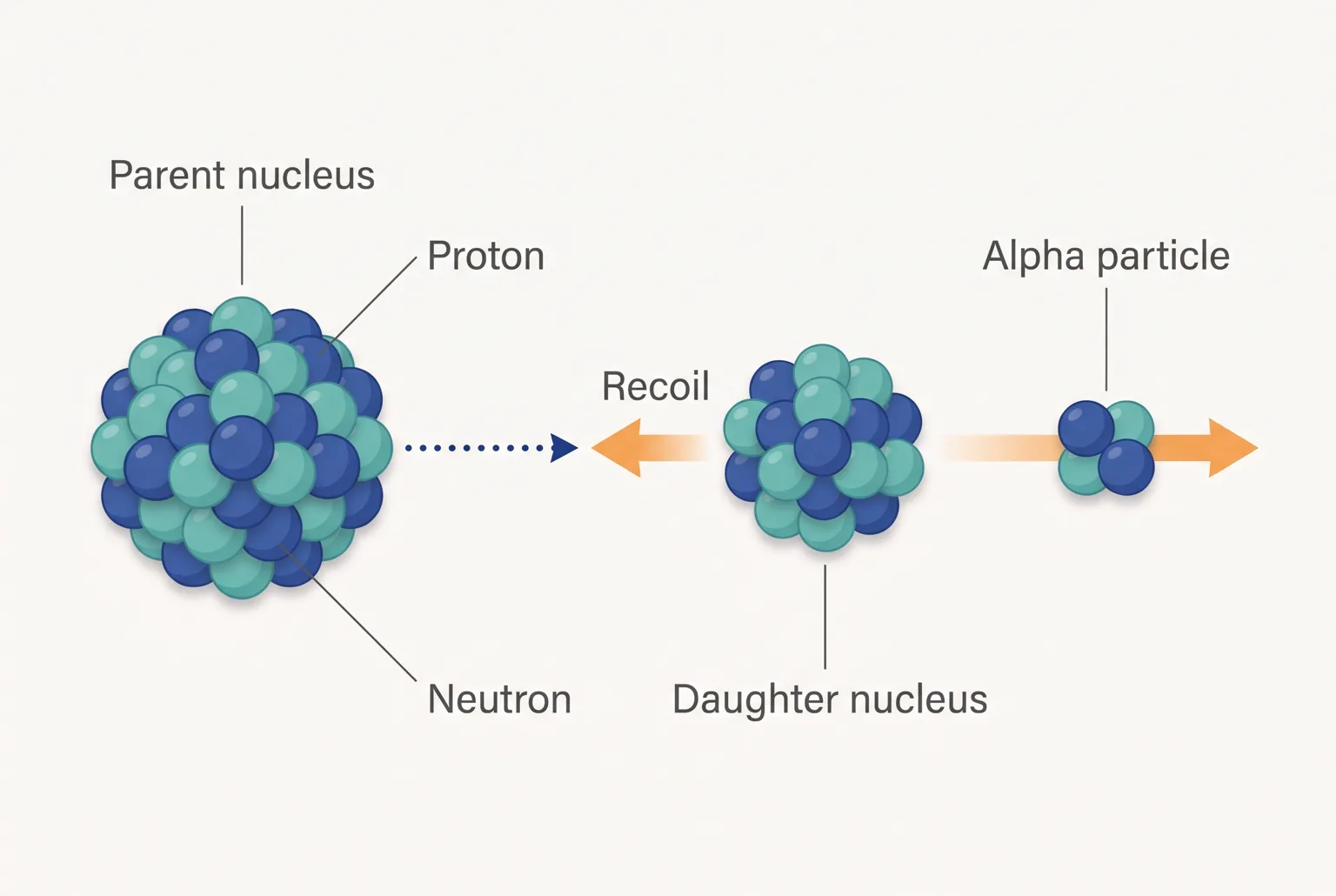
For a nuclear reaction, the Q-value is the initial rest mass minus the final rest mass, multiplied by . A positive value means the reaction releases energy; a negative value means it requires energy input. Even a positive value does not tell you how much kinetic energy one product receives. The alpha-decay solutions use momentum conservation to account for daughter recoil when a parent at rest decays into two products and the daughter is left in its ground state.
The fission and fusion exercises also distinguish energy per event from total energy and from power. A fission energy quoted per nucleus applies to the nuclei that actually undergo fission. In the deuterium fusion exercise, each event uses a pair, so the number of nuclei and the number of events are not the same. A power calculation then relates energy to the time over which it is delivered.
Quick self-check before opening a worked solution
Use the exercise index to pick a question, then write down what the final quantity should describe: one nucleus, one nucleon, one reaction event or a whole sample. In a decay problem, decide whether the data specify an absolute rate or a fraction of the initial activity. In a mass calculation, label the given masses as atomic or nuclear before subtracting anything.
Then use the file's question-to-solution links to compare your first equation with the worked setup. If the answers differ, check the mass convention, the number of events and the units before redoing the arithmetic.
Spotted an error? Report a correction. Practise this in the app: notes, formula sheets and mind maps.













































































































































































Loading comments…