Nuclei: Class 12 NCERT Notes on Binding Energy, Fission and Fusion
CBSEPhysicsNuclear Physics
These notes for NCERT Class 12 Physics Chapter 13, Nuclei, explain nuclide notation, nuclear size and nearly constant nuclear density. They also show how mass defect becomes binding energy and how the binding-energy curve explains fission and fusion.
Reading a nuclide: Z, N, A and the unit u
Rutherford's alpha-scattering experiments showed that almost all of an atom's mass and all of its positive charge sit in a tiny central nucleus. The nucleus holds more than 99% of the atom's mass. Nuclear radii are a few femtometres, while atomic radii are of order m.
A nucleon is either a proton, with charge , or a neutron, which is neutral. Chadwick identified the neutron in 1932. Radiation from alpha-irradiated beryllium knocked protons out of paraffin, and conservation of energy and momentum applied to the recoils revealed a neutral particle.
In the notation :
- counts protons and fixes the element.
- counts all nucleons.
- The nuclear charge is .
Isotopes share but differ in . The unit u is one-twelfth of the mass of a neutral carbon-12 atom in its ground state: kg.

Nuclear Physics | Class 12 | NCERT Notes
In the StudentCurio app
These Class 12 notes cover nuclear composition and properties, mass defect and binding energy, nuclear stability, and fission and fusion. They help students revise core nuclear physics concepts and energy-generation processes.
Why radius grows as A^(1/3) but density stays fixed
Scattering data show that nuclear volume is roughly proportional to . For a sphere this means , so with m. This length is 1 fm, also called a fermi.
The same relation gives the density. The mass of a nucleus is about , and its volume is . The factor cancels:
Most nuclei therefore have a similar density, of order kg m. That is roughly times the density of water. This supports the picture of a nucleus as a drop of nearly uniform matter.
The worked examples follow one routine. Convert the mass from u to kg, find the volume from and , then divide mass by volume.
Mass defect and binding energy with atomic masses
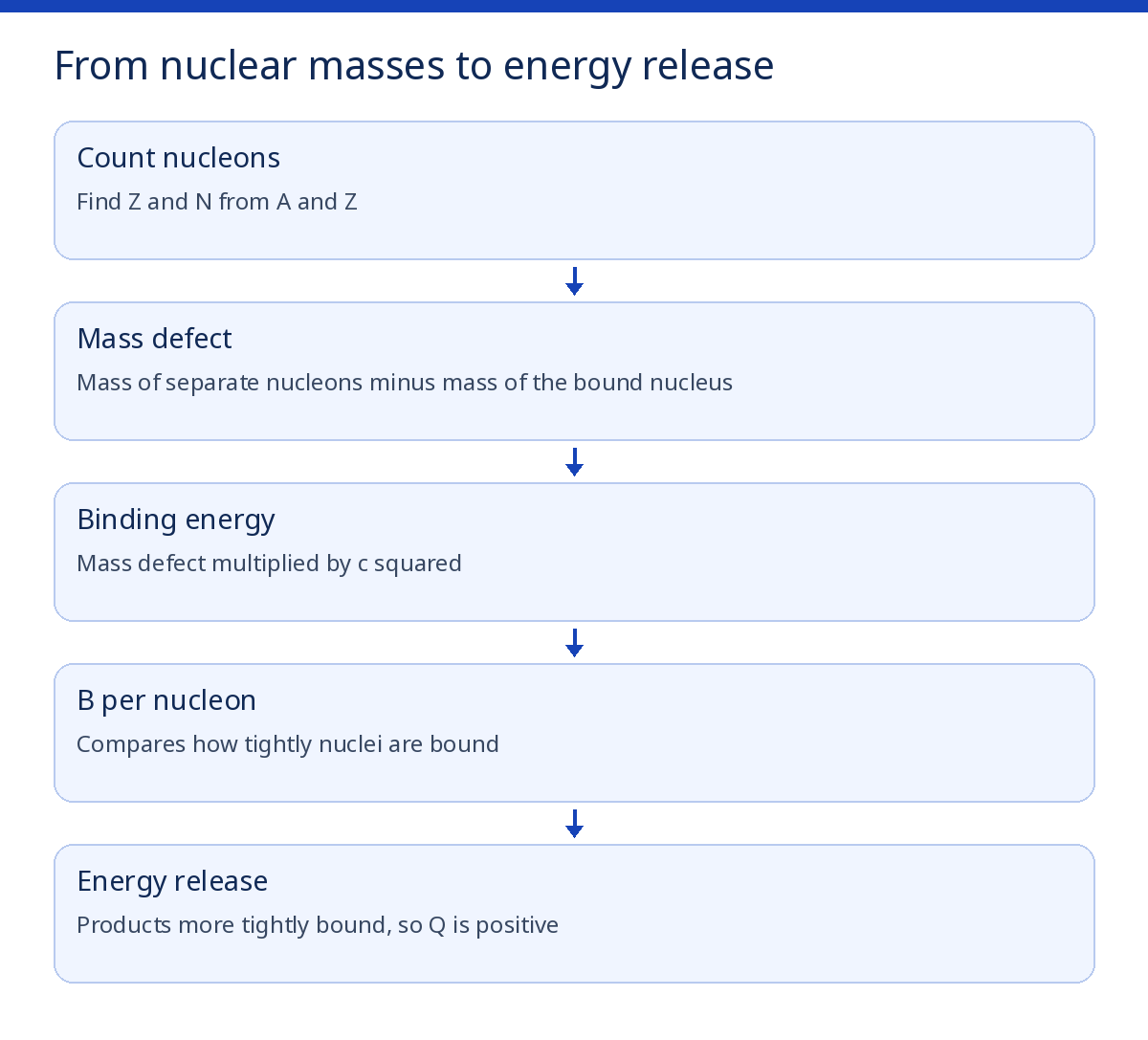
Rest energy is , and a moving particle has total energy . A bound nucleus has less rest mass than its separated nucleons. The difference is the mass defect:
, with
Energy is released when free nucleons at rest form the nucleus. The same energy must be supplied to separate it again.
Good to remember: when you are given neutral atomic masses, use u in place of . Then , and the electron masses cancel. Convert with MeV, or with the rounded 931 MeV when a question supplies it.
The copper-coin example takes one more step. It multiplies the binding energy per nucleus by the number of atoms, found from the molar mass and Avogadro's number.
Reading the B/A curve and the valley of stability
The binding energy per nucleon, , compares how tightly different nuclei are bound. The curve has three features:
- It rises steeply for light nuclei. He, C and O are tightly bound compared with their neighbours.
- It peaks broadly near iron and nickel, at about 8.8 MeV per nucleon for Fe.
- It falls slowly to about 7.6 MeV for U, partly because of proton-proton repulsion.
Energy is therefore released when a heavy nucleus splits, or when light nuclei combine, into more tightly bound products. The energy gained equals the increase in total binding energy, with the number of nucleons conserved.
Stability also depends on . Stable light nuclei lie near . Stable heavy nuclei need , because neutrons add nuclear attraction without adding Coulomb repulsion. Stable nuclei often have even , even , or both. Whether a particular decay occurs also depends on the energies of its possible products.
Properties of the short-range nuclear force
The attractive nuclear interaction binds both protons and neutrons. At nuclear distances it overcomes electric repulsion and is far stronger than gravity, but its range is only a few femtometres.
The potential energy of a pair of nucleons has a minimum near fm. Using , the force is:
- repulsive inside the minimum;
- attractive just outside it;
- negligible at large separations.
The force is approximately charge independent for comparable pp, nn and np states. It is spin dependent, can have non-central parts and does not follow an inverse-square law.
Saturation means a nucleon interacts strongly only with its nearby neighbours. This explains why varies slowly across much of the curve.
Q-value, fission channels and the factor k
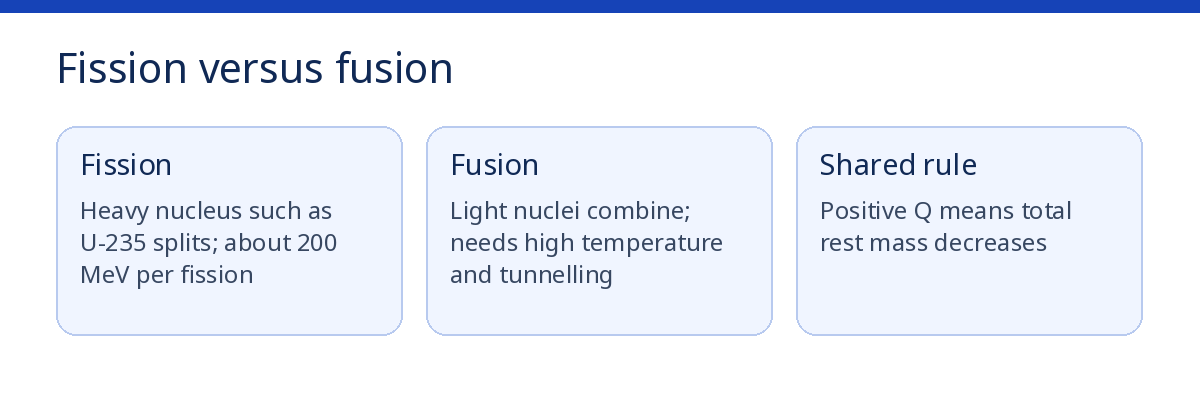
For any reaction, , using one consistent mass convention. A positive means energy is released. Nuclear -values are measured in MeV, while individual chemical reactions involve energies of order eV.
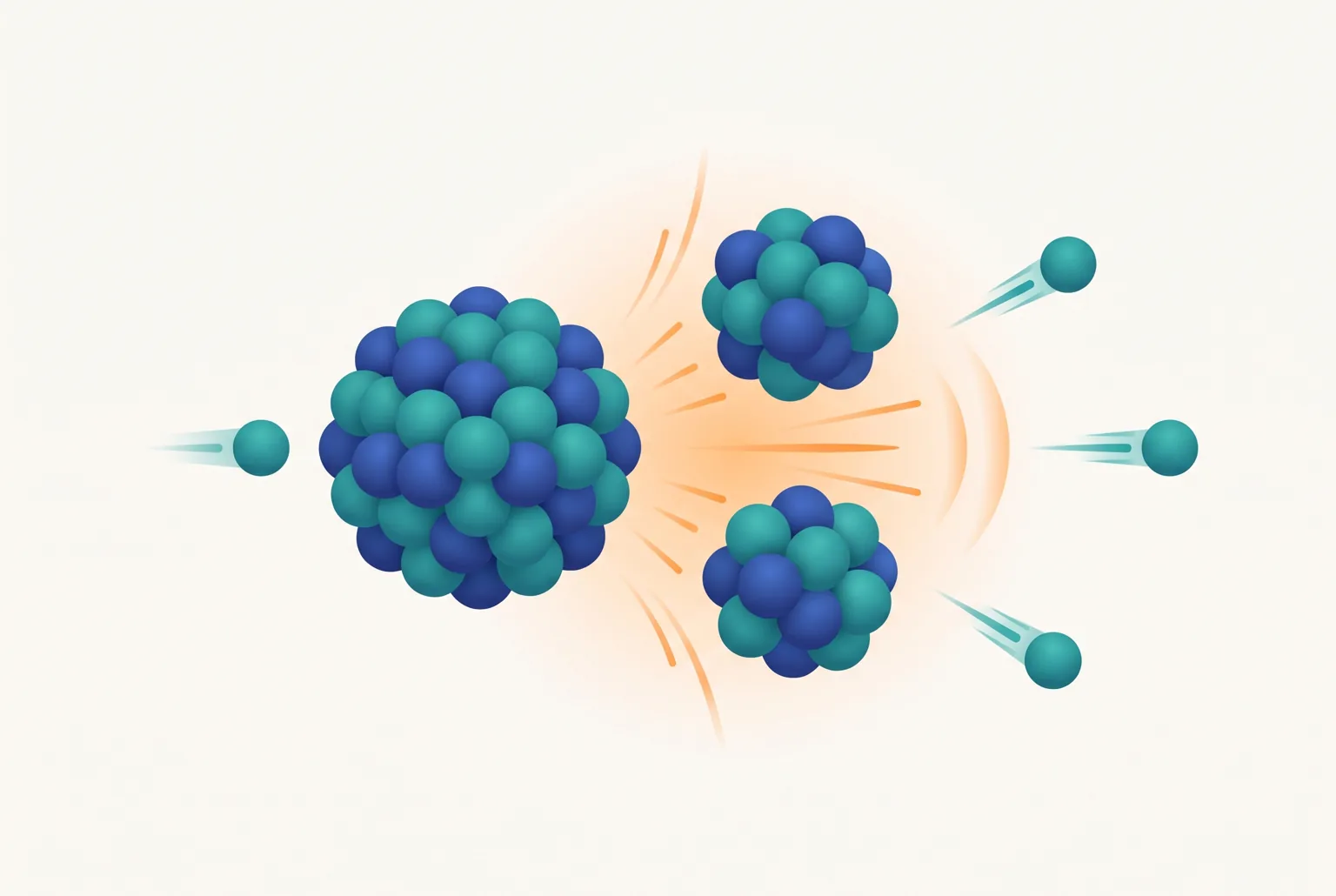
Uranium-235 can split after absorbing a slow neutron. One possible channel is , in which both mass numbers and charges balance. Each fission releases energy of order 200 MeV, much of it at first as kinetic energy of the fragments. The radioactive fragments then undergo beta decay, often with gamma emission.
The multiplication factor compares the neutron populations of successive generations:
- is subcritical, and the fission rate falls.
- is critical, and the rate can stay steady.
- is supercritical, and the rate grows.
A reactor keeps the chain reaction steady using four main parts. The moderator (water, heavy water or graphite) slows neutrons. Control rods containing boron or cadmium absorb neutrons. The coolant removes heat from the core, and shielding attenuates radiation.
Fusion: overcoming Coulomb repulsion in stars
In fusion, light nuclei combine into a more tightly bound nucleus. Because the nuclei repel each other, they must get close enough for the short-range attraction to act. A high temperature increases the number of close encounters, and quantum tunnelling allows fusion below the peak of the Coulomb barrier.
The Sun's core is at about K. In the proton-proton chain, the first three steps occur twice, and then two He nuclei fuse. The net result is that four protons become one He nucleus, releasing about 26.7 MeV. Neutrinos carry off part of this energy.
Controlled fusion uses a plasma at around K. Confining the plasma, keeping it hot and extracting useful energy remain major research challenges.
Common mistakes in Nuclei calculations
- Mass conventions: use atomic masses with , or nuclear masses with . Never mix the two.
- Size versus density: , but density does not depend on .
- Sign of Q: a positive means rest mass decreases and energy is released, in fission and fusion alike.
- Critical means steady: describes a steady chain reaction, not zero fission.
The notes close with a formula summary table, and their six worked examples are worth reattempting.
Frequently asked questions
Why do some worked examples use 931 MeV instead of 931.5 MeV?
The notes state MeV. Some examples use the rounded value of 931 MeV because the question itself supplies it.
Which textbook chapter do these notes follow?
They follow NCERT Class 12 Physics, Part II, Chapter 13 (Nuclei).
Spotted an error? Report a correction. Practise this in the app: notes, formula sheets and mind maps.













































































































































































Loading comments…