Class 12 Physics Case Studies for Nuclear Physics Concepts
CBSEPhysicsNuclear Physics
A comprehensive guide to Class 12 CBSE case-based assessments covering nuclear density, forces, fission reactions, and mass-energy equivalence with structured problem-solving for board exam preparation.
Applied Learning through Case-Based Scenarios
The Chapter 13 resource for Class 12 Physics focuses exclusively on case-based assessments, a critical component of the modern CBSE curriculum. Unlike traditional practice sets that focus on isolated numericals, this material uses eleven distinct case studies to contextualize nuclear physics. By presenting a passage—such as the historical development of India’s Apsara reactor or the discovery of the nucleus by Rutherford—the resource requires learners to extract data and apply theoretical laws to specific scenarios. There are 50 questions in total, ranging from conceptual multiple-choice questions to complex numerical accounting of mass-energy conversion. This format encourages students to look at the nucleus not just as a collection of symbols, but as a physical system governed by specific constraints of range and energy. For effective use, students should read the provided context carefully, as many variables needed for calculation, such as the value of or specific mass numbers, are often embedded within the case descriptions.

Nuclear Physics | Class 12 | CBSE Case-based Assessment
In the StudentCurio app
This document provides a collection of case-based assessment questions for Class 12 Physics covering nuclear composition, density, forces, mass-energy equivalence, and nuclear reactions with detailed step-by-step solutions.
Understanding Nuclear Composition and Geometry
A foundational aspect of this resource is the study of nuclear composition and the resulting physical properties. The material explains that the nucleus contains approximately 99.9% of an atom's mass, concentrated in a region roughly 10,000 times smaller than the atom itself. It reinforces the relationship between mass number , atomic number , and neutron count , where . Beyond simple counting, the resource introduces the spherical-nucleus model where the radius is determined by the formula . Here, acts as a constant radius parameter typically valued between and . One of the most significant concepts covered is the approximate independence of nuclear density from mass number. Since the nuclear volume is proportional to , and mass is also proportional to , the density remains constant across different elements at an immense scale of approximately . Learners are tasked with interpreting graphs of against and performing density calculations for specific isotopes like Oxygen-16 or Iron-56.
Characteristics of the Strong Nuclear Interaction
The resource provides detailed inquiry into the nature of nuclear forces, which are essential for understanding nuclear stability. It characterizes the nuclear interaction as a strong, short-range force that dominates over the Coulomb repulsion between protons at separations of approximately . A key verified fact included in the source is the charge-independent nature of this force; when comparing corresponding states, the interaction between a proton-proton pair is approximately equal to that of a proton-neutron pair once electromagnetic effects are excluded. However, the resource also clarifies that this force is not purely attractive; it includes a repulsive core at extremely short distances to prevent the collapse of the nucleus. Students are challenged to compare the magnitudes of nuclear and electrostatic forces at varying distances, such as , where the short-range nature of the nuclear force means it becomes negligible compared to the long-range electromagnetic interaction.
Mass-Energy Equivalence and Decay Accounting
A significant portion of the assessment is dedicated to mass-energy bookkeeping, grounded in Einstein’s relation . The material covers the conversion of rest mass into kinetic energy and other forms, emphasizing that while total energy is conserved, the sum of separate particles' rest masses is not. Through case studies on isolated neutron decay, learners must calculate energy properties of undetected particles (like neutrinos or antineutrinos, often referred to in the source as an 'undetected third particle'). The resource provides tabulated data of rest energy and kinetic energy in for various particles, requiring students to assess physical consistency. For instance, it asks whether a specific reaction is energetically permissible based on whether the total initial energy matches the final sum. It also touches upon the conversion of mass into electrical energy, such as calculating the mass-energy equivalent of of power supplied for one hour, assuming 100% conversion efficiency.
Mechanics of Nuclear Fission and Reactors
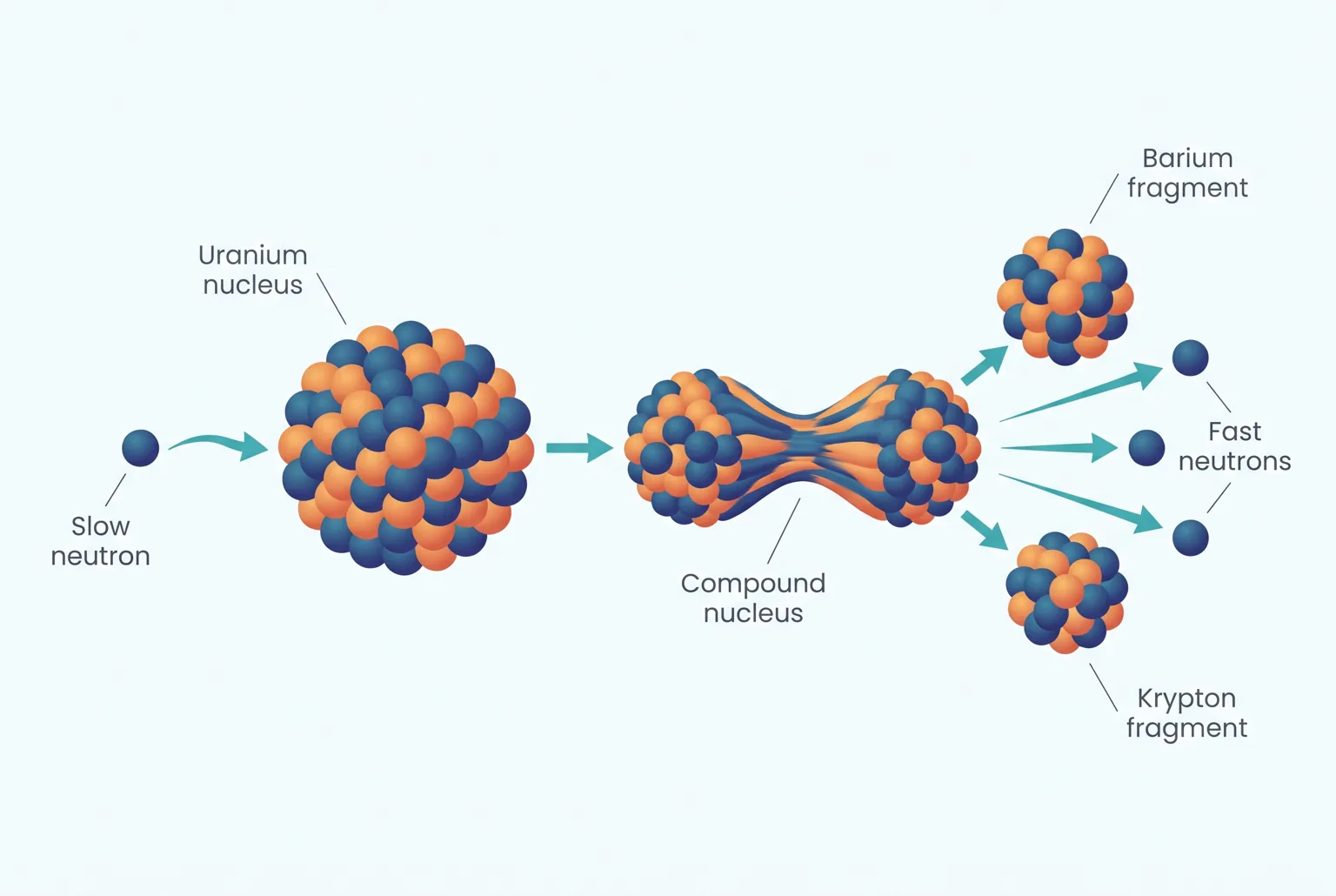
Fission is treated as a process of splitting heavy nuclei (typically with ) into lighter, more tightly bound fragments. The resource highlights the liquid-drop model as a primary explanation for the fission mechanism. It provides specific reaction equations, such as the neutron bombardment of Uranium-235 forming an unstable excited Uranium-236* compound nucleus before splitting into fragments like Barium and Krypton. Central to these case studies is the concept of a chain reaction and the effective multiplication factor . Criticality is achieved when , representing a self-sustained reaction. The resource also discusses the role of moderators, such as graphite or light water, which are used to slow down fast prompt neutrons (which typically have kinetic energies around ) to thermal speeds through elastic scattering. This slowing is necessary to increase the probability of further fission events in reactors used for power generation and research.
Nuclear Spin and Stability Markers
The material introduces advanced markers for assessing nuclear stability and structure. It notes that nuclear spin is directly connected to nucleon pairing: even-even nuclei have a spin of zero, while nuclei with odd mass numbers possess half-integer spin, and odd-odd nuclei have integer spin. Furthermore, it explains the importance of the nuclear quadrupole moment, which indicates whether a nucleus has a spherical or non-spherical charge distribution. Stability is further assessed through neutron-proton balance and mass defect. The assessment includes questions on classification, asking students to distinguish between isotopes, isobars, and isotones (nuclides with the same neutron number). These theoretical tools allow learners to predict whether a particular isotope, such as a specific Uranium or Hydrogen isotope, is fissile or stable within an interacting nuclear system.
Common Mistakes and Useful Connections
- Common mistake: Assuming nuclear density increases with mass number. The source material emphasizes that volume and mass both scale with , keeping the density approximately constant () for all nuclei.
- Good to remember: In nuclear reaction equations, always check for the presence of the 'compound nucleus' (like ). This is an intermediate, unstable state before fission fragments are formed.
- Before you move on: Ensure you can distinguish between fission (heavy nucleus splitting) and fusion (light nuclei combining). The resource provides reaction classification exercises specifically for this purpose.
- A useful connection: The multiplication factor determines reactor state. If , the reaction is subcritical and will die out; if , it is supercritical and can lead to an uncontrolled reaction.
Frequently asked questions
How is the nuclear radius related to the mass number?
The nuclear radius is proportional to the cube root of the mass number , expressed as .
What determines if a nuclear chain reaction is critical?
A chain reaction is considered critical and self-sustaining when its effective multiplication factor is exactly equal to 1.
What is the typical energy released in a single Uranium-235 fission event?
According to the source material, a representative Uranium-235 fission channel releases approximately of energy.
What role does a moderator play in a nuclear reactor?
Moderators like graphite or light water slow down fast neutrons through elastic scattering, allowing them to become thermal neutrons capable of sustaining a fission chain reaction.
Spotted an error? Report a correction. Practise this in the app: notes, formula sheets and mind maps.













































































































































































Loading comments…