Moving Charges and Magnetism: Class 12 NCERT Guide
CBSEPhysicsMoving Charges and Magnetism
This CBSE Class 12 Physics guide shows how to use the NCERT textbook chapter to connect currents, magnetic fields and forces. It explains when a magnetic field bends a particle’s path, how to find the field of a current loop and what to look for in the worked examples.
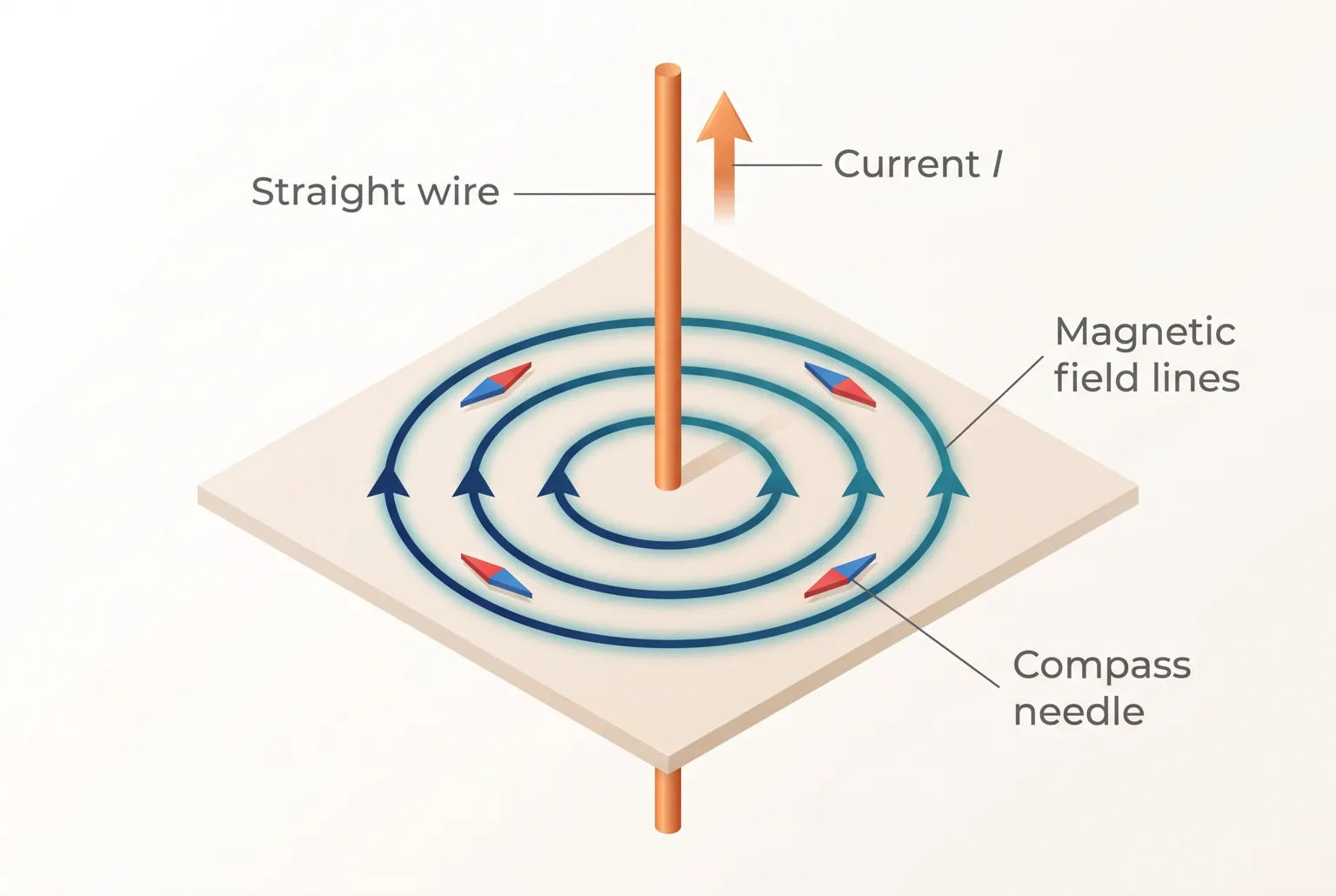
Start with the compass around a current-carrying wire
Oersted’s demonstration introduces the chapter’s first question: what produces a magnetic field? Around a straight wire carrying current, the magnetic field forms concentric circles. The compass needle aligns tangentially to a circle, not towards or away from the wire, when the field from the current dominates Earth’s magnetic field. Bringing the compass closer or increasing the current makes the deflection more noticeable. Reversing the current reverses the direction of the wire’s magnetic field.
Read Figure 4.1 with the chapter’s page convention in mind: a dot means out of the page and a cross means into it. The figure introduces a distinction that runs through the chapter. Calculating the field a current produces is a different task from calculating the force an external field exerts on that current.

Moving Charges and Magnetism | Class 12 | NCERT Textbook
In the StudentCurio app
This textbook chapter covers magnetic fields produced by currents, charged-particle motion and Lorentz force, forces on conductors, current-loop torque, and moving-coil galvanometers. It includes worked examples and end-of-chapter questions for Class 12 students studying magnetic effects of current.
Read the Lorentz force one term at a time
The Lorentz force combines electric and magnetic effects on a point charge: . The electric term depends on the charge and the electric field at the particle’s position. The magnetic term also depends on the particle’s velocity. It vanishes if the particle is at rest or if its velocity is parallel or antiparallel to the magnetic field. That does not imply zero total force if an electric field is present.
For a nonzero magnetic force, the cross product gives a direction perpendicular to both velocity and field. Use the right-hand rule to find the direction for a positive charge and reverse it for a negative charge. Example 4.2 isolates this sign change by comparing an electron and a proton with the same velocity and field directions. Keep the charge sign for the direction, but use its magnitude when calculating the size of the force.
When the circular-motion formula applies
A magnetic force does no work on a particle because it is perpendicular to the instantaneous velocity. It can change the direction of motion without changing the speed. This is unlike an electric force, which can change the particle’s kinetic energy if it has a component along or against the motion.
In a uniform magnetic field acting alone, a particle entering perpendicular to the field moves in a circle. The magnetic force supplies the centripetal force, giving in the nonrelativistic treatment used here. If the particle also has a velocity component along the field, use only the perpendicular component in the radius formula. The unchanged parallel component carries the particle along the field as it turns, producing a helix. The pitch is the distance travelled along the field in one revolution. With no perpendicular component, there is no turning at all. Figures 4.5 and 4.6 make these differences easier to see than the formulas alone.
From a moving charge to a current-carrying conductor
The textbook derives the force on a straight wire by adding the magnetic forces on its moving charge carriers. For a straight segment carrying a steady current in a uniform external field, the result is . The vector points along the conventional current, even when the mobile carriers are electrons drifting the other way. The current itself is a scalar in this expression.
Example 4.1 adds a mechanics question: can the magnetic force balance the wire’s weight? As you read it, identify why the force must point upwards before equating the magnitudes. For a curved conductor, the chapter instead treats the wire as a collection of short segments. Their force contributions must be added as vectors because the direction of the current changes along the wire.
Good to remember: an element is not the whole wire
The Biot–Savart law gives the magnetic field contribution of a small current element at an observation point in vacuum. Its magnitude depends on the sine of the angle between the element and the displacement from that element to the observation point. An element aligned with that displacement contributes zero. The inverse-square distance dependence belongs to the individual contribution; it is not a rule to apply directly to the net field of an entire conductor.
For the field on the axis of a circular loop, the textbook uses symmetry before adding the contributions. Diametrically opposite elements have transverse field components that cancel, while their axial components reinforce each other. The centre is a special case of this axial calculation, obtained by setting the distance from the centre to zero. In Figure 4.9, trace a pair of opposite elements and distinguish the component that cancels from the one that survives.
Use the worked examples to choose the right model
The examples are useful for practising different decisions. The suspended wire requires a force balance; the electron orbit requires a link between magnetic force and circular motion; the small current element requires the field produced at a specified point. Before reading a worked example, name what is being found and identify the two directions that determine the relevant cross product. Then check whether the calculation concerns a single particle, a conductor in an external field or a field produced by a current.
Use the end-of-chapter questions to practise making that choice without a worked setup beside you. The chapter also covers torque on a current loop and the moving-coil galvanometer, connecting the force on a conductor to the turning effect on a coil and its use in detecting current.
Spotted an error? Report a correction. Practise this in the app: notes, formula sheets and mind maps.













































































































































































Loading comments…