Moving Charges and Magnetism: Class 12 CBSE Practice and Key Ideas
CBSEPhysicsMoving Charges and Magnetism
Moving Charges and Magnetism (NCERT Chapter 4, Class 12 CBSE Physics) starts from the magnetic force on a moving charge and builds to circular and helical paths, velocity selectors and forces on wires. This guide explains these ideas as StudentCurio's 212-question assessment tests them and shows how to practise with its topic sets and worked solutions.
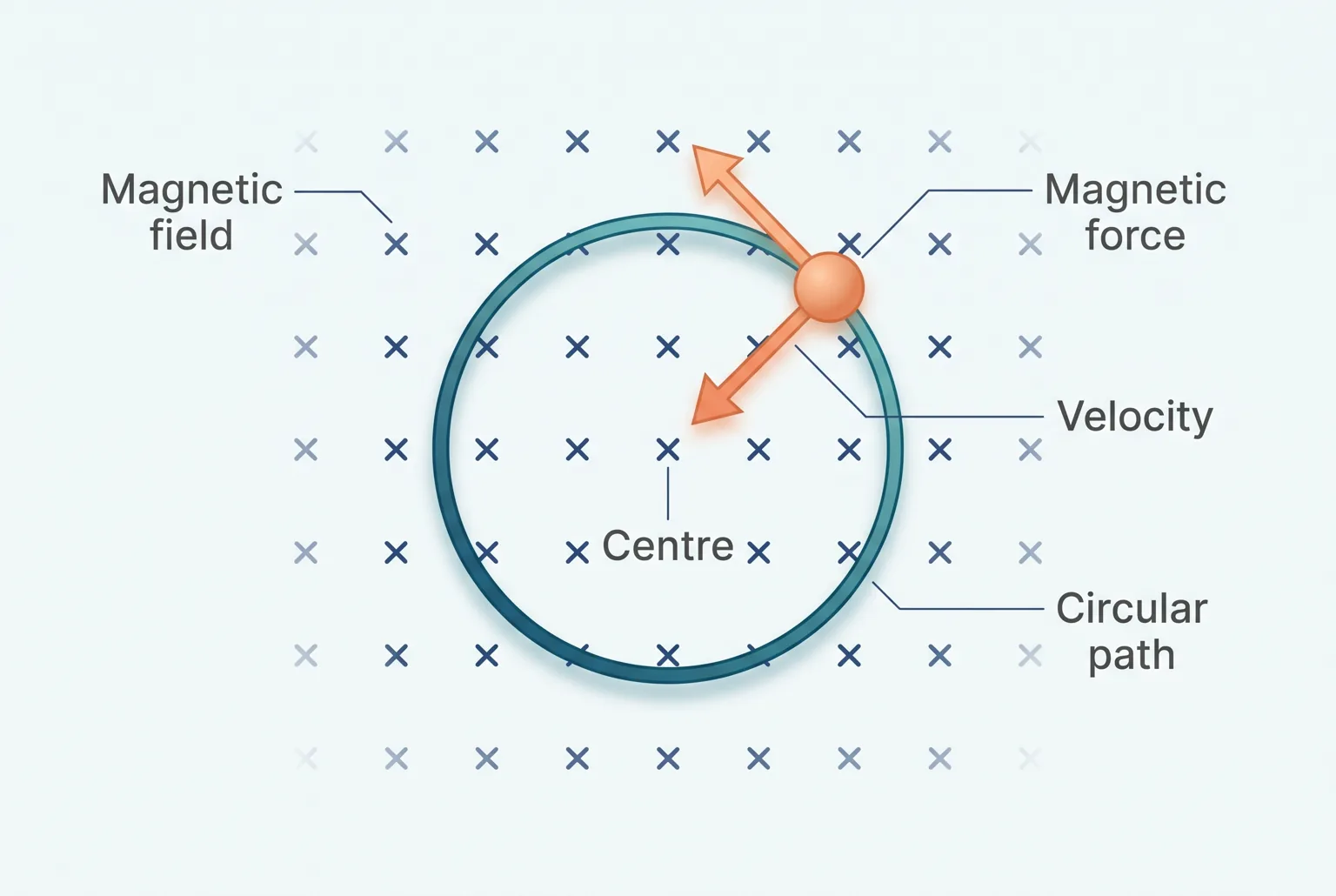
Reading the magnetic force on a moving charge
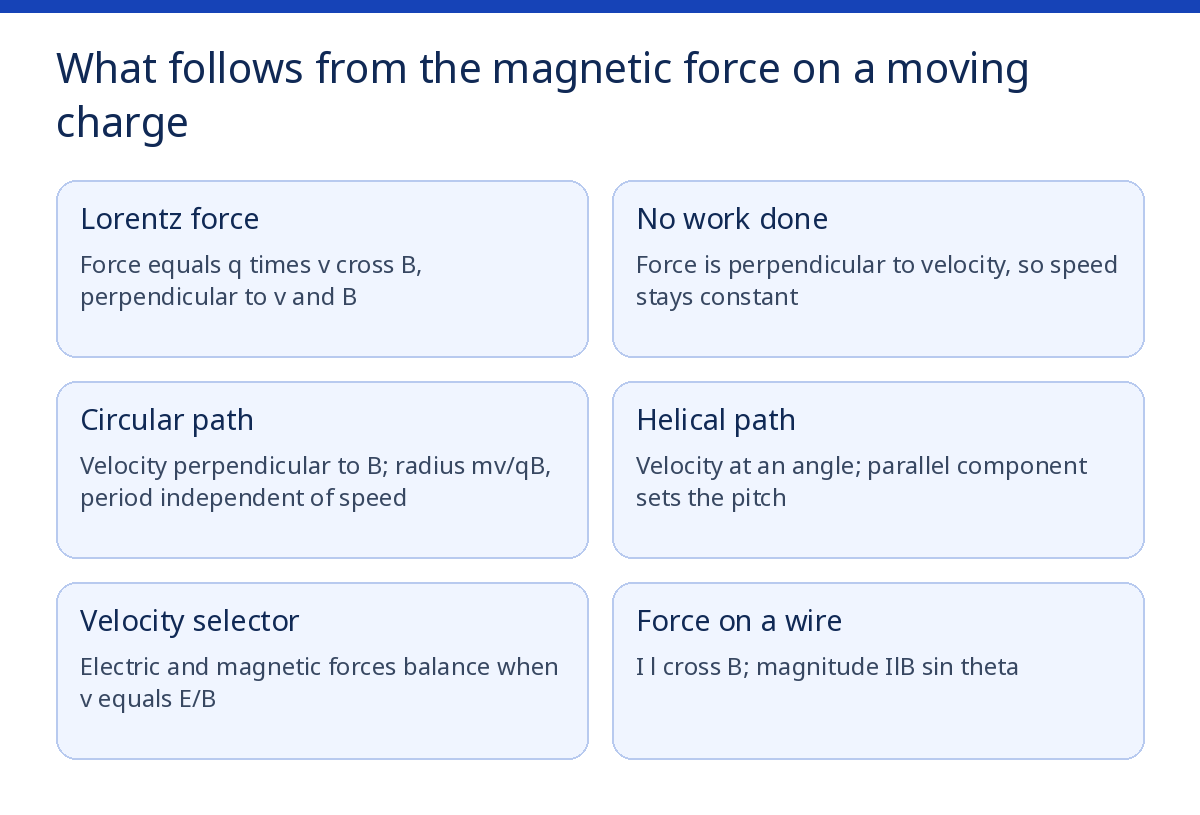
The first topic set (NCERT 4.1–4.3) rests on one vector expression, the magnetic part of the Lorentz force: . Its magnitude is , where is the angle between and .
Three consequences recur across the questions:
- The force is largest when the charge moves at right angles to the field ().
- The force is zero when is parallel or antiparallel to , whatever the charge.
- A neutral particle such as a neutron feels no force and goes straight.
The force is perpendicular to the plane containing and . Its sense comes from the right-hand rule for : curl the fingers from towards , and the thumb gives the force on a positive charge. For a negative charge such as an electron, the direction reverses.
The same expression defines the tesla. For perpendicular motion . A field is 1 T when a 1 C charge moving at 1 m s⁻¹ perpendicular to it experiences 1 N, so 1 T = 1 N A⁻¹ m⁻¹.

Moving Charges and Magnetism | Class 12 | CBSE Assessment
In the StudentCurio app
212 original Class 12 Physics questions on moving charges and magnetism, arranged by NCERT topic, with step-by-step worked solutions. Five topic sections (magnetic force and motion in a magnetic field; Biot-Savart law and the circular loop; Ampere's law and the solenoid; parallel currents and torque on a current loop; the moving coil galvanometer) plus mixed chapter practice, with MCQs, assertion-reason, 2-, 3-, 4- and 5-mark questions and case-based questions.
Why a magnetic field never changes a particle's speed
A favourite idea for derivation and assertion–reason questions is that the magnetic force does no work. The worked solutions argue through power: . A cross product is perpendicular to each of its factors, so this product vanishes at every instant. The total work is therefore zero over any path.
Speed and kinetic energy stay constant; only direction changes. This holds even in a strong, steady but non-uniform field. A tempting trap is to assume a winding path through such a field must alter the speed.
A related pattern asks when a charge passes through a pure magnetic field undeflected. With and , zero force needs . The velocity must therefore lie along or against the field. Changes in the field's magnitude from point to point do not matter along such a line.
Circles, helices and the radius formula
When , the force has constant magnitude and stays perpendicular to the velocity, so it acts as a centripetal force. Equating gives
, , .
The period and frequency do not depend on the speed or the radius. This decides comparisons of revolution rates between particles.
If the velocity makes an angle with , resolve it into two components:
- produces circular motion of radius .
- is unaffected and carries the particle steadily along the field.
The path is a helix, and its pitch is .
Ratio questions compare a proton, an alpha particle or an electron. First identify what is held equal:
- equal speeds make ;
- equal momenta make ;
- equal kinetic energy needs .
For particles accelerated from rest through a potential difference , use before applying the radius formula.
Balancing forces in a velocity selector
In crossed fields, , and the beam velocity are mutually perpendicular. They are oriented so that the electric force and the magnetic force oppose each other.
A particle goes straight when , that is . This condition is independent of the particle's charge and mass. Faster particles () bend towards the magnetic force, and slower ones bend towards the electric force. A slit on the straight line therefore passes only one speed.
A case-based question applies this to a mass spectrometer. Selected ions then enter a second region containing only a magnetic field and follow semicircles, which links back to .
Direction versions ask which way must point for a given and . Find the magnetic force by a cross product first, then make the electric force cancel it.
Force on a current-carrying conductor
For a straight wire, , with magnitude . The force per unit length is .
For a coil of turns with only one side in the field, the net extra force is the force on that side, . Balance and support problems set this force equal to a weight, .
Some questions place a wire inside a solenoid. There the field runs along the axis, with magnitude . Here is the number of turns per unit length, and every winding layer must be counted.
The worked solutions settle compass directions by assigning axes: east as , north as and up as . They then evaluate cross products such as .
Common mistakes to avoid
- Forgetting to reverse the force direction for an electron or another negative charge.
- Using the full speed instead of for the radius of a helix.
- Claiming a non-uniform magnetic field can speed a particle up.
Fields of currents, torque and the galvanometer
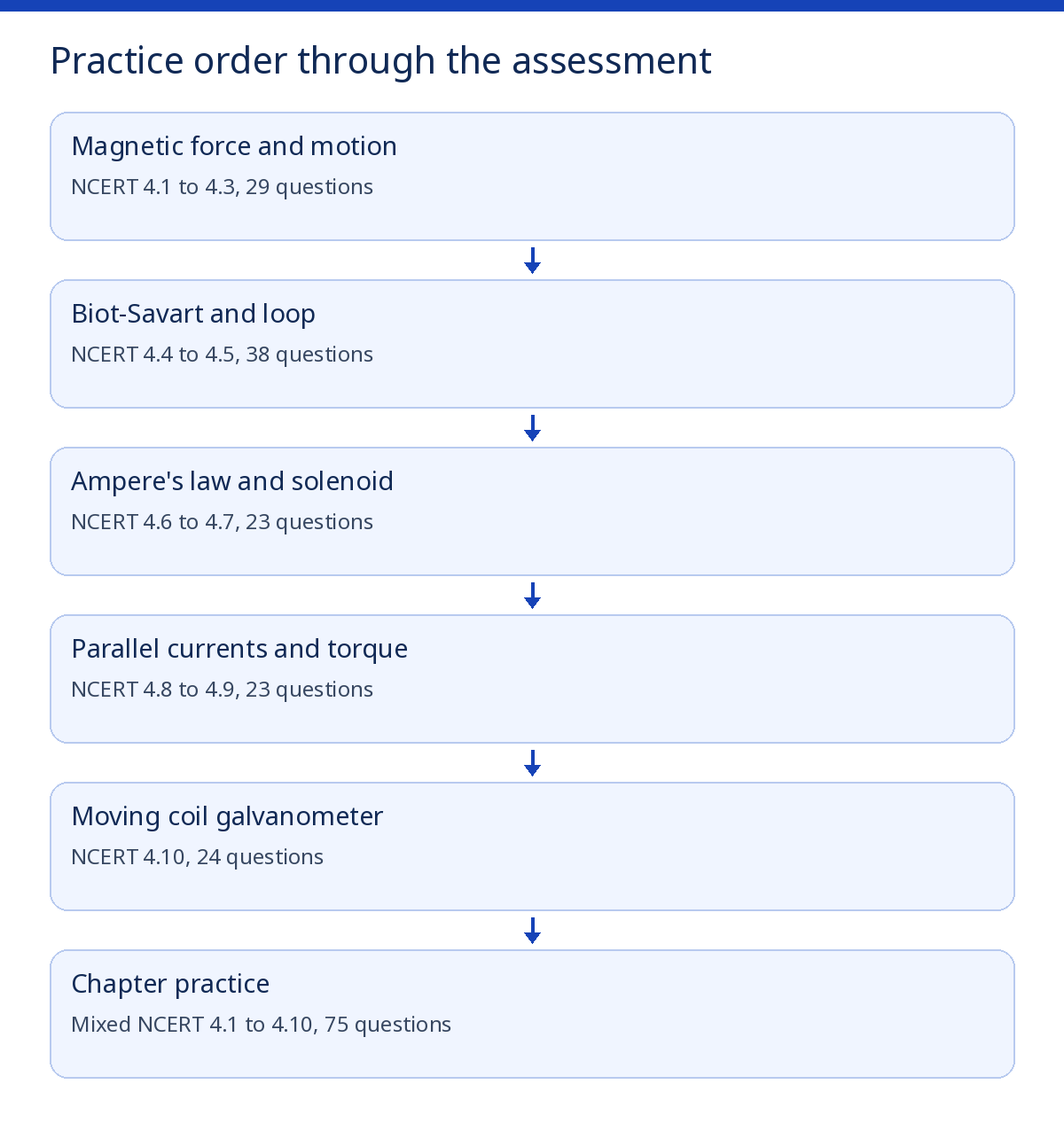
The remaining topic sets follow NCERT order:
- Biot–Savart law and the circular current loop (NCERT 4.4–4.5, 38 questions)
- Ampère's circuital law and the solenoid (4.6–4.7, 23 questions)
- Parallel currents and torque on a current loop (4.8–4.9, 23 questions)
- The moving coil galvanometer (4.10, 24 questions)
The cover gives the field of a long straight wire in vacuum: at distance . For current out of the page, the field circles the wire anticlockwise, following the right-hand rule. Learn it with the solenoid result , which Topic 1 questions already use.
Working from topic sets to the 75-question mixed set
Each topic set contains:
- multiple-choice and assertion–reason questions;
- 2-mark very short answers and 3-mark short answers;
- a 4-mark case-based question made of four 1-mark MCQ parts;
- long answers worth 5 marks, plus 4-mark long answers in Topics 3 and 4;
- step-by-step worked solutions.
The 75-question Chapter Practice mixes NCERT 4.1–4.10 in the same formats.
Work through one topic set at a time before attempting the mixed set. When checking an answer, compare your reasoning with the solution's steps: the formula stated, the angle identified and the direction justified.
Quick self-check before mixed practice
- Can you explain why the period of circular motion does not depend on speed?
- Can you say which component of velocity sets the pitch of a helix?
- Can you state the velocity-selector condition and explain why it ignores mass?
Frequently asked questions
Which question formats does this Moving Charges and Magnetism assessment use?
It uses MCQs, assertion–reason questions, 2-, 3-, 4- and 5-mark questions, and case-based questions with four 1-mark parts. Every set has worked solutions.
How are the 212 questions organised?
There are five topic sets following NCERT sections 4.1–4.10, with 29, 38, 23, 23 and 24 questions. A mixed Chapter Practice set adds 75 more.
Spotted an error? Report a correction. Practise this in the app: notes, formula sheets and mind maps.













































































































































































Loading comments…