Magnetism and Matter: Class 12 CBSE Assessment Guide and Key Ideas
CBSEPhysicsMagnetism and Matter
This guide to Class 12 Physics Chapter 5, Magnetism and Matter, explains the ideas behind a 115-question CBSE assessment. It covers axial and equatorial dipole fields, cut magnets, closed field lines, solenoids and current loops as dipoles, and the orbiting electron.
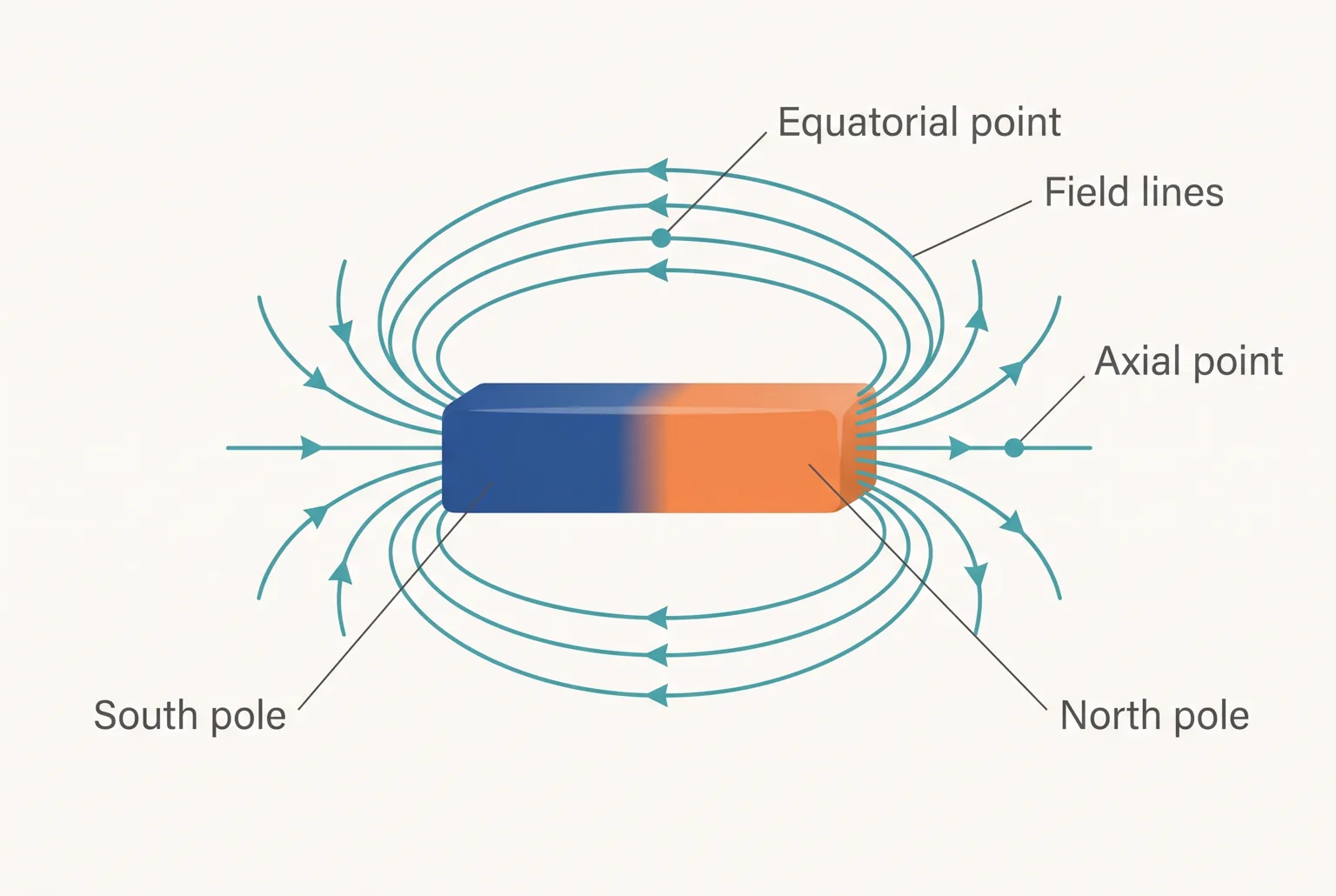
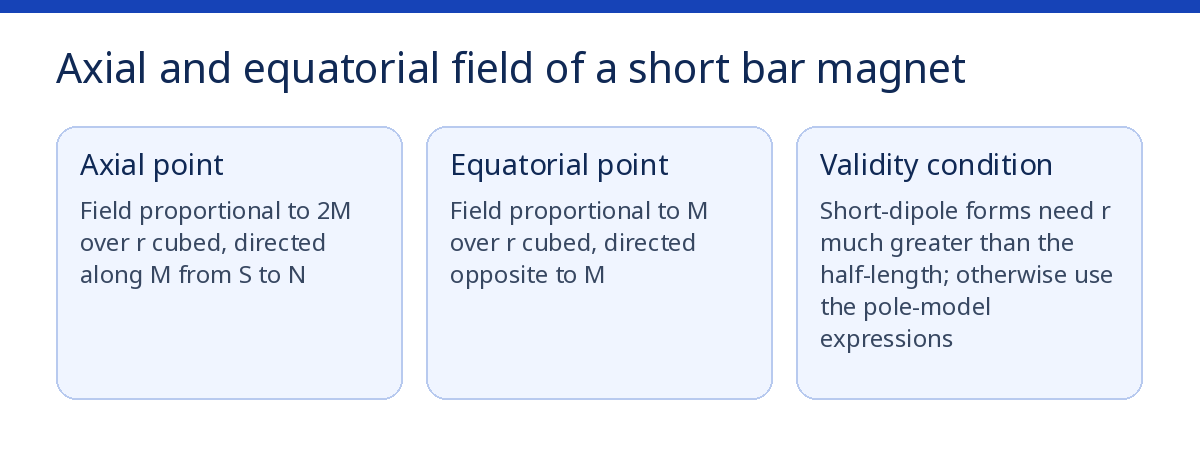
Axial versus equatorial field of a short bar magnet
Section 1 relies on two results for a short bar magnet of moment at distance from its centre:
- Axial point: , directed along (from S to N).
- Equatorial point: , directed opposite to .
At equal distances, . Both fields fall as , so a ratio question usually reduces to cubing a distance ratio. The solutions use T m A.
The short-dipole form holds only when is much larger than the half-length . When it is not, the worked solutions use the pole-model expression on the equatorial line. On the axis, the field varies as .
A strong answer first compares with , states which expression it uses, and gives the field's direction as well as its magnitude.

Magnetism and Matter | Class 12 | CBSE Assessment
In the StudentCurio app
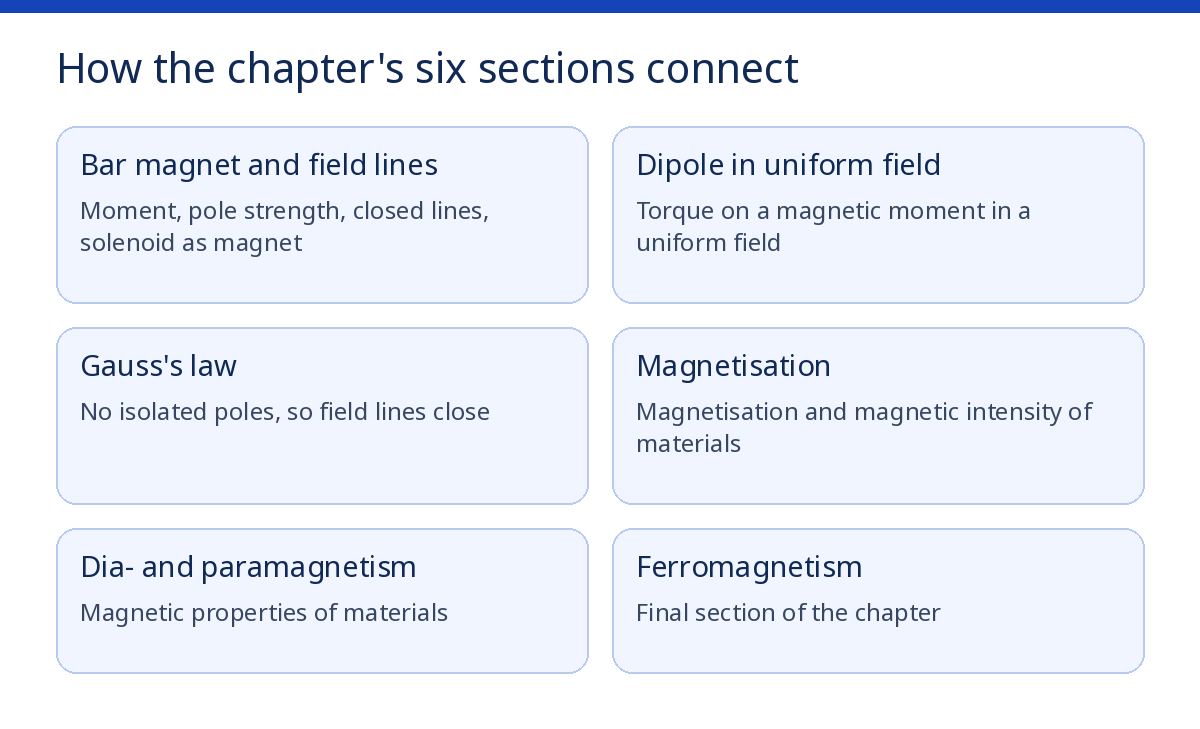
115 Class 12 Physics questions on magnetism and matter, arranged by NCERT topic and matched to the 2025-26 CBSE syllabus, with step-by-step worked solutions. Six topic sections (the bar magnet and magnetic field lines; magnetic dipole in a uniform field; magnetism and Gauss's law; magnetisation and magnetic intensity; diamagnetism and paramagnetism; ferromagnetism), each with MCQs, assertion-reason, 2-, 3-, 4- and 5-mark questions and case-based questions.
What cutting a magnet does to pole strength and moment
The source builds this topic on two relations: and, for a uniformly magnetised bar, , where is the magnetisation and the cross-sectional area.
Pole strength therefore depends on the material, its state of magnetisation and its cross-section. For fixed and , it does not depend on length. The two kinds of cut follow directly:
- Transverse cut: only the length changes. Pole strength is unchanged, and each piece's moment scales with its length.
- Lengthwise cut: the length is unchanged, but the area is shared between the pieces. Pole strength falls in proportion.
In every case each piece is a complete dipole; isolated poles are never obtained. When cut pieces are rearranged, their moments add as vectors, so pieces pointing in opposite directions cancel.
One question asks about a hole drilled through a magnet's centre. Reason from what actually depends on: pole strength and magnetic length.
Assertion-reason items here test the same ideas. Judge separately whether each statement is true and whether the Reason actually explains the Assertion.
Why magnetic field lines close on themselves
A magnetic field line is an imaginary curve whose tangent at any point gives the direction of there. The source lists three properties:
- Field lines form closed loops, running N to S outside a magnet and S to N inside it.
- Their crowding indicates field strength, so they are denser near the poles.
- They have no isolated starting or ending points.
Two lines cannot intersect where the field is non-zero: a crossing would give two tangents, meaning two field directions at one point.
The lines close because there are no isolated magnetic poles, so has no sources or sinks (). Section 3, Magnetism and Gauss's Law, develops this idea.
Contrast an electric dipole: its electrostatic field lines begin on the positive charge and end on the negative charge, so they do not form closed loops. The source also covers the pole-model Coulomb law, , treating it as a model only, since isolated poles are not observed.
Current loops and solenoids as magnetic dipoles
Several questions treat coils as bar magnets. A coil of turns, each of area , carrying current has moment , along the axis with direction given by the right-hand rule.
For a solenoid, a face around which the current flows anticlockwise, as seen by the viewer, behaves as a north pole. Inside, the field runs from S to N. Far away, its field closely matches that of a bar magnet, so at distant points it can be treated as a short dipole. Well inside, away from the ends, , where is the number of turns per unit length. For a circular coil, the field at the centre is .
In "same wire, new shape" problems, start by writing the fixed-length condition. If and are unchanged, the moments are in the ratio of the areas per turn.
The unit question links two topics. From the unit of is J T; using , that unit can be rewritten as A m.
The orbiting electron as a tiny magnetic dipole
A 5-mark question extends the current-loop idea to the atom. An electron of charge in a circular orbit acts as a current loop, so it is a magnetic dipole.
The result to derive is , where is the orbital angular momentum. The negative sign comes from the electron's negative charge: the moment points opposite to .
The question then asks for when . This connects the chapter's dipole language to atomic magnetism, the basis of the later sections on magnetic properties of materials.
Common slips with dipole directions and vectors
- Equatorial direction: the equatorial field is opposite to , not along it.
- Direction of : it points from the south pole to the north pole inside the magnet.
- Short-dipole condition: do not use the formulas when is not much greater than .
- Adding moments: two moments at an angle combine by the vector law, , not by simple addition.
How the six NCERT-topic sections are organised
The assessment has 115 numbered questions arranged by NCERT topic and matched to the 2025-26 CBSE syllabus:
- The Bar Magnet and Magnetic Field Lines (27 questions)
- Magnetic Dipole in a Uniform Magnetic Field (21)
- Magnetism and Gauss's Law (10)
- Magnetisation and Magnetic Intensity (15)
- Diamagnetism and Paramagnetism (22)
- Ferromagnetism (20)
Every section runs from 1-mark MCQs (including assertion-reason items) through 2-mark and 3-mark answers to 4-mark case-based questions, where you attempt any four of five subparts, and 5-mark long answers. Step-by-step worked solutions close each section.
Work through the sections in order, because Sections 1 and 2 supply the dipole tools the later ones use. Attempt a full section before opening its solutions, then check your choice of formula and the directions you stated.
Quick self-check: can you explain why breaking a magnet never isolates a pole? Can you say when the short-dipole formulas may be used?
Frequently asked questions
Is this assessment meant for JEE preparation?
No. It is a CBSE Class 12 Physics assessment arranged by NCERT topic and matched to the 2025-26 CBSE syllabus. It uses board formats from 1-mark MCQs to 5-mark long answers.
Do the worked solutions show the method or only the final answers?
The source describes them as step-by-step worked solutions. They state which formula applies and why, then show the calculation and the direction of the result.
Spotted an error? Report a correction. Practise this in the app: notes, formula sheets and mind maps.













































































































































































Loading comments…