Magnetism and Matter: CBSE Class 12 PYQs and Solutions
CBSEPhysicsMagnetic Properties of Matter
This guide to the CBSE Class 12 Physics chapter Magnetism and Matter explains the ideas behind 46 board questions from 2021 and 2023–2026. It covers the electron's orbital magnetic moment, energy, work and torque on a bar magnet, field lines, and classifying materials by susceptibility, permeability and temperature.
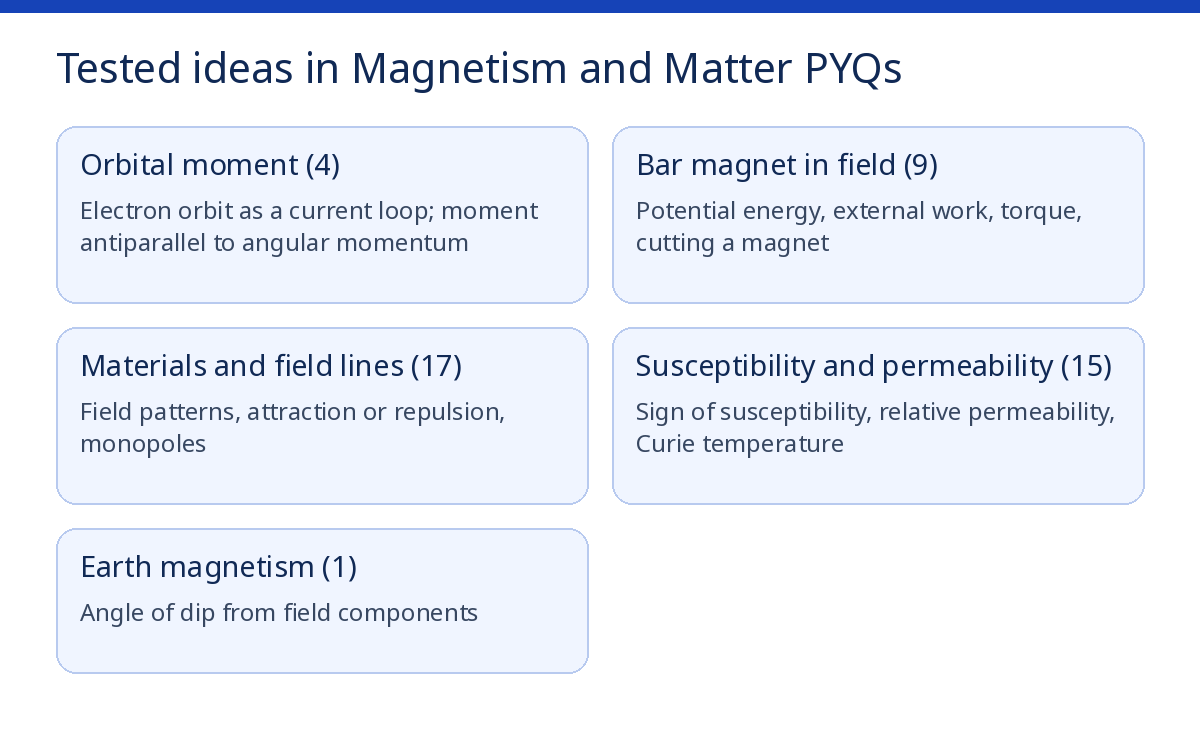
Where the 46 board questions fall in Magnetism and Matter
The collection is labelled Chapter 5, Magnetic Properties of Matter. It maps to the NCERT chapter Magnetism and Matter.
It prints 46 questions from 2021 and 2023–2026. Each question keeps its original number and set label, including Delhi, Outside Delhi, Compartment and Term 1 papers.
The topic index shows where the weight lies:
- Magnetic materials and field patterns: 17 questions
- Susceptibility, permeability and temperature: 15 questions
- Bar magnets, torque and potential energy: 9 questions
- Orbital magnetic moment and angular momentum: 4 questions
- Earth magnetism: 1 question
Questions on how materials respond to a field (32 of 46) outnumber the derivations and numericals. Those derivations and numericals appear mainly as subjective items.

Magnetic Properties of Matter | Class 12 | Previous Year Paper
In the StudentCurio app
A comprehensive collection of solved previous year questions (PYQs) from CBSE board exams, covering magnetic dipoles, Earth's magnetism, and the classification of magnetic materials for Class 12 Physics students.
Deriving the orbital moment from a revolving electron
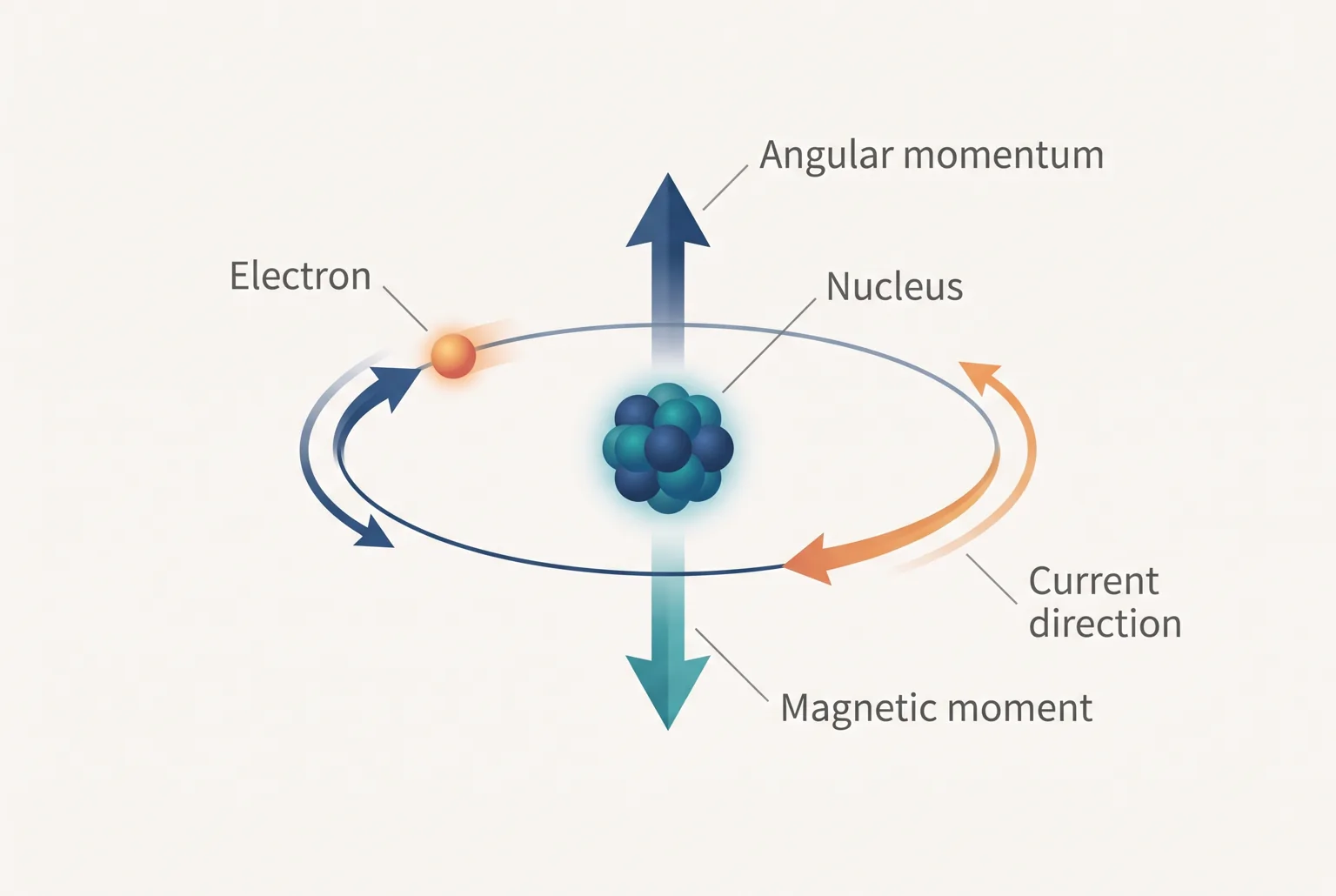
Several subjective questions treat an electron orbiting a nucleus as a tiny current loop. One 2025 stem asks for the dipole moment of an electron moving anticlockwise. It then asks how that moment relates to angular momentum.
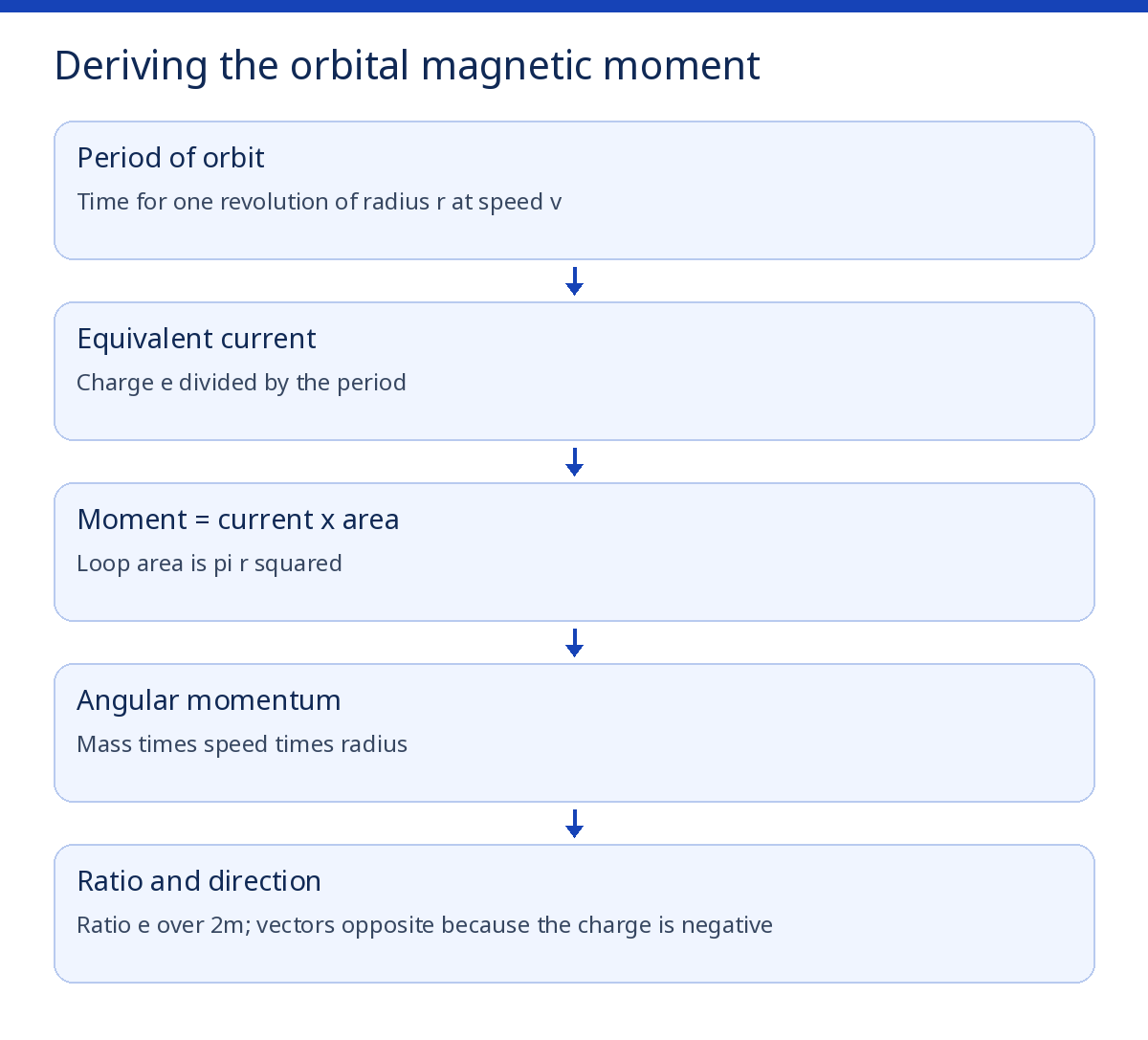
The worked solutions follow one chain:
- The period is , so the equivalent current is .
- The loop area is , which gives . This can also be written as with .
- The orbital angular momentum is .
- Dividing gives , which is independent of radius and speed. That is why a 2026 compartment question asks you to prove that is constant.
The direction step decides marks. The electron's charge is , so conventional current flows opposite to its motion. The moment follows the conventional current, while follows the electron. The two vectors are therefore antiparallel: .
Sign slips the orbital-moment solutions correct
- Give a vector when a vector is asked for. If the question says "in vector form", write the minus sign and state that and are opposite.
- Separate the gyromagnetic ratio's magnitude from its sign. The solutions define it as magnetic moment per unit angular momentum, with magnitude . In the signed relation , the coefficient is . Say which one you are quoting.
- Label the directions. For an anticlockwise electron, the solution's sketch shows out of the page and into the page.
Bar magnet in a uniform field: energy, work and torque
The numericals rest on three relations. In each, is the angle between the moment and the field.
- Potential energy:
- External work in a slow turn: . For a magnet starting aligned with the field (), this becomes .
- Torque magnitude:
Energy is lowest when the moment is parallel to the field. This is the stable orientation.
Torque is zero both parallel and antiparallel to the field, even though the energies in those two positions differ. Turning the magnet to the normal position also costs less work than turning it fully opposite to the field.
The MCQs test the same ideas with fewer numbers:
- the force and torque on a magnet parallel to a uniform field
- the rotation that halves an initial torque
- pole strength and moment after cutting a magnet
- the axial field of a short dipole
Classifying materials by susceptibility, permeability and response
The largest group of questions describes one classification through different clues:
- the sign and size of susceptibility , for example , or with small
- relative permeability compared with 1, such as or a value between 0 and 1
- permeability less than that of free space
- being pushed out of a uniform field, or repelled by both poles of a magnet
- whether field lines crowd into a bar or are pushed out of it
- temperature effects, including heating a ferromagnet past its Curie temperature
The same materials recur across papers: aluminium, copper, sodium, calcium, nickel, iron, bismuth, lead, water, gadolinium, sodium chloride, copper chloride and alnico.
Build one NCERT-based table with three columns: diamagnetic, paramagnetic and ferromagnetic. For each column, record the sign of , the range of , the field-line picture and the temperature behaviour. Then place every recurring material in its column.
One item also converts a given relative permeability into susceptibility, so learn the NCERT relation between the two.
Field lines, monopoles and inseparable poles
A 2023 subjective question asks two things:
- whether field lines represent lines of force on a moving charge
- how Gauss's law for magnetism would change if monopoles existed
The 2021 items test whether field lines form closed loops, what the tangent at a point shows, and whether two lines can intersect.
The absence of monopoles links several questions, including why a magnet's poles cannot be separated.
Another question asks you to sketch how a paramagnetic bar and a diamagnetic bar modify a uniform field, and how temperature affects each. Practise both drawings until the difference in line density is clear.
Reading assertion-reason items in this chapter
The assertion-reason statements test several ideas:
- whether all atoms carry a net moment
- whether a ferromagnet loses magnetisation abruptly
- whether field lines concentrate inside a copper bar
- why poles cannot be separated
Judge each statement separately. First check the assertion, then the reason, and only then decide whether the reason explains the assertion.
The option codes differ between papers. One version's option (D) reads "Assertion is false, but Reason is true", while others use "both false". Read all four codes every time.
A practice order for this collection
- Start with the four orbital-moment questions. Write each derivation in full with a labelled orbit diagram before checking the solution's direction step.
- Work through the bar-magnet numericals. Lay out , , and separately, with units in J and N m.
- Build your material table, then attempt the 32 materials and susceptibility questions together. Note any material you misplace.
- Finish with the field-line items and the single Earth-magnetism question on the angle of dip.
Quick self-check: Can you explain why does not depend on orbit radius? Can you explain why a magnet antiparallel to a field feels no torque yet is not in its lowest-energy state?
Frequently asked questions
Which NCERT chapter does this PYQ collection match?
It is titled Magnetic Properties of Matter (Chapter 5) and maps to the NCERT Class 12 Physics chapter Magnetism and Matter.
Which exam years are included?
The collection lists 46 questions from 2021 and 2023–2026 CBSE papers, including compartment and Term 1 sets.
What question formats appear?
There are subjective questions (derivations, numericals and reasoning) and single-correct MCQs, several of which are assertion-reason items.
Spotted an error? Report a correction. Practise this in the app: notes, formula sheets and mind maps.













































































































































































Loading comments…