Moving Charges and Magnetism: CBSE Class 12 PYQs and Solutions
CBSEPhysicsMagnetic Effects of Current
This guide covers a chapter-wise collection of solved CBSE Class 12 board questions on Moving Charges and Magnetism (NCERT Chapter 4). It explains how the questions test the fields of currents, the motion of charges in magnetic fields, forces between currents, torque on current loops and galvanometer conversion.
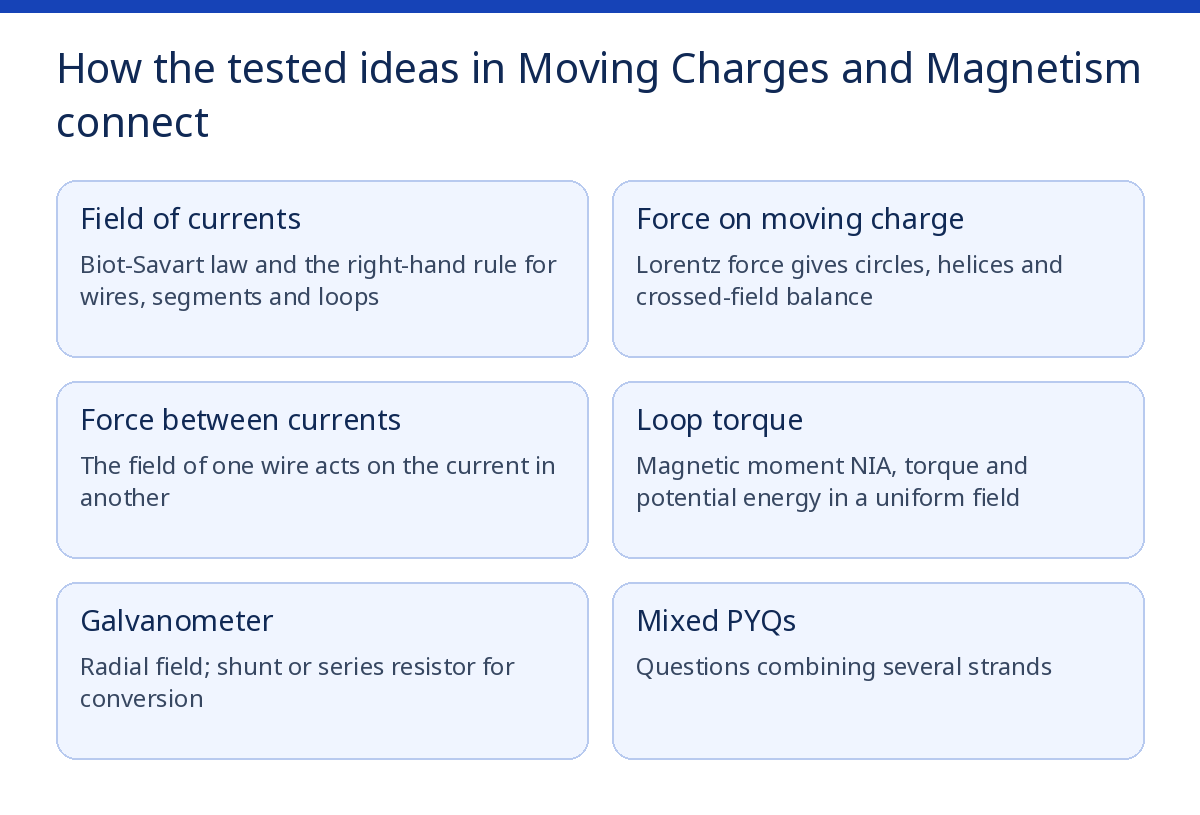
Six tested strands of Moving Charges and Magnetism
The collection prints 151 previous year questions with exam-year coverage of 2021 and 2023–2026. The labels include Delhi, Outside Delhi and Compartment sets. A topic index sorts every question into one of six strands:
- Magnetic field of currents: 41 questions
- Magnetic force and charged-particle motion: 42 questions
- Force between currents: 13 questions
- Current loops, torque and magnetic moment: 19 questions
- Moving-coil galvanometer and its conversion: 17 questions
- Mixed magnetic-effect PYQs: 19 questions
The first two strands make up more than half of the collection. Questions are split into MCQ (single correct answer) items, which include assertion-reason items, and subjective questions. The solutions are grouped in the same two sections. The questions keep their original serial order and exam labels.

Magnetic Effects of Current | Class 12 | Previous Year Paper
In the StudentCurio app
A 136-page comprehensive collection of solved previous year questions (PYQs) for CBSE Class 12 Physics, covering the full chapter with detailed step-by-step solutions for MCQs, long-form problems, and assertion-reason questions.
Finding field direction from a short current segment
Many field questions ask which way points before they ask how large it is. One typical stem places a 1 cm segment along the x-axis, centred at the origin, and asks for the field at a point on the y-axis.
The Biot–Savart law handles this kind of question:
The direction of the field comes from the cross product of the current element with the displacement to the field point. Because the segment is short compared with the distance, you can treat it as a single element.
Around a long straight wire, the field lines form circles. Their sense follows the right-hand thumb rule.
Other items combine several sources, such as perpendicular wires, wires at the corners of a square, or concentric coils. The method stays the same each time. Find each contribution separately, then add the contributions as vectors.
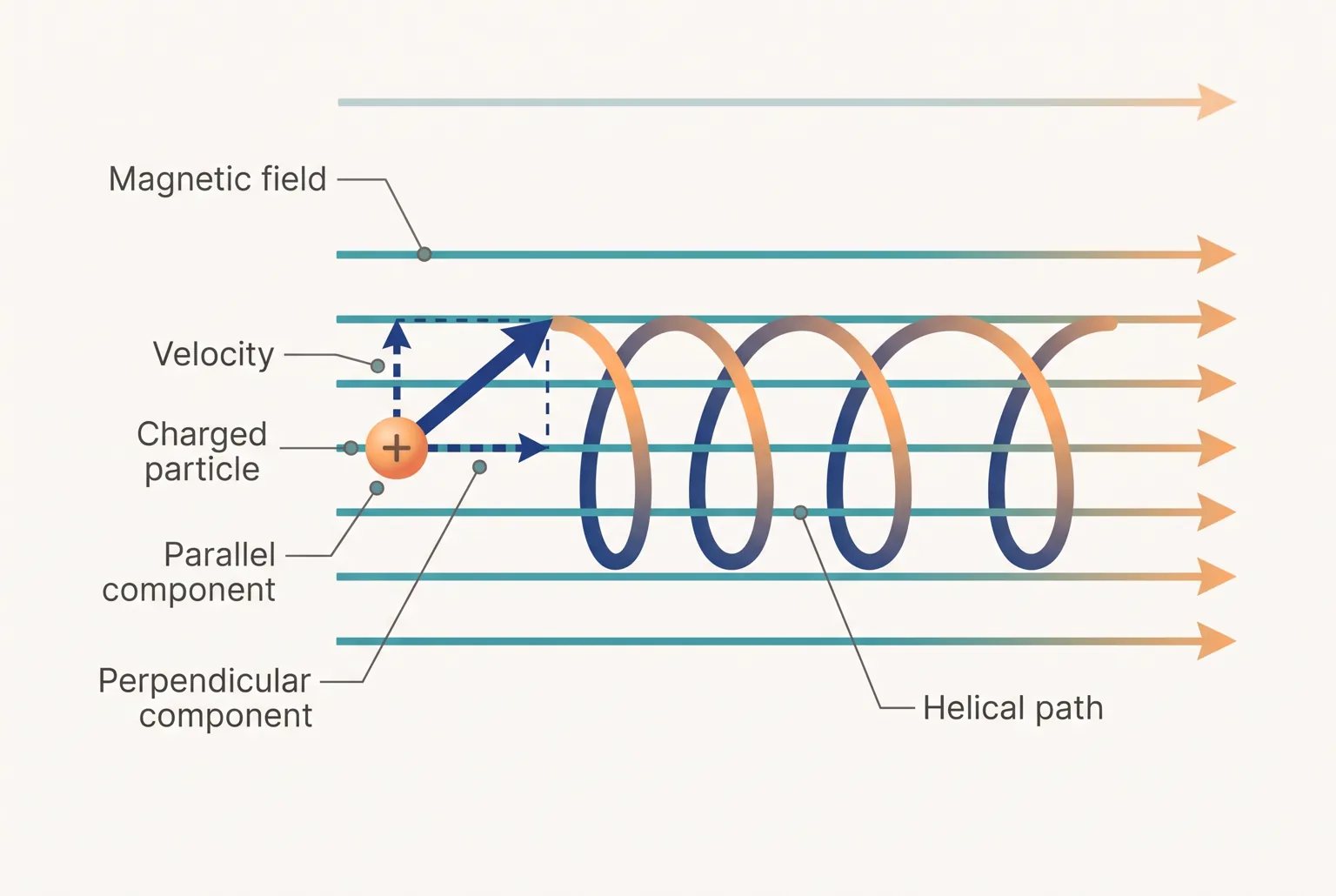
Charged particles in magnetic and crossed fields
The largest strand rests on the Lorentz force, . Because this is a cross product, the force is perpendicular to both and . Some questions test only this, by asking for the axis along which the force acts.
When , the magnetic force supplies the centripetal force:
, which gives
Questions then ask you to compare radii for different particles, to rescale when the mass or charge changes, or to pick the correct graph of against .
If the velocity has a component along , split the velocity into two parts. The perpendicular part produces circular motion. The parallel part is unaffected, so the path becomes a helix whose axis lies along the field.
In crossed fields, a particle passes undeflected when the electric and magnetic forces balance. If the question gives kinetic energy instead of speed, combine this condition with .
Forces on conductors and between parallel currents
A current-carrying segment in a magnetic field experiences the force . MCQs often give in component form, with both and parts acting on a wire along . Use and to evaluate the force component by component, keeping track of each sign.
For two long parallel conductors a distance apart, the force per unit length is . To decide whether the force attracts or repels, find the field of one wire at the position of the other, then apply .
Scaling questions change the currents and the separation. Read the dependence on and on before you compute anything. Beams of moving charges are treated as currents in the same way.
Magnetic moment, torque and work on current loops
A coil of turns, area and current has magnetic moment , directed along the normal to the coil's plane. In a uniform field, the coil feels a torque and has potential energy .
The work done in rotating a loop equals the change in between the initial and final angles of with .
Net force and net torque are separate questions. Check each one independently for a loop in a uniform field.
Converting a moving-coil galvanometer
A moving-coil galvanometer uses a soft iron core to produce a radial magnetic field. Assertion-reason items probe how the core, the radial field and the relation between deflection and current are linked. Revise the NCERT reasoning for each link.
Numerical items use two conversions:
- Ammeter: connect a shunt in parallel. Then .
- Voltmeter: connect a resistance in series. Then .
One stem uses two series resistors that give two ranges and asks for . This means writing two simultaneous equations.
The resistance of the converted ammeter is the parallel combination of and , not alone.
Sign and unit slips in magnetism numericals
- Units: Areas appear in mm², distances in cm and fields in mT or nT. Convert all of them to SI first. For example, 1 mm² equals m².
- Cross-product order: Reversing or flips the sign of every component.
- Charge sign: For a negative charge, the force is opposite to the direction that gives.
- Assertion-reason: Judge each statement's truth separately. Only then decide whether the reason explains the assertion.
Practising the strands in a sensible order
Use the topic index rather than the serial order. Work through the strands in this sequence: field of currents, charged-particle motion, forces between currents, loops and torque, galvanometers, and finally the mixed set.
Attempt each MCQ before opening its linked solution. Then compare your steps with the worked method, not only your chosen option. Leave the subjective questions until the related MCQs feel routine.
Quick self-check: Can you derive from a force balance? Can you explain why the derivation needs ?
Frequently asked questions
Which NCERT chapter does this PYQ collection match?
It matches NCERT Class 12 Physics Chapter 4, Moving Charges and Magnetism. The collection titles it 'Magnetic Effect of Current'.
Which exam years do the questions come from?
The collection lists exam-year coverage of 2021 and 2023–2026. It includes Delhi, Outside Delhi and Compartment sets.
Are assertion-reason questions included?
Yes. They appear within the MCQ section on topics such as the galvanometer core, magnetic flux and charged-particle motion.
Spotted an error? Report a correction. Practise this in the app: notes, formula sheets and mind maps.













































































































































































Loading comments…