Electric Charges and Fields: CBSE Class 12 PYQs and Solutions
CBSEPhysicsElectrostatics
This guide uses a 145-question CBSE Class 12 previous-year collection for Unit I (Electric Charges and Fields, with Electrostatic Potential and Capacitance) to show what the board keeps testing. It explains Coulomb's law graphs, charge sharing, field from potential, system energy, dipoles and Gauss's law, then sets out a practice order.
Five strands the Unit I questions keep testing
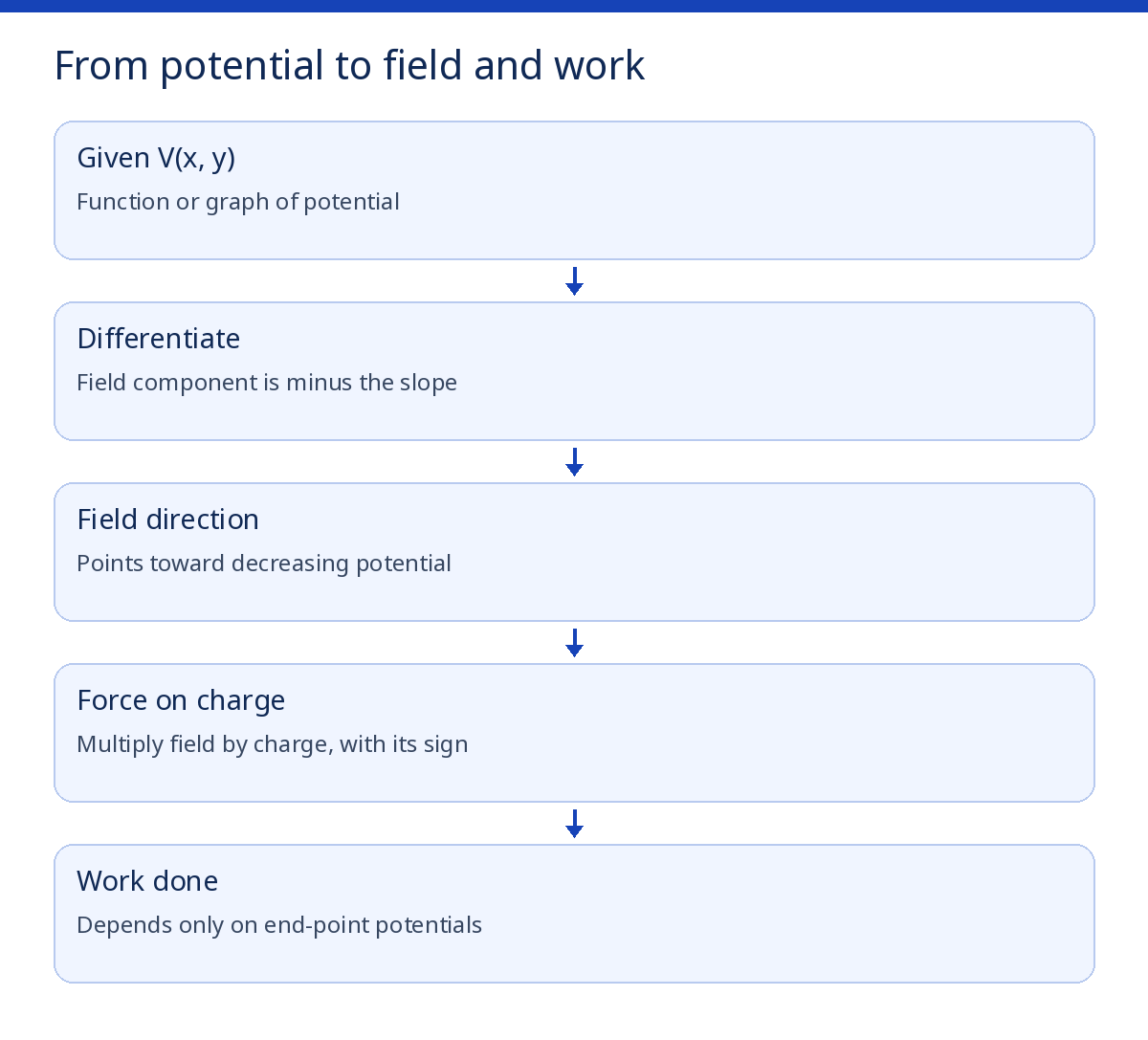
The collection treats Electrostatics as CBSE Unit I. This combines Chapter 1, Electric Charges and Fields, with Chapter 2, Electrostatic Potential and Capacitance. Its topic index sorts all 145 questions into five strands:
- Charge, Coulomb's law and conductors: 27 questions
- Electric field and dipoles: 37 questions
- Electric flux and Gauss's law: 20 questions
- Electric potential and potential energy: 43 questions
- Mixed electrostatics: 18 questions
Potential and field questions together make up more than half the set. Moving fluently between , and energy is therefore the core skill.

Electrostatics | Class 12 | Previous Year Paper
In the StudentCurio app
A comprehensive 110-page collection of 145 solved previous year questions for CBSE Class 12 Physics, covering Electric Charges and Fields, Gauss Law, Potential, and Capacitance.
Coulomb's law graphs and charge sharing between conductors
The collection uses , so Coulomb's law reads .
Several questions plot against . Each pair of charges then gives a straight line through the origin with slope , so comparing slopes compares products of charges. One stem shows two such lines for pairs sharing a common charge and asks you to rank the three magnitudes.
Conductor questions rest on two ideas:
- Charge conservation. Identical metal balls that touch share the algebraic total equally, so opposite charges partly cancel first.
- Common potential. Conductors joined by a wire reach the same potential. For an isolated sphere, , which links each sphere's charge to its radius.
Another item asks how a body's mass changes when it becomes charged. Charging means electrons are gained or lost.
Reading the field from a potential function or graph
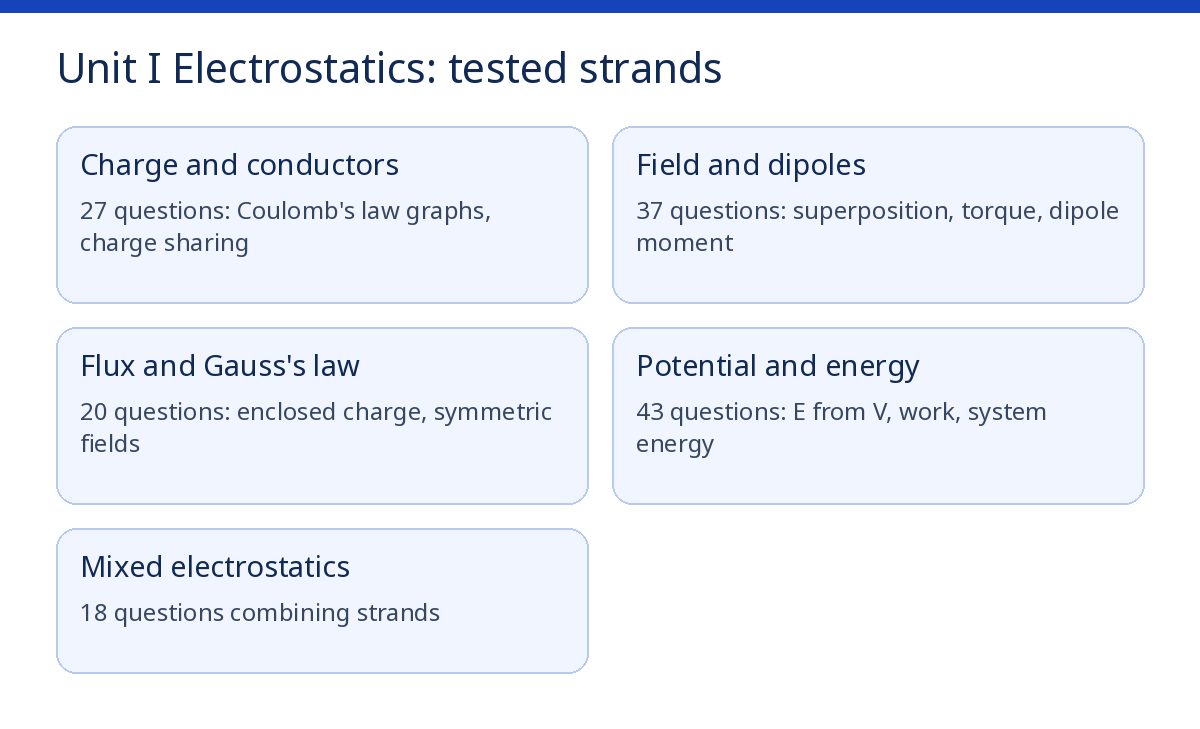
Many questions give the potential and ask for the field. The working relation is . In two dimensions it becomes .
The minus sign means the field points toward decreasing potential. One stem gives a potential falling linearly with and asks for the field's magnitude and direction.
On a – graph, the force on a charge is largest where the graph is steepest, not where is largest.
The reverse direction also appears. Given , find a potential difference from , keeping the order of and consistent. For 2D potentials, find both field components at the point before working out the angle with the -axis.
Potential energy of charge systems and work done
For a system of point charges, , summed over each pair once. Triangle, square and collinear arrangements in the collection test this pair-counting.
Bringing a charge slowly from infinity to a point at potential needs external work . More generally, the work done by an external agent equals the change in potential energy. The field's work is the negative of that change.
The field of static charges is conservative, so work depends only on the end points. Moving a charge between points at equal potential, or along an equipotential surface, needs no work. Equipotential-diagram questions build on this.
Common mistakes these questions expose:
- Dropping the sign of a negative charge inside .
- Counting each pair twice in .
- Swapping and .
- Substituting cm values, or ignoring the and n prefixes.
Dipoles, torque and superposition of fields
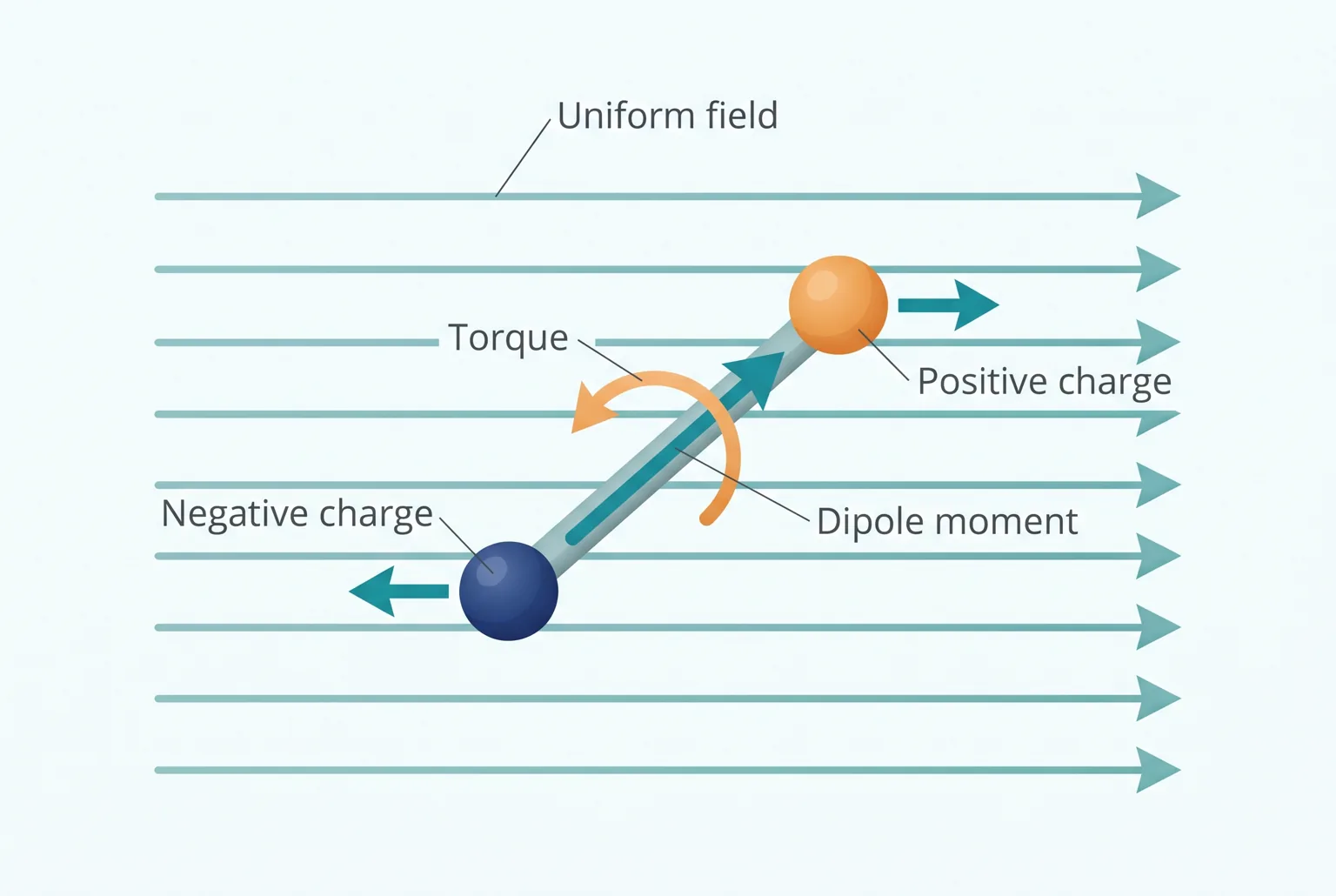
Dipole questions use of magnitude , directed from to . For several dipoles, the net moment is their vector sum.
In a uniform field:
- The torque is , with magnitude .
- The potential energy is .
- An external agent's work in rotating the dipole is , so compute both dot products.
Point-field questions place charges at triangle vertices, on axes or on a ring. Draw each field vector at the point, resolve it into components, and cancel the symmetric components before adding the rest. Some items add a uniform applied field to a Coulomb field, so the net force comes from perpendicular components.
Applying Gauss's law to symmetric charge distributions
Gauss's law gives the flux through a closed surface as . Flux depends only on the enclosed charge, not on the surface's size or shape.
To find a field, match the Gaussian surface to the symmetry:
- a coaxial cylinder for a long charged wire;
- a concentric sphere for a charged shell or sphere.
State how the field varies with distance and give its direction. Field lines point away from positive charge and toward negative charge.
In electrostatics, the field inside a conductor's material is zero and its interior is equipotential. Questions test this through -versus-distance graphs and hollow conductors placed in external fields.
How the MCQ, assertion-reason and subjective items are framed
The edition contains 88 single-answer MCQs, 56 subjective questions (some with passage-based subparts) and one multiple-answer MCQ. The cover lists exam years 2021 and 2023–2026, with Term 1 questions from session 2021–22 dated 2021.
Each question keeps its original header, such as Set 55/1/1, Delhi Set 1 or a Compartment set. These labels were transcribed from the compilation and not independently authenticated. The source questions carry no marks, so the edition omits them.
Within the MCQs, expect:
- Assertion-reason items with the standard codes (A)–(D);
- graph-choice items, such as picking the correct – or acceleration–distance curve;
- figure-reading items built on equipotentials and charge arrangements.
Working through the added solutions and source review notes
The source compilation supplied only an answer key, so every worked solution is marked as an Added solution. Key discrepancies, missing assumptions and ambiguous wording are explained beside the affected solutions. Review notes after the solutions list the source's limitations.
A practical order is to work strand by strand:
- Charge and Coulomb's law.
- Field and dipoles.
- Gauss's law.
- Potential and energy.
- Mixed electrostatics.
Pick question numbers from the topic index. Attempt each one before using its offline View Solution link, then compare your steps, not just your option. Read any discrepancy note before trusting the printed key.
Quick self-check: Why does flux ignore the Gaussian surface's size? Why is force largest where changes fastest? Why does touching conductors conserve the algebraic charge?
Frequently asked questions
Are marks given for each question in this collection?
No. Marks were not printed alongside the source questions, so the edition omits them.
Are the worked solutions official CBSE solutions?
No. The source supplied only an answer key. Every worked solution is labelled an Added solution, and key discrepancies are explained beside the affected questions.
Spotted an error? Report a correction. Practise this in the app: notes, formula sheets and mind maps.













































































































































































Loading comments…