Case-based Assessment for Class 12 Electrostatics
CBSEPhysicsElectrostatics
A comprehensive 15-case study guide for CBSE Class 12 Physics, providing 73 solved questions on electrostatic potential, energy systems, and capacitor dynamics.
Structure and Navigation of the Assessment
This resource is designed as a focused preparation tool for the CBSE Class 12 Physics curriculum, specifically addressing Chapter 2: Electrostatic Potential and Capacitance. It contains 15 distinct case studies and a total of 73 questions. The material is organized to facilitate active recall, presenting all 73 questions first, followed by a dedicated solutions section. To assist learners in navigating this volume, the document includes a clickable index and two-way links that connect specific questions directly to their corresponding explanations.
The assessment covers a broad range of question formats, including multiple-choice questions (MCQs), numerical short-answer problems, and tasks requiring the interpretation of graphs and diagrams. The diagrams provided, such as redrawn circuits and potential-distance graphs, are intended to clarify the spatial relationships between charges and fields. A unique feature of this edition is the inclusion of a correction record at the end, which explains updates made to specific solutions, ensuring the learner is working with verified technical data.

Electrostatics | Class 12 Physics| CBSE Case-based Assessment
In the StudentCurio app
A comprehensive collection of 15 case-based studies and 73 solved questions focusing on electrostatic potential and capacitor dynamics for CBSE Class 12 Physics preparation.
Analyzing Potential for Point Charge Systems
A significant portion of the material, specifically Case Studies 1 and 8, focuses on the potential of point charges. The resource defines electrostatic potential at an observation point as the work done by an external agent in slowly moving a unit positive charge from infinity to . Learners are challenged to interpret potential variation graphs ( vs. ) to determine the signs of charges and identify locations where the electric field is zero.
These sections emphasize that the electric field relates to the gradient of the potential. By examining the slope of the curve, students can distinguish between positive and negative charges and determine their relative magnitudes. The material also explores the work done by the electric field when moving charges within dipole configurations, specifically looking at displacements along the axes (, , or ) relative to the charge positions and .
The Physics of Work and Potential Energy
Case Studies 2, 6, and 10 investigate the energetic properties of charge systems. The source material defines potential energy as the energy possessed by a system of charges due to their positions, establishing a zero-energy reference at infinite separation. It provides the fundamental formula for mutual potential energy in air: .
Learners must distinguish between the work done by the electric field () and the work done by an external agent () during slow transport. The questions require calculations for separating electrons, moving charges within square configurations, and calculating the work needed to move charges between specific coordinates. The resource highlights that electrostatic force is conservative, meaning work depends only on the initial and final positions, not the path taken.
Motion in Uniform Electric Fields
In Case Studies 4 and 7, the resource applies electrostatics to particle physics, specifically the movement of a proton in a uniform electric field . It introduces the relationship for potential differences between points separated by a distance measured parallel to the field. Using the proton's mass and charge , the assessment asks learners to calculate changes in kinetic and potential energy.
These cases bridge the gap between abstract field theory and physical systems, such as the potential energy between protons in a nucleus or the external work required to separate charges from a fixed distance to infinity. The material emphasizes how the total mechanical energy of a charge is affected as it moves in the direction of the electric field versus opposite to it.
Equipotential Surfaces and Geometry
Case Study 9 is dedicated to equipotential surfaces, which are defined as surfaces where every point has the same potential. The material explains that for an isolated point charge, these surfaces are concentric spherical shells. A critical rule established here is that electric field lines are always perpendicular to equipotential surfaces at every point.
Questions in this section test the learner's understanding of the zero-work principle: the electrostatic work done in moving a test charge along an equipotential surface is always zero. This applies to various geometries, including charges moved in circular paths around a central charge or movement across the surfaces of dipoles. The resource helps students identify that while potential values may be chosen at fixed intervals, their spatial spacing is often nonuniform depending on the field strength.
Conductors and Spherical Capacitance
Case Studies 5 and 11 transition into the concept of capacitance, beginning with isolated spherical conductors. The capacitance of a sphere of radius in a vacuum is given as , demonstrating that capacitance is directly proportional to the radius. The material notes that a capacitor would require a radius approximately 1500 times larger than the Earth's radius.
Practical problems in these sections involve calculating the charge needed to raise a conductor's potential to a specific level (e.g., ) and determining the dimensional formula for capacitance (). One advanced scenario explores merging 64 identical small spheres into a single large sphere, requiring the learner to apply laws of volume and charge conservation to find the new capacitance and charge.
Dielectric Materials and Parallel-Plate Capacitors
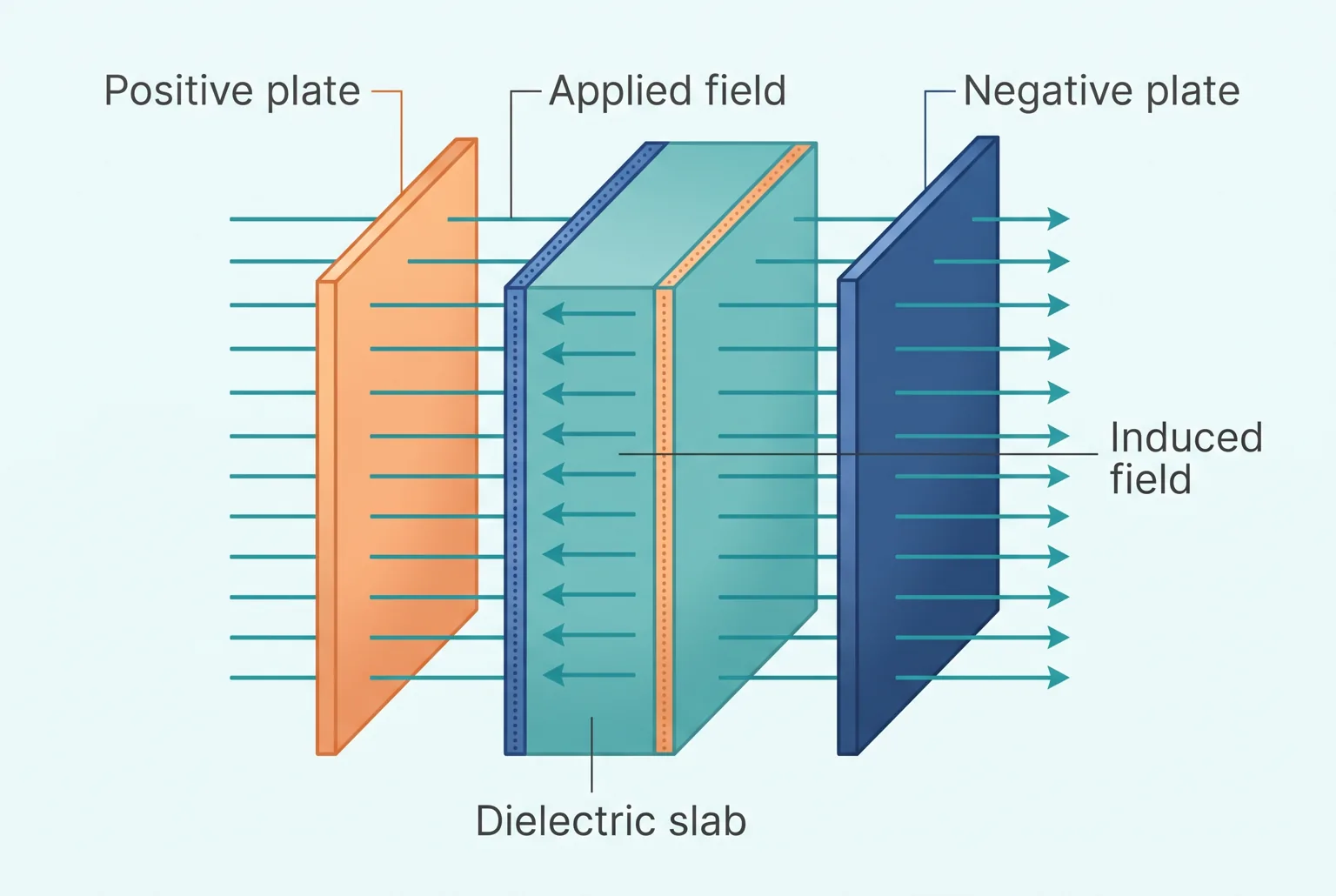
The final focus of the assessment, found in Case Studies 3, 12, 13, and 15, covers the parallel-plate capacitor and the effects of dielectrics. It explains that when a dielectric slab is inserted between plates, an induced field is set up opposite to the applied field , resulting in a net field .
The material demonstrates that filling the gap with a dielectric of constant increases the capacitance (). Learners must solve problems where plate separation is altered while dielectrics like wax are inserted. Additionally, the resource covers the behavior of uncharged metallic (copper) slabs placed between plates, providing the formula for the modified capacitance: , where is the thickness of the slab. This section concludes with the mechanisms of dielectric polarization and the energy stored in the electric field of the capacitor.
Spotted an error? Report a correction. Practise this in the app: notes, formula sheets and mind maps.













































































































































































Loading comments…