Electrostatic Potential and Capacitance: Class 12 Notes
CBSEPhysicsElectrostatic Potential and Capacitance
These NCERT revision notes for CBSE Class 12 Physics connect electric potential, field and energy before moving to dielectrics and capacitors. Use the clickable chapter index to pair a concept or derivation with a worked example that tests when the rule applies.
Start with the reference point and the sign of work
Electric potential is external work per unit positive test charge when the charge is moved slowly from a chosen reference point. For an isolated, finite charge distribution, the notes normally take infinity as the zero of potential. A potential difference, however, depends on the endpoints, not on the path between them or on where you set zero.
For motion from A to B, write before substituting numbers. The change in potential energy is , using the signed charge. Work done by the electric field is ; external work is for a slow transfer with no change in kinetic energy. Keep the units distinct: a volt is a joule per coulomb, while an electron-volt is a unit of energy.

Electrostatic Potential and Capacitance | Class 12 | NCERT Notes
In the StudentCurio app
These Class 12 revision notes cover electric potential, potential energy, dipoles, conductors and dielectrics, capacitance, capacitor combinations, and stored energy, with worked examples. They help CBSE students review key concepts and practise electrostatics problems.
Choose the potential expression that fits the charge geometry
For a point charge, with zero at infinity, applies at distance . Potential falls as the inverse distance, whereas the field magnitude falls as the inverse square. With several sources, add their signed potentials as scalars. The distance in each term runs from that particular source to the observation point; there are no vector components to resolve.
The shell and dipole sections show why geometry matters. A uniformly charged thin spherical shell has the same exterior potential as a point charge at its centre, but its interior potential is constant at the surface value. For a dipole, the potential depends on direction as well as distance. The approximation requires , where is the half-separation and is measured from the dipole moment.
Quick self-check: zero potential or zero field?
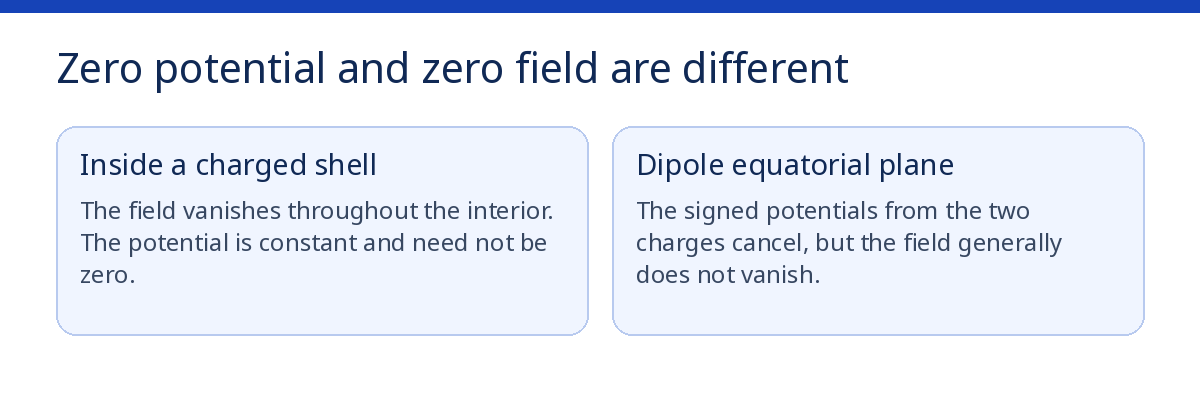
The notes give two useful cases to compare. Inside a uniformly charged shell, the field is zero but the potential need not be zero. On a dipole’s equatorial plane, the two scalar potential contributions cancel exactly when zero is taken at infinity, but the field generally does not vanish. Ask yourself which case depends on potential being constant throughout a region and which depends on cancellation at points on a plane.
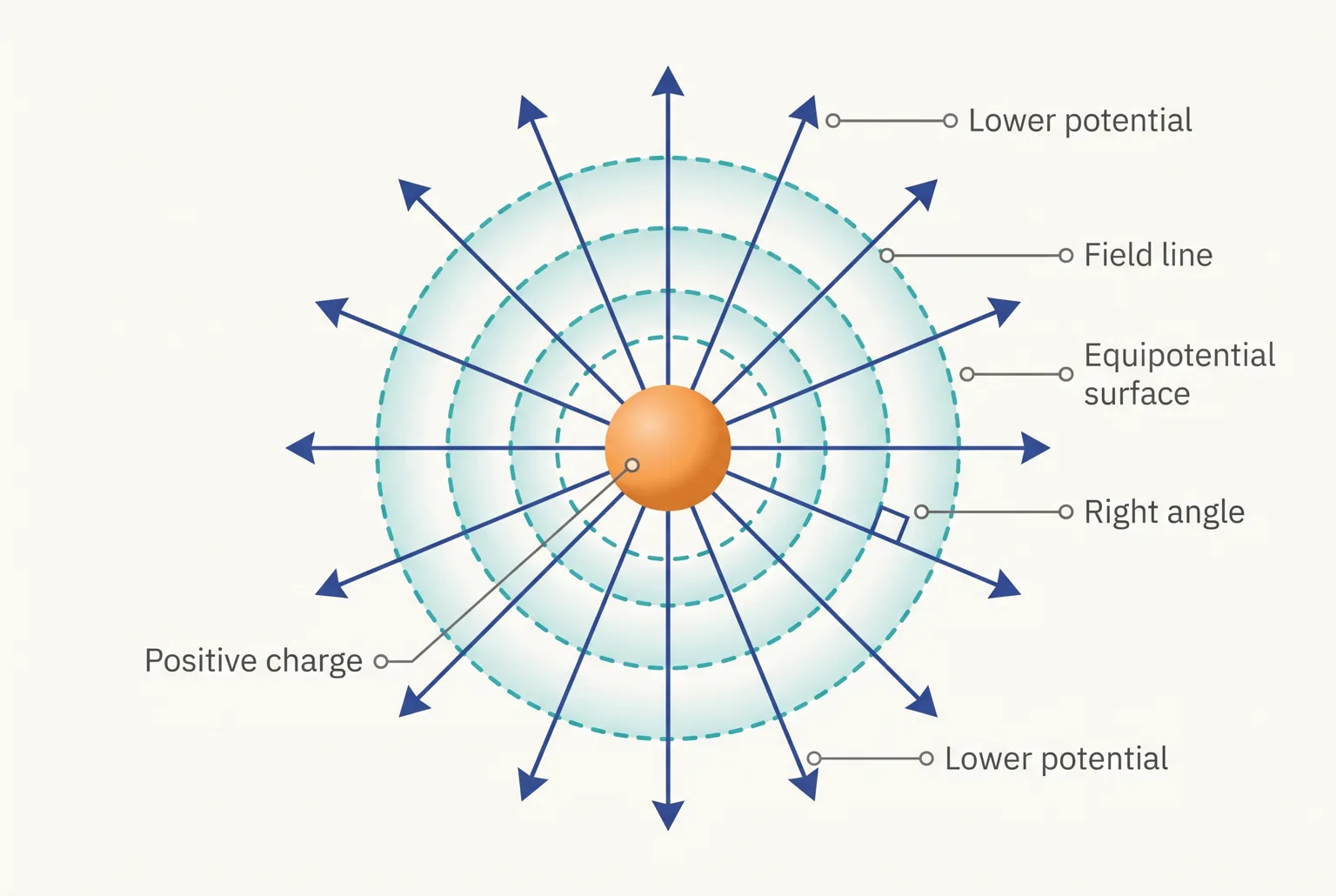
Where the field is nonzero, it is perpendicular to an equipotential surface and points toward lower potential. Moving along that surface involves no work by the field. In a uniform field, only the displacement component along the field changes the potential. When comparing a diagram’s surface spacing, remember that closer spacing indicates a stronger field only if successive surfaces represent equal potential steps.
Distinguish assembly energy from energy in an external field
For a system of charges assembled from infinite mutual separation, count the interaction energy of each distinct pair once. Like-charge pairs contribute positive energy and unlike-charge pairs contribute negative energy with that reference. If the charges also sit in an external potential, add for each charge. These external terms do not get a factor of one half: the sources of that potential are not members of the system being assembled.
For a dipole in a uniform field, the forces on the two charges cancel, but they can still turn the dipole. With perpendicular alignment chosen as zero, . The notes’ energy curve explains why parallel and antiparallel alignment both have zero torque yet differ in stability: one is an energy minimum and the other a maximum.
Connect dielectric polarization to capacitance
The second index groups conductors and shielding with dielectric polarization, then moves to parallel plates, dielectric filling and stored energy. This sequence helps separate two ideas: free charge redistributes in a conductor at electrostatic equilibrium, whereas a dielectric polarizes in an electric field. Capacitance relates the magnitude of charge on either plate to the potential difference across the plates; it is not the amount of charge stored.
Use the index to distinguish examples involving a dielectric that fills the gap from those involving slabs, air gaps or mixed dielectric regions. A completely filled gap and a partially filled gap are not interchangeable. Before selecting a relation, identify which material occupies each region and how those regions are arranged between the plates.
Before calculating, check what stays fixed
For capacitor combinations, identify the connections before combining capacitances. Capacitors in parallel share a potential difference because they connect across the same two nodes. In a simple series chain with initially neutral, isolated junctions, the capacitors carry equal charge magnitudes. Use these conditions to check your interpretation of the network before reading the worked steps.
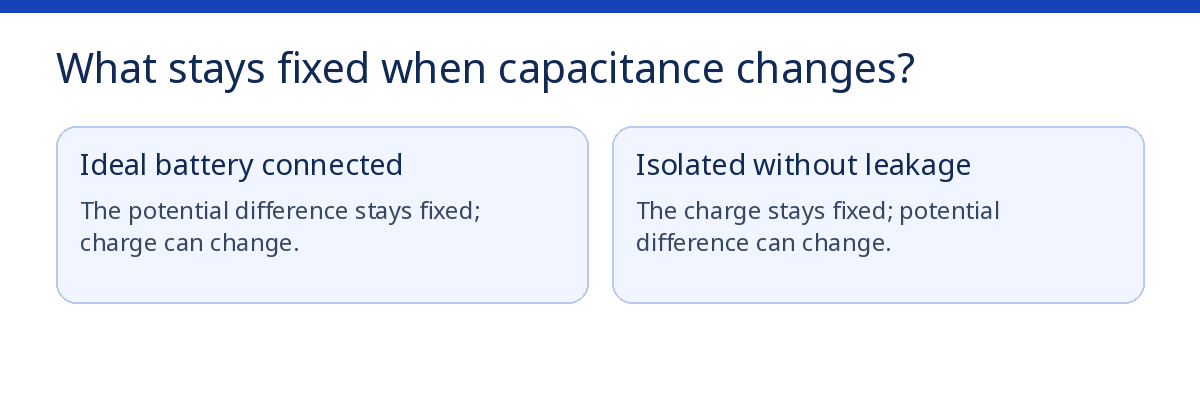
For a change such as inserting a dielectric or moving the plates, first check whether the capacitor remains connected to a battery. An ideal battery maintains the potential difference, while an isolated capacitor retains its charge if there is no leakage. That distinction determines what can change and which form of the stored-energy expression is most useful.
Use the clickable index to revisit a specific step
The two index pages list topics alongside worked examples, with page numbers keyed to the original notes. If a sign is unclear, go back from a work example to the potential-difference definition. For a capacitor problem, choose between the entries on combinations, battery connection and charge sharing according to the setup. The supplied excerpt ends during the dipole-approach example, so that example is omitted here; the capacitor topics are identified from the chapter index.
Spotted an error? Report a correction. Practise this in the app: notes, formula sheets and mind maps.













































































































































































Loading comments…