Electromagnetic Waves: Class 12 NCERT Physics Guide
CBSEPhysicsElectromagnetic Waves
This CBSE Class 12 NCERT Physics chapter uses a charging capacitor to explain why a changing electric flux matters, then connects that idea to electromagnetic waves. Use its diagrams and exercises to distinguish field directions, vacuum wave relations and the regions of the electromagnetic spectrum.
Why a charging capacitor changes Ampère’s law
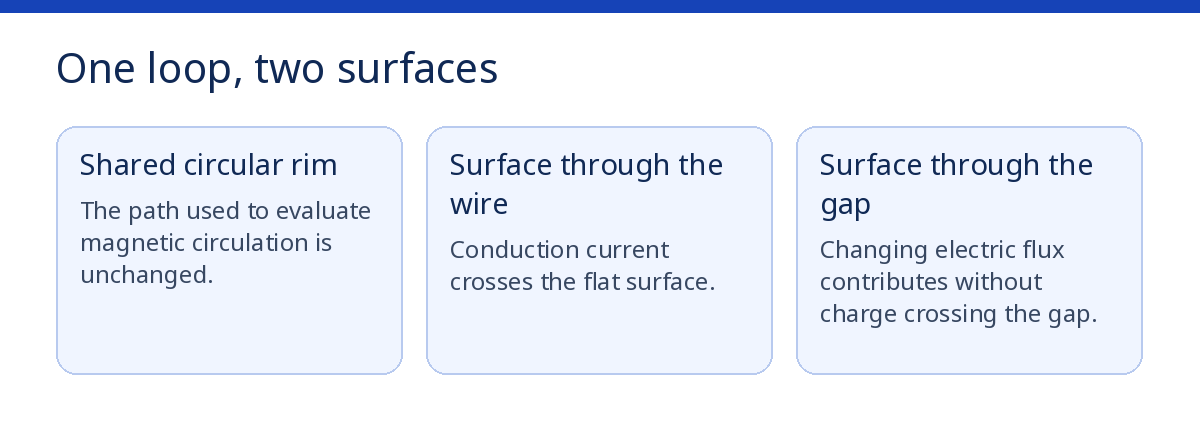
Figure 8.1 starts with one circular loop near the wire of a charging capacitor. A flat surface bounded by that loop cuts through the wire, so conduction current crosses it. A pot-shaped surface with the same rim extends between the plates and avoids the wire, so no conduction current crosses it. The original form of Ampère’s law would give different values for the magnetic circulation around the very same loop. Changing the surface used in a calculation cannot change the field along its boundary.
Maxwell’s correction accounts for what the second surface does intercept: electric flux that changes as charge builds up on the plates. The displacement current through a fixed surface is . The Ampère–Maxwell law uses the sum of conduction and displacement current through the chosen surface, giving the same circulation for either choice.

Electromagnetic Waves | Class 12 | NCERT Textbook
In the StudentCurio app
This textbook chapter covers displacement current, the characteristics and transverse nature of electromagnetic waves, and the spectrum from radio waves to gamma rays, including applications. It helps Class 12 Physics students understand the chapter’s core concepts and review them through textbook exercises.
Common mistake: treating displacement current as charge flow
In the textbook’s idealised parallel-plate model, charges move through the wire but do not cross the gap. The displacement current through the gap equals the conduction current in the wire because the electric flux between the plates changes as charge accumulates. The two contributions have the same value in this comparison, but they do not describe the same process. In particular, a nonzero electric flux is not enough: if the flux through the chosen surface is steady, its displacement-current contribution is zero.
This distinction connects the chapter to Faraday’s law. Changing magnetic flux induces an electric field, while a changing electric flux contributes to magnetic circulation through the Ampère–Maxwell law. Read the two laws together in the chapter’s Maxwell’s equations box. The comparison explains how time-varying electric and magnetic fields can be coupled even in a region with no conduction current.
From an accelerating charge to a transverse wave
The chapter uses an oscillating charge to explain radiation qualitatively. A stationary charge has an electric field, and a steady current produces a magnetic field, but neither is a source of electromagnetic radiation in the cases described here. An oscillating charge accelerates and radiates at its oscillation frequency. The wave carries energy away from the source, and it can propagate through a vacuum without matter to vibrate. Hertz’s experimental demonstration tested Maxwell’s prediction that electromagnetic waves exist.
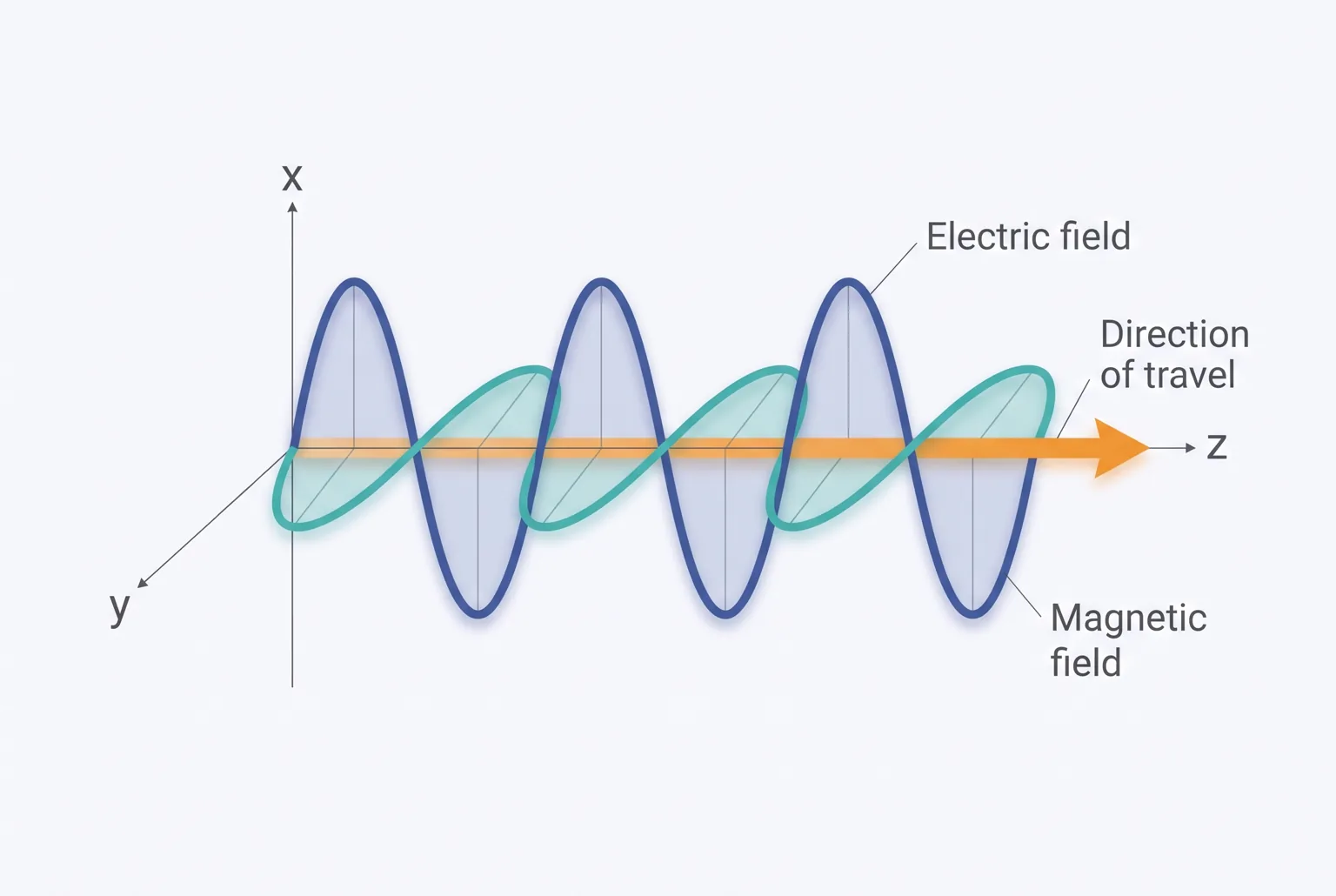
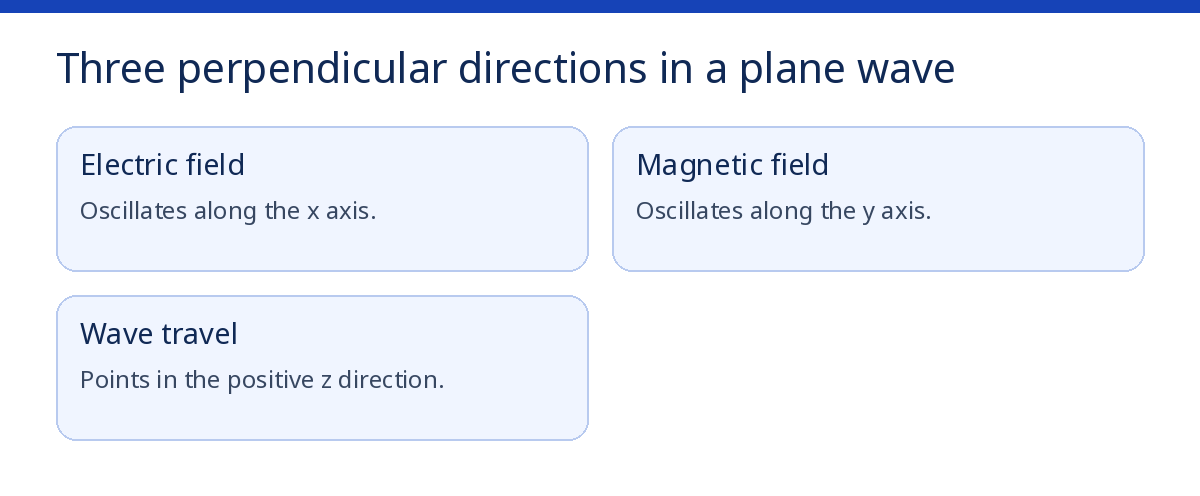
In Figure 8.3, the wave propagates along the positive direction, while the electric field oscillates along the axis and the magnetic field along the axis. Transverse means that both fields are perpendicular to the direction of travel; they are also perpendicular to each other. The figure is a snapshot in space. The sinusoidal expressions describe how the fields vary both along the direction of travel and over time.
When to use the vacuum wave relations
For an electromagnetic wave in vacuum, use , with . Frequency in hertz and wavelength in metres give speed in metres per second. Since the vacuum speed is the same across the spectrum, a higher frequency means a shorter wavelength there. Do not substitute the vacuum speed for the speed in a material such as glass; the chapter explains that the speed in a medium depends on its electric and magnetic properties.
The chapter writes the same speed relation as . In the sinusoidal expressions, describes how quickly the phase varies with position, and describes how quickly it varies with time. The two field components have the same phase. For the plane wave in vacuum, relates their amplitudes; it does not tell you which way either field points. Use the wave geometry to reason about directions separately.
Read the spectrum as a continuum
Figure 8.4 arranges the spectrum from longer to shorter wavelengths: radio waves, microwaves, infrared, visible light, ultraviolet, X-rays and gamma rays. Reading that list from left to right in wavelength order also takes you from lower to higher frequencies. The chapter stresses that the regions do not have sharp boundaries: the names reflect, roughly, how waves are produced or detected. Visible light is one region of the spectrum, not a separate kind of wave.
Pair the names with the chapter’s explanations of sources and uses. Accelerating charges in conducting wires can produce radio waves for communication. The short wavelengths of microwaves make them suitable for radar, including systems used in aircraft navigation. Hot bodies emit infrared, and materials that absorb it can warm up. These examples link each region to a physical process rather than leaving the spectrum as a list to memorise.
Quick self-check before the textbook exercises
Redraw the loop in Figure 8.1 once, then sketch the two surfaces that share it. For each surface, identify what crosses it and what changes as the capacitor charges. Ask yourself which quantity is evaluated along the loop and which quantities depend on the surface you choose. If those roles are unclear, return to the flux argument before trying to recall the equation from memory.
Then sketch the three directions in Figure 8.3 without looking. Explain why the fields can oscillate without pointing along the direction of travel. In the end-of-chapter exercises, mark whether you are reasoning about field directions, relating field amplitudes, or linking frequency and wavelength. That distinction helps you choose a relation and check whether its conditions are met.
Editorial note: This guide omits the disputed dating of Hertz’s demonstration, a related historical timing claim and the worked solution to Example 8.2.
Spotted an error? Report a correction. Practise this in the app: notes, formula sheets and mind maps.













































































































































































Loading comments…