Electromagnetic Induction: CBSE Class 12 PYQs and Solutions
CBSEPhysicsElectromagnetic Induction
This guide to CBSE Class 12 Physics Chapter 6, Electromagnetic Induction, explains magnetic flux, Faraday's and Lenz's laws, motional emf, self and mutual inductance, and ac generators. It also shows how this 100-question solved PYQ collection is organised by topic, so you can practise each idea in turn.
Flux linkage and Faraday's rate-of-change rule
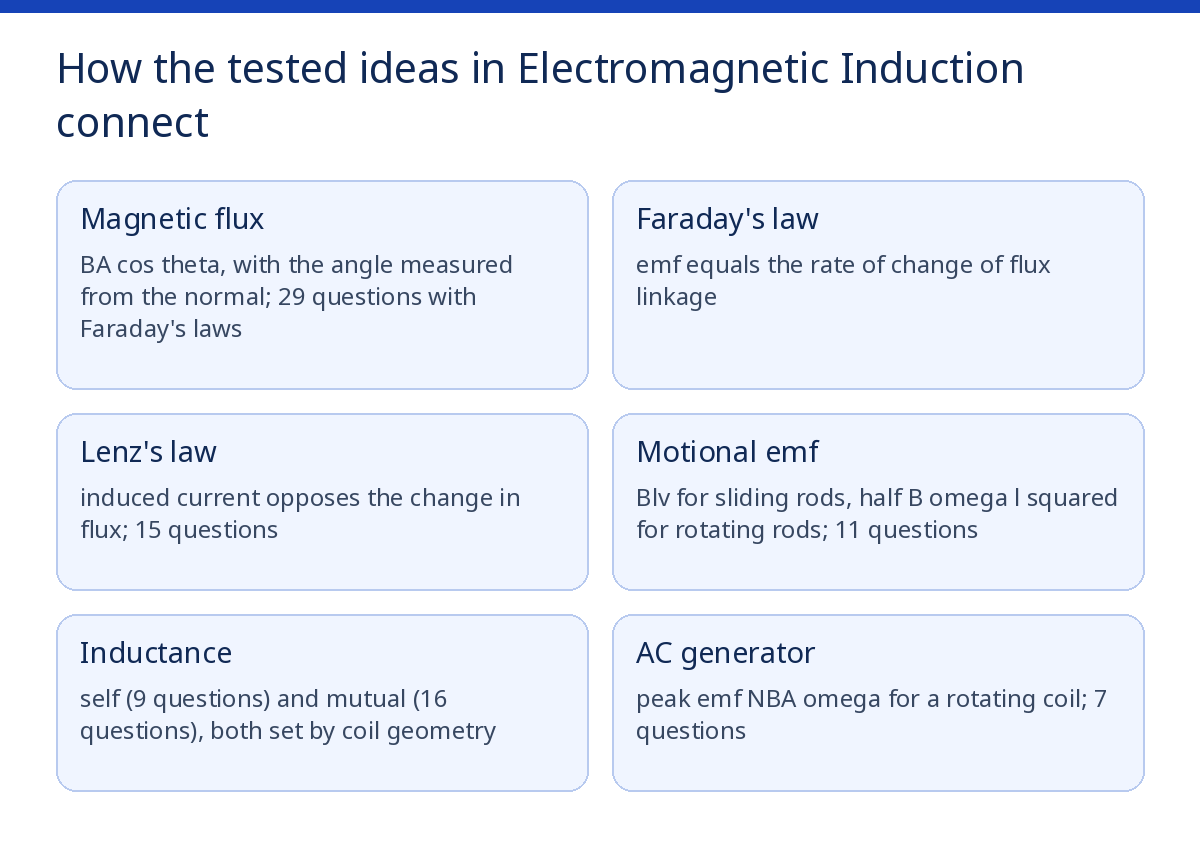
The largest group in this collection, Magnetic flux and Faraday laws, has 29 questions. For a plane loop in a uniform field, the flux is , measured in weber. Here is the angle between and the area vector, which points along the normal to the loop.
Faraday's law gives the induced emf in a coil of turns as . The emf depends on how fast the flux changes, not on how large the flux is. Assertion–reason items test exactly this distinction.
The board varies what changes with time:
- Field as a function of time: or is given as a polynomial in , so you differentiate and then substitute the instant asked for.
- Changing area: a loop's radius shrinks at a constant rate.
- Rotation: a loop turns through a given angle in a given time.
- Vector data: and are given in form, so the flux is a dot product.
When a question asks for current or charge, use . The charge that flows depends only on the total flux change: .

Electromagnetic Induction | Class 12 | Previous Year Paper
In the StudentCurio app
A comprehensive 95-page collection of solved previous year questions for CBSE Class 12 Physics, covering Faraday’s laws, Lenz’s law, motional EMF, and inductance with detailed solutions.
Lenz's law: predicting direction and opposition
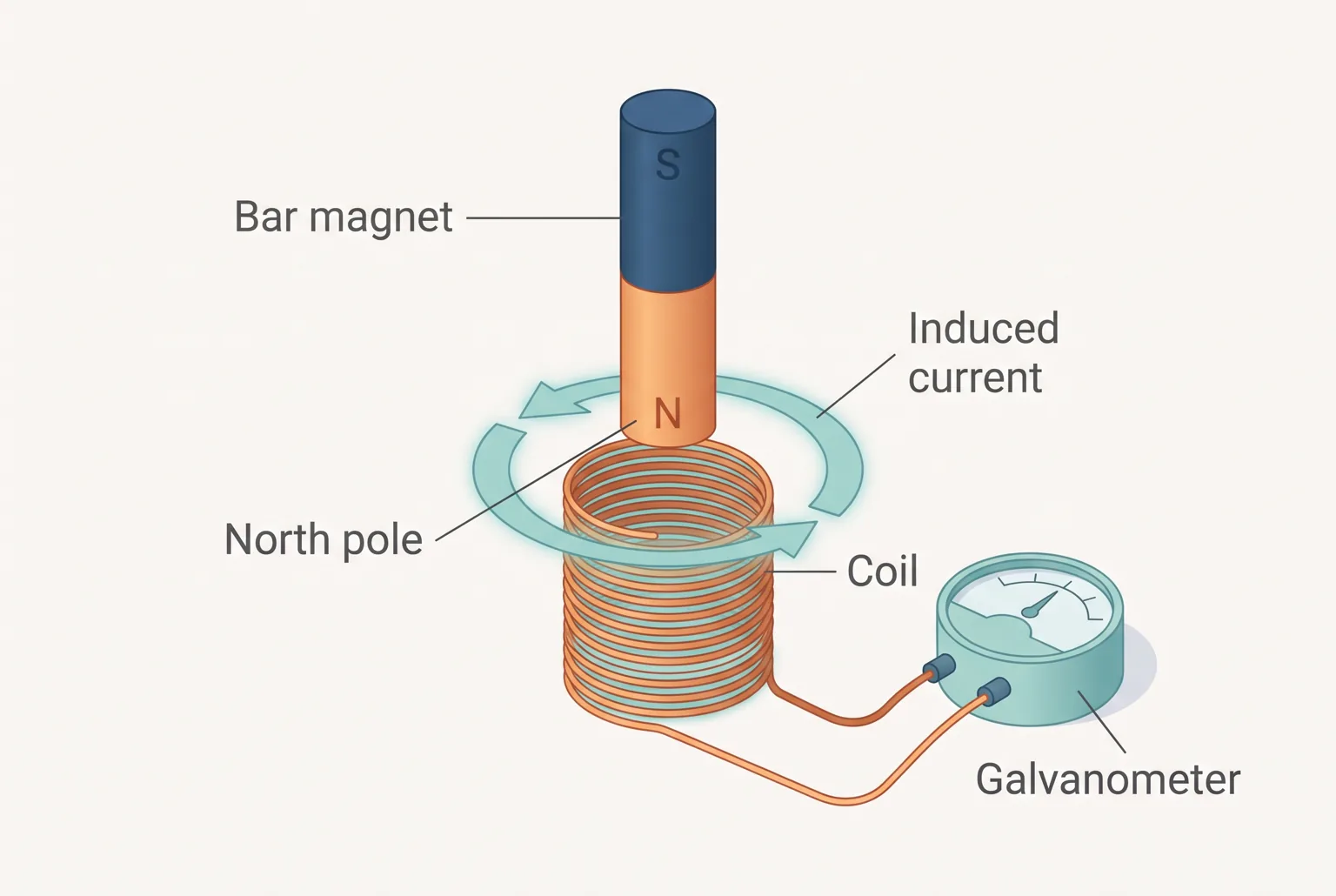
The 15 Lenz law questions ask which way the induced current flows, or how a moving magnet behaves. The induced current always opposes the change in flux that produces it. NCERT treats this as a consequence of the conservation of energy.
A typical stem drops a magnet, north pole down, along the axis of a vertical closed solenoid and asks for the current direction seen from above. A reliable sequence of steps is:
- Find the direction of the flux through the coil.
- Decide whether that flux is increasing or decreasing.
- Choose the induced field that opposes this change.
- Use the right-hand rule to convert that field into a clockwise or anticlockwise current.
The same idea recurs with magnets falling through rings, hollow metallic cylinders and loops with a cut, two loops side by side with a growing current in one, and a soft iron rod falling onto a U-shaped magnet. Before predicting any opposition, always ask whether a closed conducting path exists.
Motional emf for rods on rails and rotating rods
The 11 motional emf and energy questions involve conductors moving through a field. A rod of length moving with speed , where rod, velocity and field are mutually perpendicular, has emf across its ends.
In one paraphrased stem, a vertical rod moves east through the horizontal component of the Earth's field. The key step is choosing the field component that is perpendicular to both the rod and its velocity.
A rod rotating about one end with angular speed develops , where for a frequency given in rev/s.
Rail problems link emf to energy. The induced current feels a magnetic force that opposes the motion. Keeping the rod at constant velocity therefore needs an external force. The mechanical work done by that force appears as Joule heat in the resistance.
Self and mutual inductance as properties of geometry
Self-induction questions (9) and mutual induction questions (16) test two related definitions.
A changing current induces an emf in its own coil, . It also induces an emf in a neighbouring coil, . Both and are measured in henry.
For a long solenoid, . This depends only on turns per unit length, cross-sectional area and length, not on the current. For two long coaxial solenoids, , where is the inner radius, because only that area is shared.
The energy stored in an inductor is . Dimension questions, such as those on self-inductance or the rate of change of flux, are easiest if you start from these defining equations. Note that the rate of change of flux has the unit of volt.
Rotating coils and the ac generator
Seven questions cover rotating coils and generators. A coil of turns and area rotating with angular speed in a field produces , so the peak emf is .
Stems often state the rotation rate in everyday terms, such as half a rotation per second. Convert this to before substituting. Conceptual items ask which coil properties appear in this expression and which do not.
Common mistakes in induction questions
- Plane versus normal: in is measured from the normal. If a stem gives the angle with the plane of the coil, convert it first.
- Flux versus its rate: a large flux does not by itself mean a large emf.
- Forgetting : multiply by the number of turns for flux linkage and emf.
- Unit slips: mT, cm, mm, ms and gauss values appear throughout, so convert to SI first.
- Open circuits: an emf can exist across a cut, but no current flows without a closed path.
Working through this collection topic by topic
The PDF prints 100 previous year questions with complete worked solutions, with stated exam-year coverage of 2021 and 2023–2026. Each question keeps its original number and exam label, such as a year with Delhi, Outside Delhi, Compartment or a set code.
The topic index on page 3 links every question to one of seven groups; the seventh, mixed electromagnetic-induction PYQs, has 13 questions. Questions are split into MCQs (single correct answer), including assertion–reason items, and subjective questions, with solutions following in the same split.
A practical revision order:
- Work the flux and Faraday group first, since every other topic builds on it.
- Move on to the Lenz, motional emf, inductance and generator groups.
- Finish with the mixed set as a test of combined ideas.
Attempt each question before opening its solution, then compare your steps, not only your final option.
Quick self-check before opening the solutions
- Can you explain why emf depends on rather than on ?
- Can you predict the current direction for a magnet both entering and leaving a coil?
- Can you state what changes for a magnet falling through a ring with a cut?
- Can you name which quantities set for a solenoid?
If any answer feels uncertain, revisit that topic group in the index first.
Frequently asked questions
Which years does this Electromagnetic Induction PYQ collection cover?
The cover states exam-year coverage of 2021 and 2023–2026, with 100 previous year questions.
Are the questions arranged by topic?
The questions stay in their original source order, but a topic index links each question number to one of seven groups. These are flux and Faraday's laws, Lenz's law, motional emf, self-induction, mutual induction, generators and mixed questions.
What question formats appear?
There are single-correct MCQs, including assertion–reason items, and a separate subjective section. Each part has its own worked solutions.
Spotted an error? Report a correction. Practise this in the app: notes, formula sheets and mind maps.













































































































































































Loading comments…