Electromagnetic Induction: Class 12 CBSE Practice Questions Guide
CBSEPhysicsElectromagnetic Induction
This guide explains the ideas tested in a 135-question CBSE Class 12 practice set on Electromagnetic Induction (NCERT Chapter 6): magnetic flux and its angle convention, Faraday's law with flux linkage, Lenz's minus sign and the situations where no emf appears. It also shows how the six NCERT topic sections are framed and how to practise them.
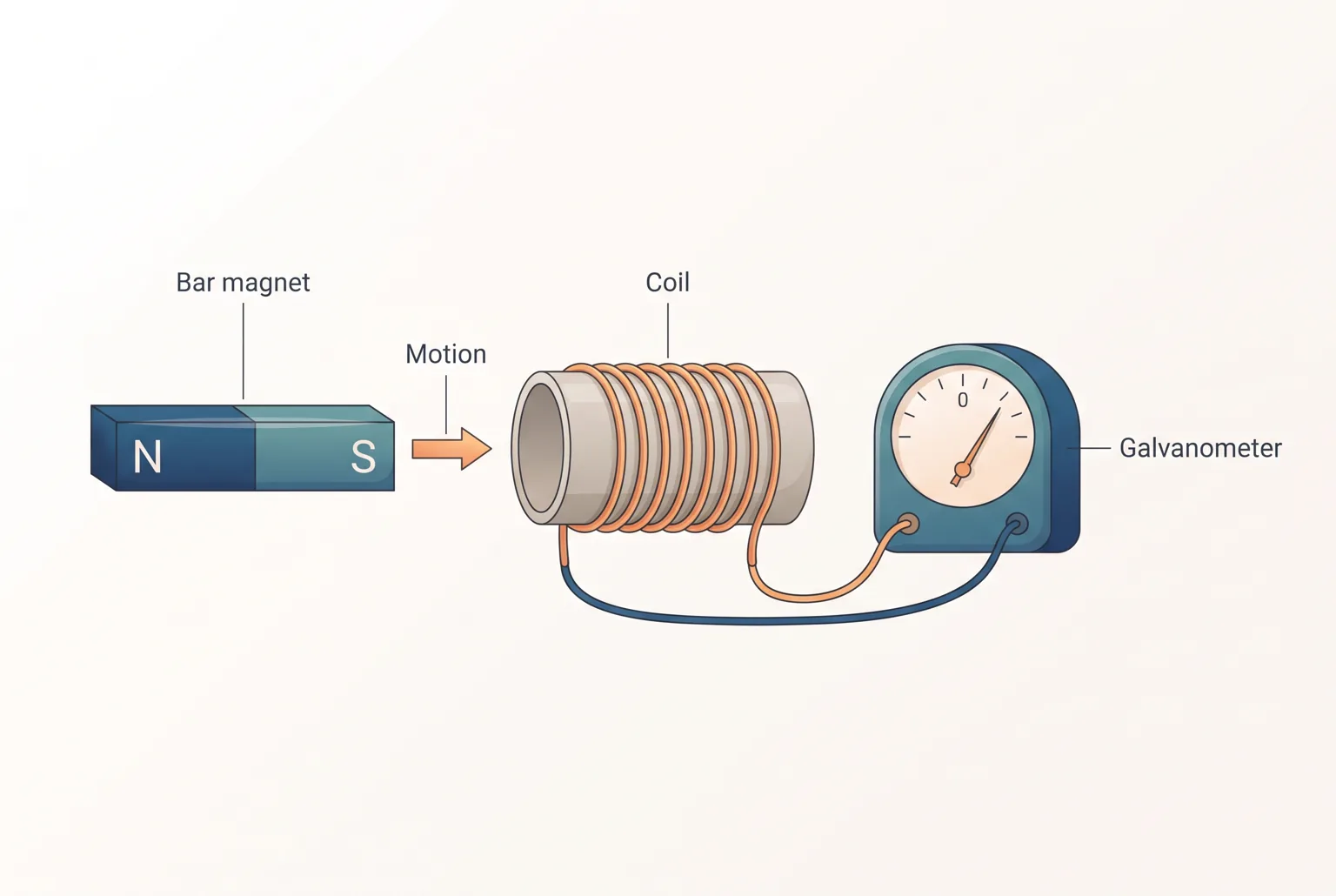
Magnetic flux: measuring the angle from the normal
Most numericals in the first topic (NCERT 6.2–6.4) start from magnetic flux, . The worked solutions measure between the field and the normal to the surface, not the surface itself.
Sometimes a question says the plane of a frame makes an angle with the field. The normal then makes the complementary angle, so the cosine changes. One solution notes that the answer would differ if the angle were read from the plane. Always check which line the angle is measured from.
For fields given in components, use . The area vector is perpendicular to the frame, so only the field component along it contributes. Components lying in the plane add nothing. Convert cm² to m² before quoting flux in webers.

Electromagnetic Induction | Class 12 | CBSE Assessment
In the StudentCurio app
135 Class 12 Physics questions on electromagnetic induction, arranged by NCERT topic and matched to the 2025-26 CBSE syllabus, with step-by-step worked solutions. Six topic sections (magnetic flux and Faraday's law; Lenz's law and conservation of energy; motional emf; mutual inductance; self-inductance; the AC generator), each with MCQs, assertion-reason, 2-, 3-, 4- and 5-mark questions and case-based questions.
Faraday's law with flux linkage and number of turns
The solutions state Faraday's two laws in a form you can reproduce in a long answer:
- First law: an emf is induced whenever the flux linked with a circuit changes. It lasts only while the change continues.
- Second law: the emf equals the rate of change of flux linkage.
Combined, they give , with for turns.
Because , flux can change through , or . The emf grows with the number of turns and with the speed of the change. For a bigger galvanometer kick, the solutions suggest faster motion, more turns, or a soft-iron core so that more of one coil's flux links the other.
Two calculation patterns recur:
- Instantaneous emf: the flux is given as a polynomial in . Differentiate it, then substitute the instant.
- Average emf: the flux changes over an interval, so use .
A companion result gives the charge driven through a coil of resistance : . It depends only on the total flux change, not on how fast it happens.
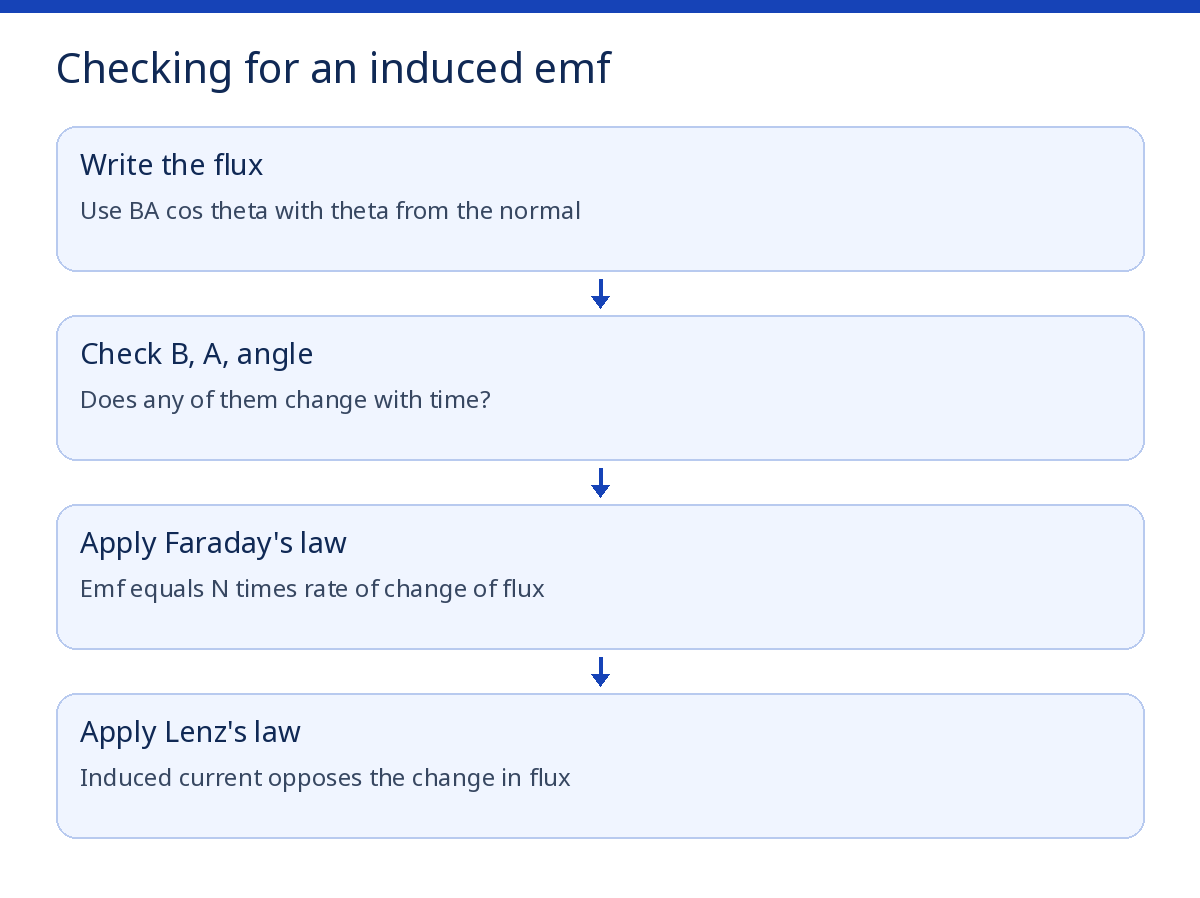
Spotting situations where no emf is induced
Several 2-mark and long-answer questions test whether you can recognise that the flux is not changing. Write the flux, then ask whether , or actually varies. The source uses three settings:
- Closing a switch in a loop around a fixed magnet completes the circuit. It changes no field, area or orientation.
- A straight current-carrying wire passes perpendicularly through the centre of a ring. Its field lines are circles in the ring's plane, so is zero over the ring.
- A magnet spun about its own long axis keeps a symmetric field pattern at the coil. Turning it end over end is different, because its magnetic moment then swings relative to the coil.
The coil-and-key experiment works the same way. With a steady primary current, the galvanometer reads zero. It deflects only while that current grows or falls.
Lenz's minus sign and induced electric fields
The solutions separate three rules:
- Faraday's law gives the size of the emf.
- Lenz's law, the minus sign, fixes its direction.
- Fleming's rules relate the directions of force, current and motion.
When an emf comes out negative, its sign depends on the chosen positive sense. The magnitude is the physical result.
For direction questions, find the sense of the existing flux and whether it is rising or falling. The induced current sets up a field that opposes that change. State the result as clockwise or anticlockwise viewed from a named axis. This is also why making and releasing a key give kicks in opposite directions.
An assertion-reason item links induction to . For a charge at rest, only the electric term can act. So when a changing drives charges round a stationary conductor, the changing field must be accompanied by an induced electric field.
Common mistakes with flux questions
- Angle taken from the plane. Convert it to the angle from the normal first.
- Missing . Flux linkage, not single-turn flux, sets the emf and the charge.
- Half-turn treated as no change. Half a revolution reverses the linkage, so the change has magnitude .
- Ignoring motion in a non-uniform field. For a frame moving through a field that also varies with time, combine both effects: .
- Skipping conversions. Areas in cm² and times in ms must become SI units.
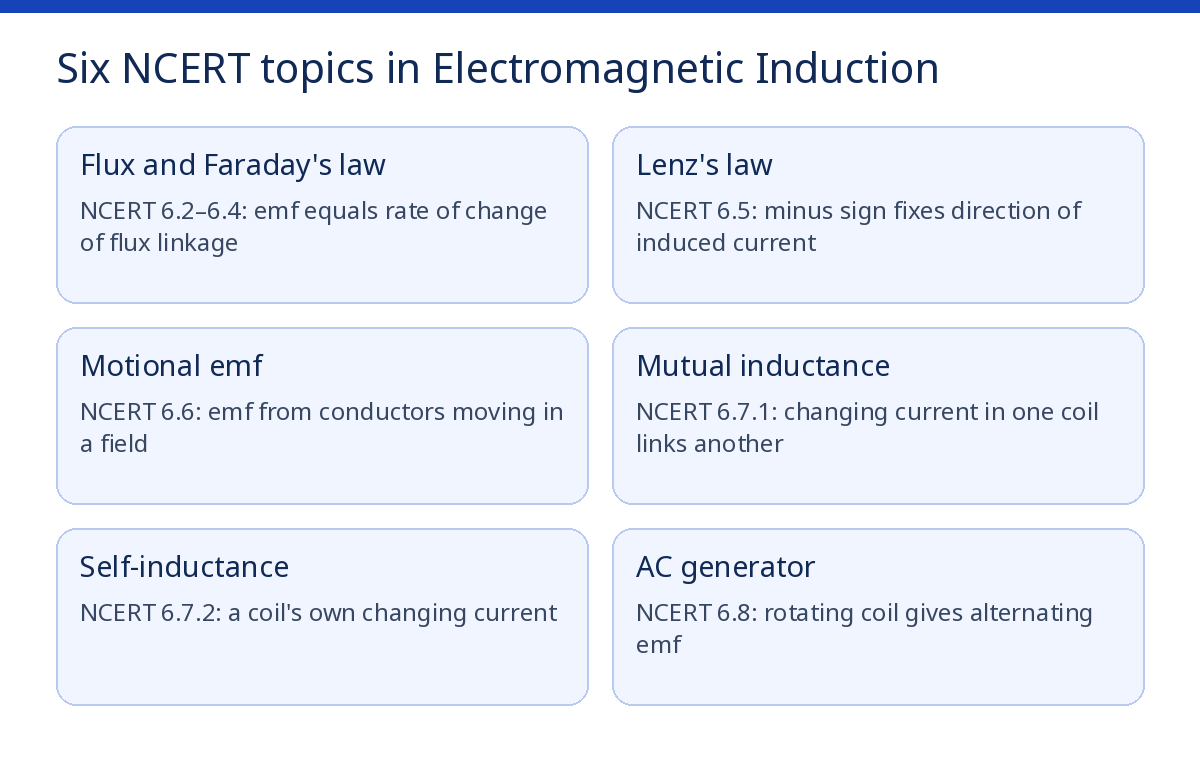
How the six NCERT topic sets are framed
The 135 questions are split by NCERT section:
- flux and Faraday's law (6.2–6.4): 22 questions
- Lenz's law and conservation of energy (6.5): 24 questions
- motional emf (6.6): 21 questions
- mutual inductance (6.7.1): 27 questions
- self-inductance (6.7.2): 26 questions
- the AC generator (6.8): 15 questions
Each section runs in the same order:
- 1-mark MCQs, including assertion-reason items with the standard four options
- 2-mark very short answers
- 3-mark short answers
- 4-mark case-based questions, where you attempt any four one-mark subparts
- 5-mark long answers
- step-by-step worked solutions
In the first topic, the case is a data-logger experiment on induced emf.
Long answers pair stating a law with applying it. One example asks you to sketch flux and emf against the position of a rod sliding through a field that fills only part of its path. A spinning copper disc uses , which links this topic to motional emf and the generator.
Practising topic by topic before mixing
Work through the topic sections in order, because flux and Faraday's law underpin the rest. Attempt a whole section before opening its solutions. Then compare your reasoning with each step, not just the final value.
Look closely at where the solutions fix a positive sense, state which angle is used or explain why a flux is constant. A full-mark answer shows these steps. Once the topic sets feel secure, move on to mixed chapter practice.
Frequently asked questions
Which NCERT sections does this practice set follow?
It follows Chapter 6 sections 6.2–6.4, 6.5, 6.6, 6.7.1, 6.7.2 and 6.8. These cover flux and Faraday's law, Lenz's law, motional emf, mutual inductance, self-inductance and the AC generator.
Does the charge through a coil depend on how fast the flux changes?
No. The source's worked solution gives , which depends only on the total change in flux and the coil's resistance.
Spotted an error? Report a correction. Practise this in the app: notes, formula sheets and mind maps.













































































































































































Loading comments…