Understanding Dual Nature of Matter and Radiation Case Studies
CBSEPhysicsDual Nature of Matter and Radiation
A comprehensive guide to Class 12 Physics Chapter 11, focusing on the 14 case-based assessments that bridge classical wave theory and quantum particle mechanics.
The Experimental Shift to Wave-Particle Duality
The study of light and matter underwent a fundamental transformation with the discovery of phenomena that classical electromagnetic theory could not explain. As outlined in the source material, while interference, diffraction, and polarisation confirm the wave nature of light, the photoelectric effect serves as the primary evidence for its particle nature. This assessment resource explores how Einstein’s photon description provides a new account of light as discrete quanta of energy. This duality is not limited to light; it extends to matter itself, a concept later formalised by de Broglie.
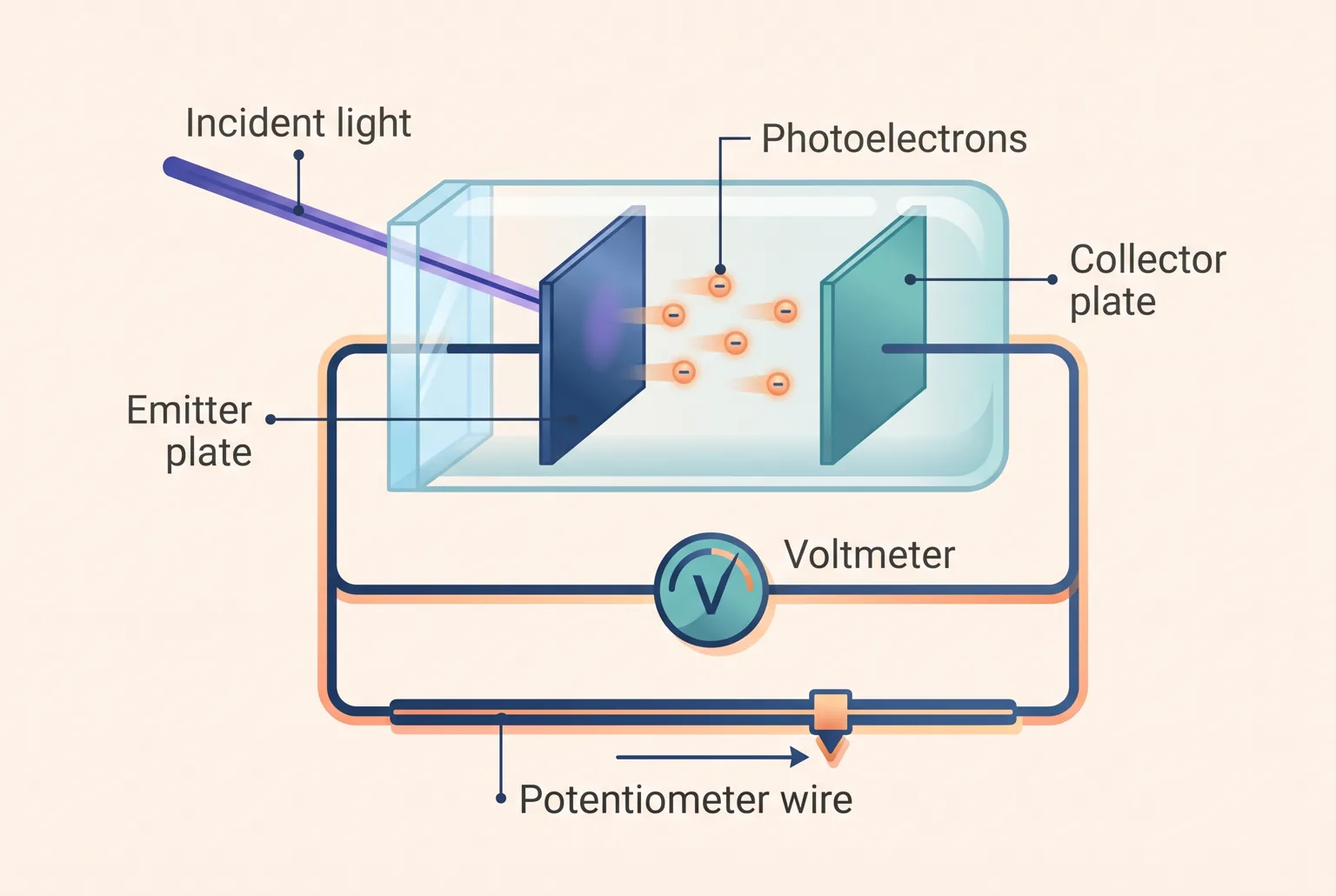
Learners using this resource will encounter case studies that trace this history, starting from Hertz’s initial observations and Lenard’s detailed experimental records. These early experiments demonstrated that ultraviolet radiation could eject charged particles—electrons—from metal electrodes in an evacuated tube. The resource emphasizes that these observations are the bedrock of modern physics, requiring students to distinguish between classical expectations and the quantum reality where energy is transferred in discrete bundles called photons.

Dual Nature of Matter and Radiation | Class 12 Physics | CBSE Case-based Assessment
In the StudentCurio app
A comprehensive set of 14 case studies featuring 66 questions on the photoelectric effect and matter waves, complete with detailed solutions for CBSE Class 12 Physics students.
Dynamics of the Photoelectric Effect
The resource provides a deep dive into the specific mechanics of photoemission. A critical concept covered is the interaction between light intensity and frequency. At a fixed frequency above the threshold, increasing the intensity of incident light increases the number of photoelectrons emitted per second, thereby increasing the photoelectric current. However, intensity has no impact on the maximum kinetic energy of the emitted electrons. This kinetic energy is strictly a function of the photon's frequency and the material's work function.
The material presents several cases where students must analyze the conditions for emission. For instance, if the incident photon energy is less than the surface's work function, no emission occurs regardless of intensity. This 'threshold' behavior is a hallmark of the particle model. The guide includes numerical exercises involving potassium-oxide plates and varying wavelength bands, from violet to red, to illustrate how wavelength and frequency dictates whether a material reaches its emission threshold.
Quantifying Energy with Einstein’s Equation
Einstein’s photoelectric equation, , is the mathematical core of this chapter. The resource uses this equation to explain the conservation of energy during a single-photon absorption event. Here, represents the incident photon energy, is the work function (the minimum energy required for an electron to escape the surface), and is the maximum kinetic energy of the escaping electron.
Several case studies focus on the graphical interpretation of this equation. Students are expected to understand why a graph of versus frequency yields a straight line with a slope equal to Planck’s constant . Similarly, the resource covers the relationship between stopping potential and the inverse wavelength . In these graphs, the horizontal intercepts reveal the threshold frequency or the threshold wavelength for different metals. This analytical approach helps learners identify which metal in a set has a higher work function simply by observing its intercept on the frequency or axis.
Circuit Measurements and Potentiometer Applications
The assessment resource distinguishes itself by including detailed circuit-based case studies. It describes an experimental setup using a photoelectric tube, an ideal voltmeter, and a potentiometer wire to vary the plate voltage. By moving a contact along a uniform potentiometer wire , the voltage across the electrodes can be precisely controlled. This setup allows for the measurement of the stopping potential—the specific retarding voltage required to reduce the photocurrent to zero.
These practical scenarios require students to apply Ohm’s law and potentiometer principles alongside quantum physics. For example, if a source has a specific EMF and internal resistance, and is connected to a potentiometer wire of a known length and resistance, students must calculate the actual potential difference across the tube. This cross-disciplinary approach ensures that learners understand not just the theory of photons, but how that theory is verified through electrical instrumentation and the measurement of saturation currents versus retarding potentials.
Photon Momentum and Radiation Pressure
Moving beyond energy, the material explores the particle-like properties of photons through momentum and radiation pressure. Even though photons are massless, they carry momentum . The resource introduces the concept of radiation pressure () on opaque surfaces. For a surface with a reflection coefficient , the pressure is given by , where is the light intensity.
Students are challenged with scenarios involving normal incidence on reflecting and absorbing surfaces. For instance, a perfectly reflecting surface experiences twice the momentum transfer compared to a perfectly absorbing one. The case studies compare these microscopic pressures to macroscopic values like atmospheric pressure, helping students grasp the scale of these forces. Numerical questions involving isotropic point sources and the power intercepted by small spheres further test the ability to calculate photon flux and the rate of momentum transfer in real-world physical models.
The Wave Nature of Matter and de Broglie Waves
The final sections of the resource cover the de Broglie hypothesis, which proposes that moving material particles exhibit wave-like properties. The de Broglie wavelength is defined as . For a particle of mass and non-relativistic kinetic energy , this relationship is expressed as . This allows for the comparison of different particles, such as electrons, protons, and alpha particles, under the same energy or momentum conditions.
The case studies emphasize that matter waves are quantum mechanical descriptions and not classical ripples of the material. Students are asked to analyze how wavelength changes as a particle's mass or velocity varies. For example, for the same kinetic energy, an electron will have a significantly larger de Broglie wavelength than a more massive proton. These comparisons are vital for understanding why wave properties of matter are observable primarily at the subatomic scale, as seen in the experimental verification of electron diffraction.
Frequently asked questions
What determines the maximum kinetic energy of a photoelectron?
According to Einstein's equation, the maximum kinetic energy () is determined by the frequency of the incident radiation and the work function of the material. It is independent of the intensity of the light.
How does radiation pressure change between absorbing and reflecting surfaces?
Radiation pressure depends on the reflectance of the surface. For a perfectly reflecting surface (), the momentum transferred is twice that of a perfectly absorbing surface (), resulting in higher radiation pressure.
What is the relationship between stopping potential and maximum kinetic energy?
The stopping potential () is the retarding potential needed to stop the most energetic photoelectrons. It is related to maximum kinetic energy by the equation .
Does a higher intensity of light mean faster electrons?
No. Higher intensity increases the number of photons striking the surface per second, which increases the number of emitted electrons (photocurrent), but it does not change the energy or speed of individual electrons.
Spotted an error? Report a correction. Practise this in the app: notes, formula sheets and mind maps.













































































































































































Loading comments…