Dual Nature of Radiation and Matter: Class 12 CBSE Practice Guide
CBSEPhysicsDual Nature of Matter and Radiation
This guide to the Class 12 CBSE chapter Dual Nature of Radiation and Matter explains work function, threshold frequency, the three routes to electron emission and how photocurrent responds to intensity, frequency and collector potential. It also shows how the 163-question assessment is arranged by NCERT topic and how to practise with it.
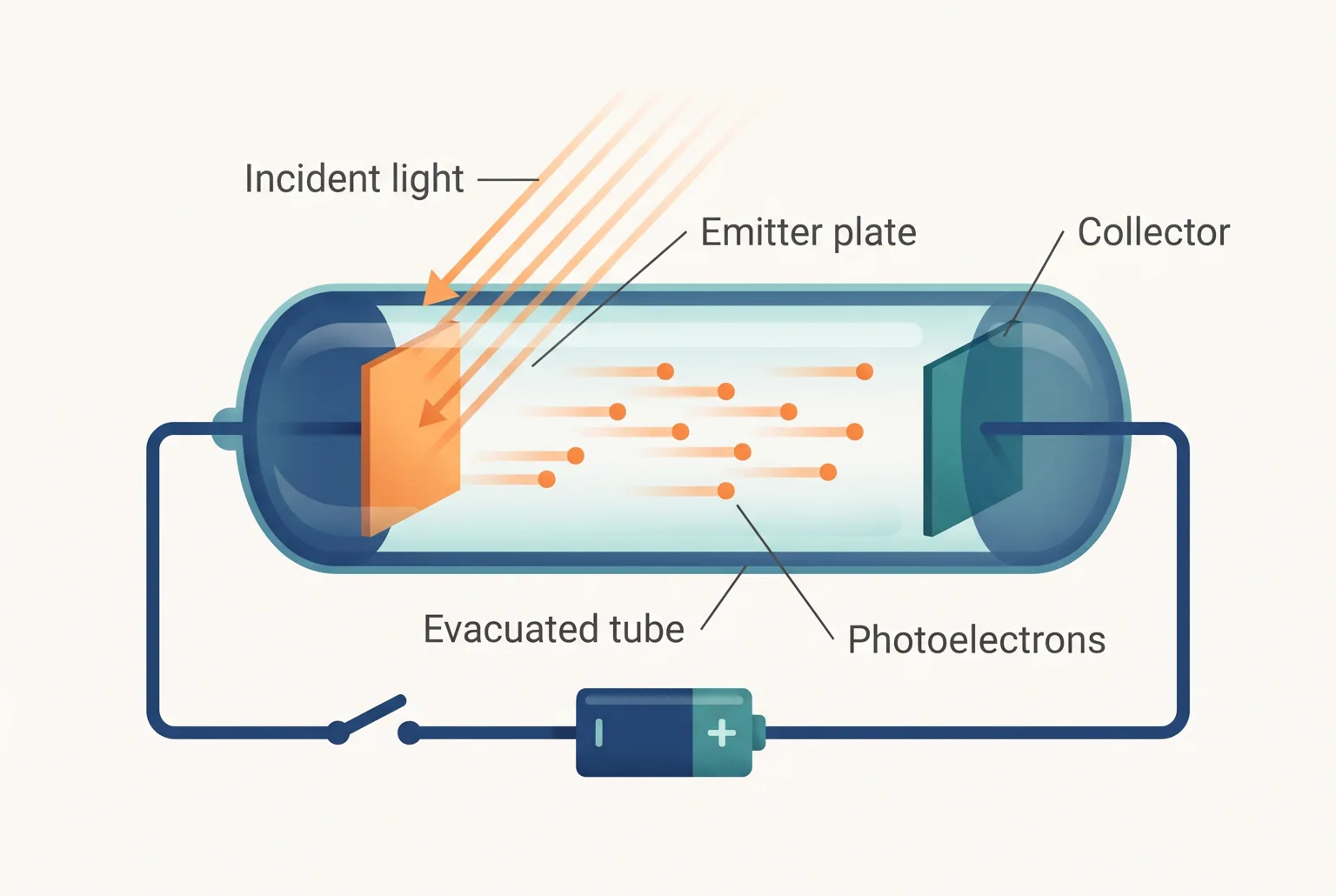
Work function and threshold frequency: what sets the cut-off
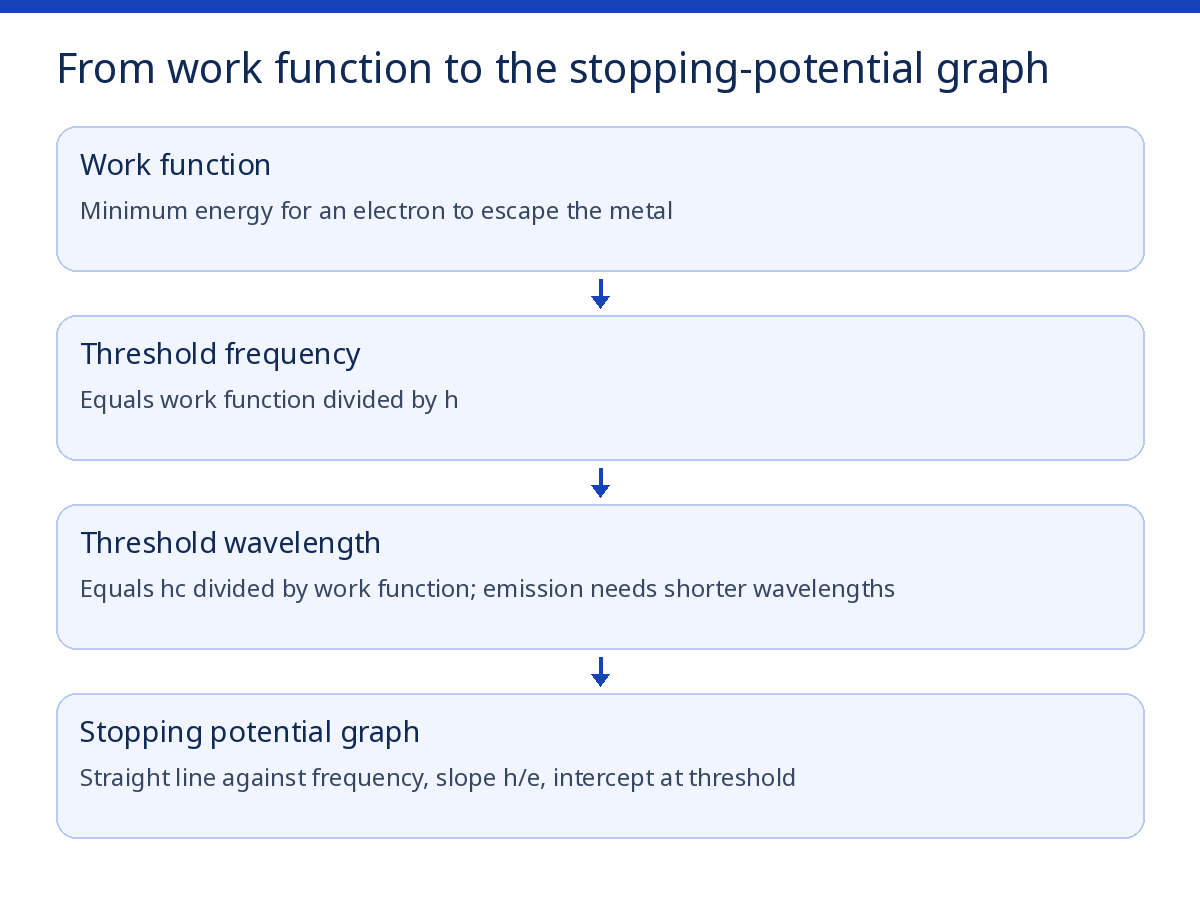
A metal holds its free electrons through the attraction of its positive ions. An electron leaves the surface only if it receives at least a minimum energy. This minimum is the work function .
At threshold, the emitted electron has zero kinetic energy. So , and the threshold frequency is . Because belongs to the emitter material and its surface, depends on that material. It does not depend on the collector voltage, plate spacing or plate area.
In wavelength form, . Emission needs , which is the escape condition . With eV nm, nm when is in eV.
A smaller work function therefore means a longer threshold wavelength. Several 2-mark and case-based questions use this inverse relation to compare metals.

Dual Nature of Matter and Radiation | Class 12 | CBSE Assessment
In the StudentCurio app
163 Class 12 Physics questions on the dual nature of radiation and matter, arranged by NCERT topic and matched to the 2025-26 CBSE syllabus, with step-by-step worked solutions. Six topic sections (electron emission and the photoelectric effect; experimental study of the photoelectric effect; photoelectric effect and wave theory; Einstein's photoelectric equation; the photon; wave nature of matter), each with MCQs, 2-, 3- and 5-mark questions and a 4-mark case-based question, plus assertion-reason items.
Thermionic, field and photoelectric emission compared
The source names three ways of supplying the minimum energy:
- Thermionic emission: heating gives the electrons enough thermal energy.
- Field emission: a very strong electric field, of order V m, pulls electrons out.
- Photoelectric emission: light of suitable frequency falls on the metal. A photocell uses this process.
Work functions are quoted in electron volts because the energies are tiny in joules. One electron volt is the energy an electron gains when it is accelerated through 1 V.
One case passage lists work functions from caesium to platinum and tests ranking. The lowest gives the lowest and the longest . A 5-mark question extends this reasoning to whether visible light (400–700 nm) can cause emission. You answer it by comparing each metal's threshold wavelength with that range.
Hertz, Hallwachs and Lenard: reading the early experiments
The 3-mark history question asks for three sets of observations:
- Hertz (1887): he was producing electromagnetic waves with a spark discharge. He found that a spark jumped the detector gap more easily when the emitter plate was lit by ultraviolet light.
- Hallwachs: a negatively charged zinc plate connected to an electroscope lost its charge under ultraviolet light. This showed that the light ejects negatively charged particles.
- Lenard: ultraviolet light on the emitter of an evacuated tube drove a current to the collector. The current stopped when the light was cut off. Below a certain frequency there was no emission, whatever the intensity.
Einstein explained the effect in 1905, and Millikan verified his equation. A good answer links each observation to what it showed. Lenard's result matters most because it introduces the threshold frequency.
Photocurrent graphs: separating intensity from frequency
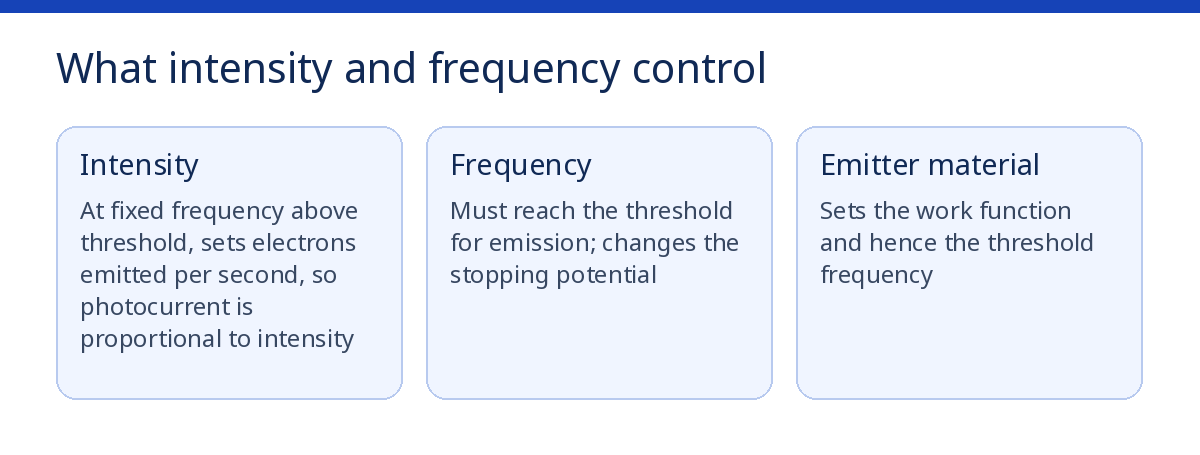
Section 2 (NCERT 11.4) centres on photocurrent graphs. Strong answers keep three controls apart.
Intensity sets how many electrons are emitted. At a fixed frequency above threshold, the number of photons arriving per second is proportional to intensity. With fixed collection conditions, so is the number of electrons emitted per second, giving . For a point source, intensity falls as , so distance-change questions reduce to an inverse-square ratio.
The collector potential shapes the current–voltage curve. As the accelerating potential rises, the current increases and then levels off at the saturation current. Making the collector negative reduces the current to zero at the stopping potential.
Frequency governs the energy of the emitted electrons rather than simply their number. One 3-mark question uses the NCERT case of three frequencies at equal intensity. It asks why the saturation currents match while the stopping potentials differ.
Stopping potential against frequency: slope and intercept
The assessment's cover plots stopping potential against incident frequency for two metals, A and B. Each line meets the frequency axis at that metal's threshold frequency. The lines are parallel because both have slope .
- The intercept identifies the metal. A larger threshold frequency means a larger work function.
- The slope is the same for every metal, because it depends only on and .
This graph connects Section 2's experiments with Section 4 on Einstein's photoelectric equation.
Common mistakes in threshold and photocurrent questions
The worked solutions correct several recurring slips:
- Linking threshold frequency to the apparatus. depends on the emitter material. It does not depend on plate area, spacing or collector voltage.
- Confusing a true reason with the correct explanation. In assertion–reason items, only relates two constants of a metal. An explanation about wavelength ranges needs the escape condition .
- Treating intensity and frequency as interchangeable. They control different features of the photocurrent curve.
- Mixing units. Keep in eV when you use eV nm. Convert it to joules before dividing by .
Working through the six NCERT topic sections
The 163 questions are split into six sections by NCERT heading:
- Electron emission and the photoelectric effect (11.2–11.3): 12 questions
- Experimental study (11.4): 18 questions
- Photoelectric effect and wave theory (11.5): 11 questions
- Einstein's photoelectric equation (11.6): 51 questions
- The photon (11.7): 23 questions
- Wave nature of matter (11.8): 48 questions
Each section starts with 1-mark MCQs and assertion–reason items. It continues with 2- and 3-mark questions, a 4-mark case-based question (attempt any four of five parts) and a 5-mark question. Step-by-step worked solutions follow each section.
Questions are numbered 1 to 163 through the whole chapter, and every question links to its worked solution and back.
A sensible order is to attempt each topic section fully before opening its solutions, then return to the questions you got wrong a few days later.
Frequently asked questions
Does the threshold frequency depend on the intensity of light?
No. Lenard found no emission below a certain frequency, whatever the intensity. The threshold frequency depends on the emitter material.
Which question formats does the assessment use?
It uses 1-mark MCQs and assertion–reason items, 2-mark and 3-mark questions, 4-mark case-based questions (attempt any four of five parts) and 5-mark long answers. Numerical problems appear in every section.
Spotted an error? Report a correction. Practise this in the app: notes, formula sheets and mind maps.













































































































































































Loading comments…