Current Electricity: CBSE Class 12 PYQs and Solutions
CBSEPhysicsCurrent Electricity
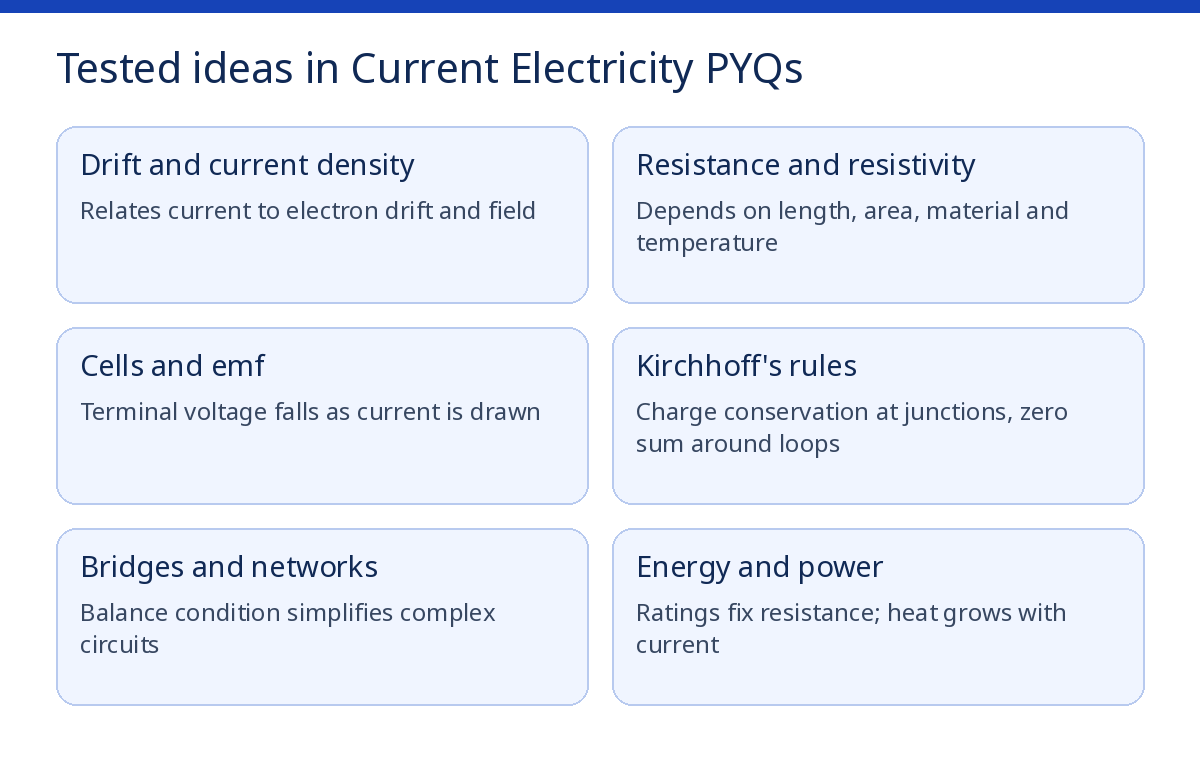
This guide to the Current Electricity PYQ collection for CBSE Class 12 explains the ideas its 168 board questions test: drift velocity and current density, resistance scaling, cells with internal resistance, Kirchhoff's rules, bridges and electrical power. It also shows how the MCQ, assertion-reason and subjective questions are framed and how to practise with them.
Drift velocity, current density and mobility
Free electrons in a metal already move randomly at large speeds. An applied field adds a small drift velocity on top of that motion, so drift does not mean every electron moves the same way. Several 2024 assertion-reason items test this picture.
The core relations are and current density . For a conductor obeying Ohm's law, and . Drift speed therefore tracks the field, and for a given wire it tracks the potential difference across it. Mobility is , so it depends on the relaxation time , not on the applied field.
Direction questions need care. Conventional current is defined by the flow of positive charge, so translate electron motion into the directions of and deliberately.
A related pattern treats an orbiting electron as a current. The method is to count the charge passing a point per unit time.

Current Electricity | Class 12 | Previous Year Paper
In the StudentCurio app
A comprehensive 147-page collection of solved previous year questions (PYQs) for CBSE Class 12 Physics, covering drift velocity, Kirchhoff's laws, Wheatstone bridge, and circuit analysis with detailed solutions.
Scaling resistance with length, area, stretching and temperature
Every wire-comparison question starts from . Here depends only on the material and temperature.
Follow the same steps each time: - Write each wire's resistance as a ratio: . - Convert diameter or radius to area with , so area scales with the square of the radius. - When a wire is stretched, its volume stays constant. A longer wire is also thinner, so rewrite as volume divided by before comparing.
A typical 2026 stem asks how resistance changes when a copper wire is stretched by a small percentage of its length.
Temperature questions use . Decide which factor actually changes appreciably in a metal as it heats up.
On a – graph, the slope gives the resistance. Comparing slopes at two temperatures links the graph back to that reasoning. Equivalent-resistivity items work the same way: find the total first, then ask which single would give it for the combined length and area.
Cells, emf and terminal voltage
A real cell has emf and internal resistance . With an external resistance , the current is and the terminal voltage is .
With the key open, no current flows, so the terminals show the full emf. Ratio questions about open and closed keys depend on this.
If a battery drives two different known currents through two different resistors, write and eliminate .
Combination questions test two rules: - In series, emfs add with sign. A cell connected the wrong way subtracts its emf, but its internal resistance still adds. - In parallel, and .
Kirchhoff's rules, meters and Wheatstone bridge balance
Kirchhoff's junction rule expresses conservation of charge: current entering a junction equals current leaving it.
The loop rule says that the potential changes around any closed loop sum to zero. Potential at a point is single-valued, so a charge returning to its start has no net change in potential. One 2026 assertion-reason item is built around exactly this idea. Choose a direction, then keep sign conventions consistent across cells and resistors.
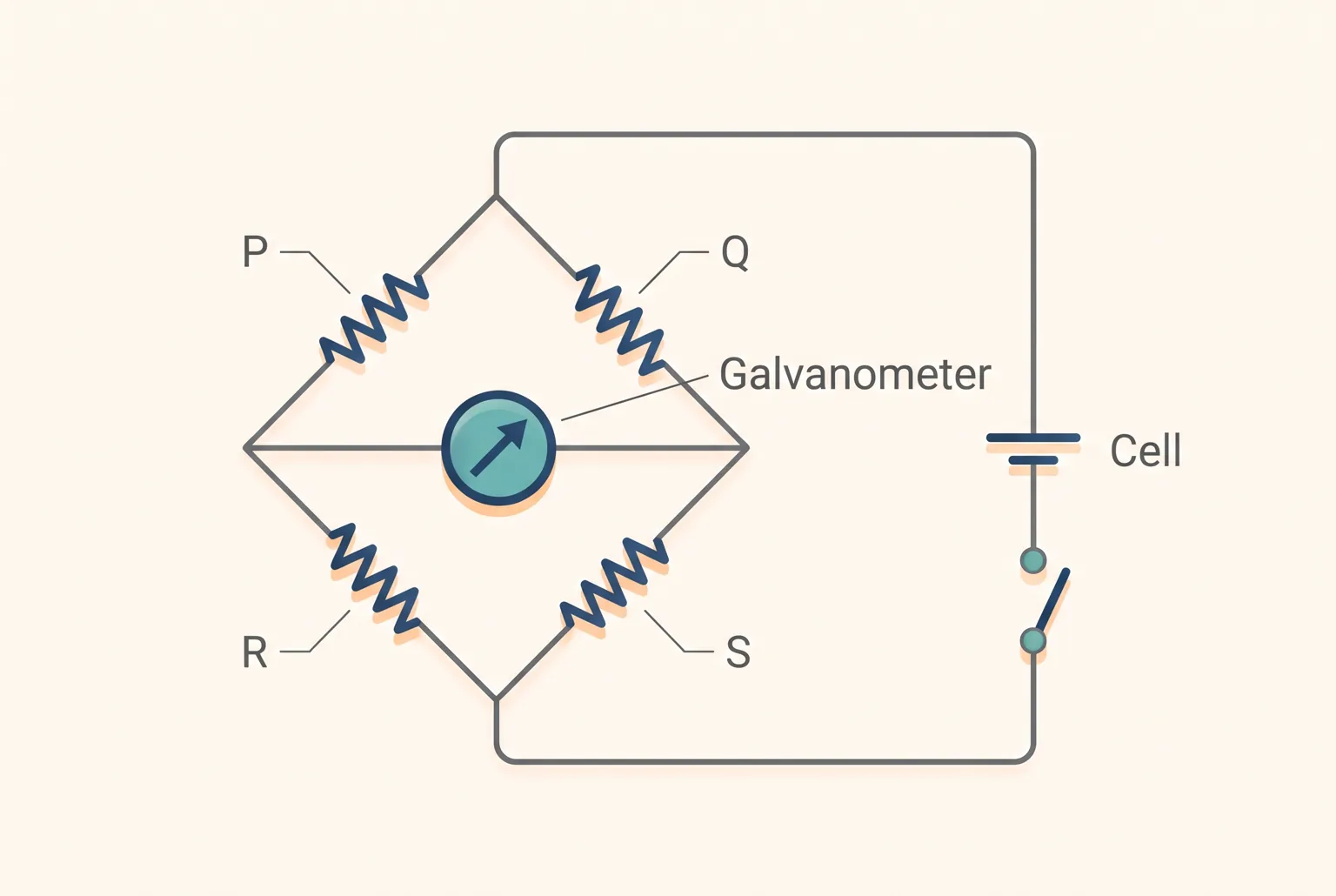
A Wheatstone bridge is balanced when . At balance the galvanometer arm carries no current and can be removed. That turns a complicated network into simple series–parallel parts. Look for this balance, or for symmetry, before writing loop equations. Also redraw any circuit whose key or switch changes between open and closed.
Meter questions assume an ideal ammeter has zero resistance and an ideal voltmeter has infinite resistance. To convert a galvanometer of resistance into a voltmeter of range , add a series resistance so that .
Power, heating and appliance ratings
A rating fixes the appliance's resistance: .
Across a fixed voltage, , so a smaller resistance draws more power. In series, the current is common, so is more convenient. Heat produced is .
Whenever a coil is cut, stretched or combined with another, recompute first. Only then apply the power formula that matches the quantity held fixed.
A 2026 stem combines two heaters rated and in series across a different supply voltage. Here ratings, series combination and a changed source all meet in one question.
Common mistakes in these question patterns
- Using the diameter ratio as if it were the area ratio. Area scales with the square of the radius.
- Keeping the cross-section unchanged when a wire is stretched. Volume, not area, stays constant.
- Subtracting the internal resistance of a reversed cell. Only its emf changes sign.
- Applying across a fixed source while forgetting that the current also changes. Use instead.
- Choosing option (A) in an assertion-reason question just because both statements are true. The reason must actually explain the assertion.
Quick self-check on current electricity reasoning
Before the mixed questions, try explaining each point in a sentence: - Why does drift speed change when the potential difference across the same wire changes? - Why is the current density defined along the field rather than along the electron motion? - Which quantity in is most affected by heating a metal? - Why does a balanced bridge let you remove the galvanometer arm?
Working through the topic index and exam labels
The collection holds 168 questions from 2021 and 2023–2026. They appear in original source order, with labels such as Delhi Set, Outside Delhi Set, numbered sets like 55/4/1 and Compartment sets.
The topic index splits them into seven groups: - Drift velocity and conductivity (38) - Resistance and temperature (31) - Cells and emf (31) - Kirchhoff laws (19) - Resistor networks and bridges (16) - Energy and power (16) - Mixed PYQs (17)
Questions come first, as single-correct MCQs (including assertion-reason items) followed by subjective questions. Worked solutions sit in a separate section, and source review notes come at the end.
A sensible order is drift and resistance first, then cells, then networks and Kirchhoff, then power, and finally the mixed set. Attempt each question before following its solution link.
Frequently asked questions
Which years does this Current Electricity PYQ collection cover?
The cover lists exam-year coverage of 2021 and 2023–2026, with questions labelled by year and set.
What question formats are included?
The collection has single-correct MCQs, including assertion-reason questions, and subjective questions. Worked solutions are in a separate section.
Spotted an error? Report a correction. Practise this in the app: notes, formula sheets and mind maps.













































































































































































Loading comments…