Atoms and Nuclei: CBSE Class 12 PYQs and Solutions
CBSEPhysicsAtomic Physics
This guide explains the CBSE Class 12 Physics previous year question collection for Unit VIII, Atoms and Nuclei, with questions labelled 2022–2026. It covers distance of closest approach, Bohr's conditions and n-scaling, spectral series, nuclear size and nuclide families, binding energy, and assertion-reason reasoning.
How 197 questions spread across Atoms and Nuclei
The compilation covers Chapter 12 (Atoms) and Chapter 13 (Nuclei). It keeps all 197 numbered questions in their original order. There are 81 single-answer MCQs, followed by 116 questions in the Subjective section, which include case-based parts and alternatives. Question headers carry exam years from 2022–2026, with set, term and compartment labels. Marks are absent from the source labels, so they are omitted.
The topic index shows where the weight lies:
- Bohr orbits, energy and matter waves: 58
- Rutherford scattering and atomic models: 34
- Nuclear reactions, fission and fusion: 24
- Hydrogen spectra and transitions: 19
- Mass defect, binding energy and stability: 19
- Nuclear size, composition and density: 18
- Nuclear forces and interactions: 13
- Mixed questions: 12
The three Atoms topics account for 111 of the 197 index entries. The Bohr model is the largest single block.

Atomic Physics | Class 12 | Previous Year Paper
In the StudentCurio app
This resource provides a comprehensive collection of solved previous year questions (PYQs) for CBSE Class 12 Physics, focusing on Atoms and Nuclei. It includes detailed solutions for topics like Bohr's model, hydrogen spectra, and nuclear binding energy.
Distance of closest approach in Rutherford scattering
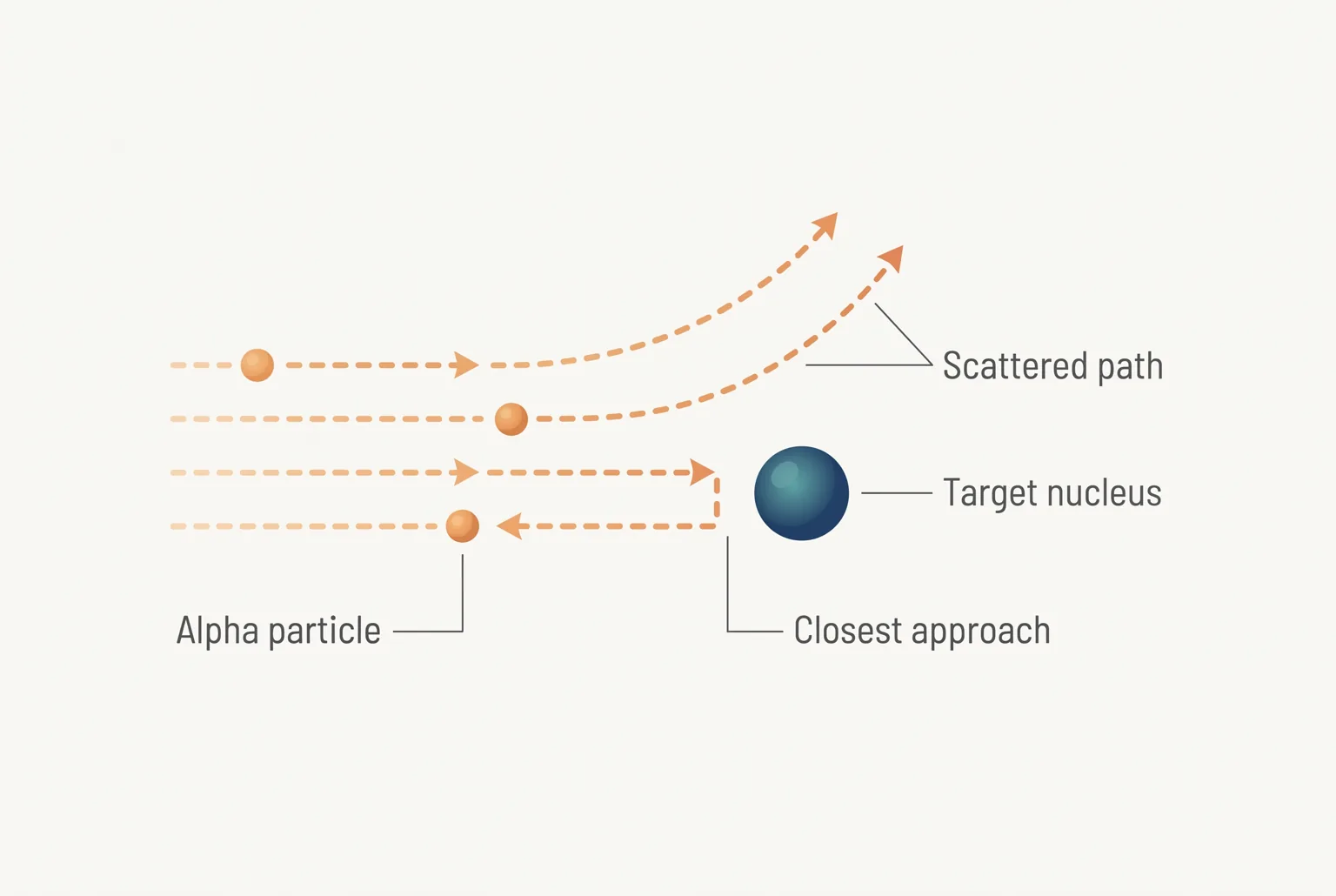
Several MCQs describe an alpha particle moving head-on towards a target nucleus and then change one condition. In some, the speed is halved. In others, the alpha particle is replaced by a proton moving at the same speed. Another variant asks how the particle's energy depends on the target charge or on the masses involved.
The reasoning is an energy balance. At the distance of closest approach , the particle momentarily stops, so all of its initial kinetic energy has become electrostatic potential energy:
For a "what happens if" question, write this balance before and after the change. Track every quantity that changes, including the projectile's charge and mass. Then take the ratio of the two cases rather than recalling a proportionality from memory.
Bohr's two conditions and the scaling-with-n questions
Most Bohr-model questions ask how a quantity varies with the orbit number . The quantities tested include radius, speed, time period, kinetic, potential and total energy, angular momentum, the gap between consecutive orbits, and de Broglie wavelength.
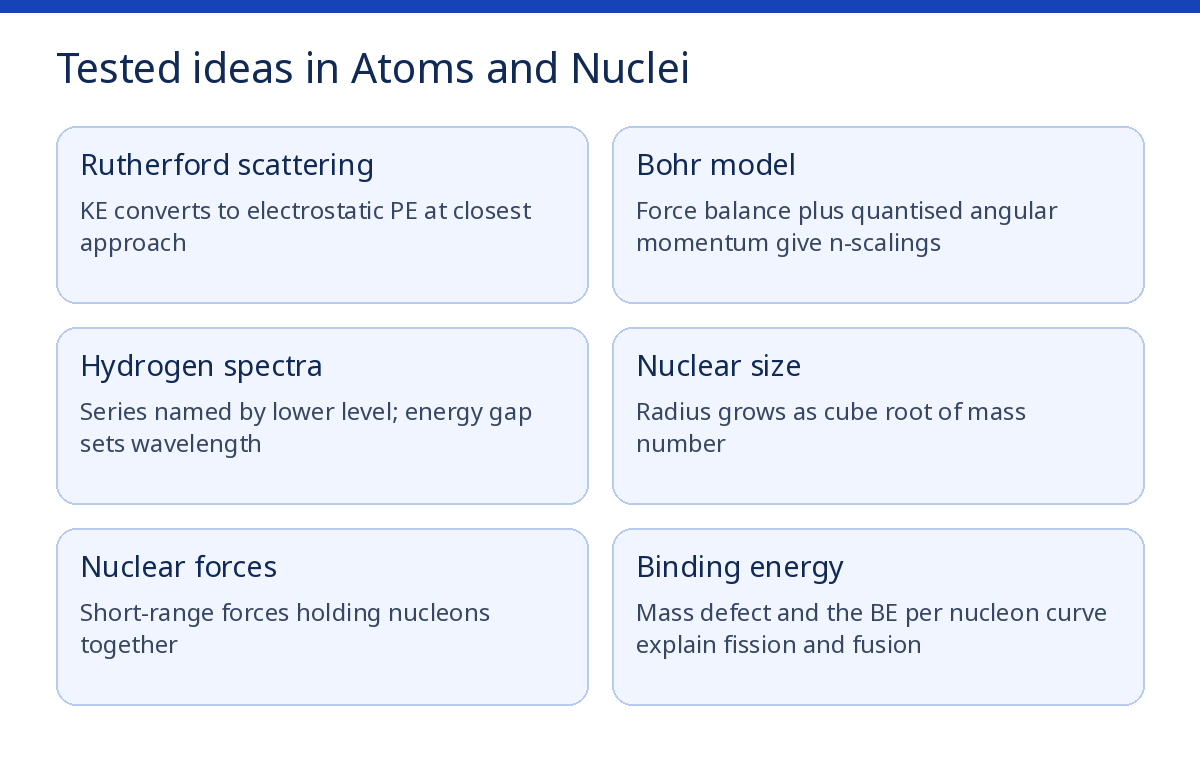
Each of these follows from two conditions:
- the electrostatic force supplies the centripetal force
- angular momentum is quantised,
Combine the two conditions to express and in terms of . From those you can build the time period, the energies and the wavelength .
Some stems give a total energy, such as eV, and ask for the angular momentum. In that case, first identify using the ground-state value of eV quoted in the papers, then apply the quantisation condition. Read phrases such as "second excited state" carefully, because excited states are counted from the ground state.
Signs and energy relations for a bound electron
Assertion-reason items in this block test why the energies have the signs they do. For a bound electron, the electrostatic potential energy is negative because zero is taken at infinite separation. Kinetic energy is always positive, and the total energy is the sum of the two.
The force balance fixes the relationship between kinetic and potential energy. Derive it once, and the ratio questions become routine. The minimum energy needed to free the electron from an orbit equals the magnitude of that orbit's total energy.
Discrete energy levels come from the quantisation postulate. The force balance on its own allows a continuous range of orbits. Matching the right cause to the right effect is exactly what the "correct explanation" codes test.
Spectral series and photon wavelength ratios
Hydrogen-spectra questions take two forms.
The first asks which region of the spectrum a named series, such as Balmer or Paschen, lies in. Anchor each series to its lower level: Lyman ends on , Balmer on and Paschen on . The size of the energy gap then decides the region.
The second form compares photons from two transitions. For example, a stem may give the wavelength for and ask for the wavelength for . Use
and form a ratio so that the constants cancel. Frequency is proportional to the energy gap, while wavelength is inversely proportional to it.
Nuclear radius, nuclide families and nuclear forces
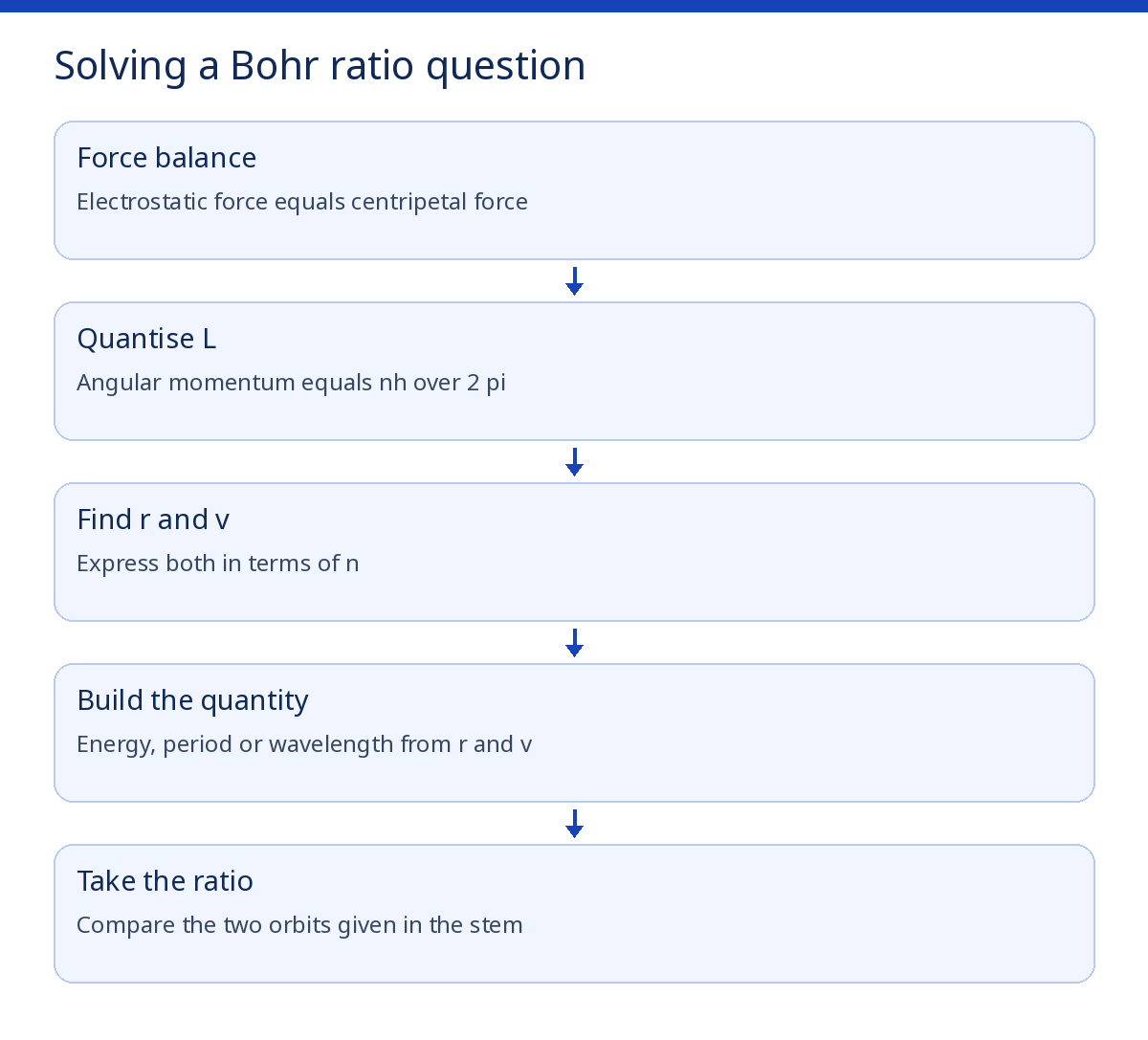
Nuclear-size questions rely on . Radius ratios for two mass numbers therefore need a cube root, not a simple ratio. The same relation shows why nuclear density does not depend on .
Terminology questions ask you to match a name to the quantity the nuclides share:
- isotopes share atomic number
- isobars share mass number
- isotones share neutron number
Questions on nuclear forces test three properties: their short range, whether they depend on the charge of the nucleons, and the separation at which a nucleon pair's potential energy is minimum. Check the powers of ten in each option against nuclear dimensions.
Mass defect, binding energy and energy release
A nucleus has less mass than its separate nucleons combined. This mass defect corresponds to the binding energy , which is the energy needed to separate the nucleus into its nucleons.
The binding energy per nucleon versus mass number curve appears in two ways. Some questions ask you to pick its correct shape. Others build it into assertion-reason items on fission and fusion, where energy is released when the products are more tightly bound per nucleon than the reactants.
For a reaction , comparing with tells you whether energy can be released. When a statement claims something holds "for all nuclei", test it against the actual shape of the curve.
Judging assertion-reason items and using the added solutions
Judge each statement on its own first. Only then decide whether the reason explains the assertion. Some items misprint the first label as "Reason (A)", so read the statements by their position.
The source supplied only an MCQ key, so every worked solution is marked Added solution, and all alternatives are worked through. Where the source wording, values or key are inconsistent, the problem is explained beside the solution and listed in the Source review notes. Read these notes before relying on a key letter.
A workable practice order is:
- the Bohr block
- spectra and Rutherford scattering
- the nuclear topics
- the mixed and subjective questions
Frequently asked questions
Which chapters does this Atoms and Nuclei PYQ collection cover?
It covers CBSE Class 12 Physics Unit VIII: Chapter 12 (Atoms) and Chapter 13 (Nuclei). The questions are labelled with exam years from 2022 to 2026.
Are marks given for each question?
No. Marks are absent from the source question labels, so the collection omits them.
Are the solutions official CBSE answers?
No. The source provided only an MCQ key, so each worked solution is marked as an added solution. Inconsistencies are flagged in the Source review notes.
Spotted an error? Report a correction. Practise this in the app: notes, formula sheets and mind maps.













































































































































































Loading comments…