Atoms: NCERT Solutions for CBSE Class 12 Physics
CBSEPhysicsAtomic Physics
This worked-solutions file covers Exercises 12.1–12.10 from the NCERT Class 12 Physics chapter **Atoms**. Use it to connect atomic models and scattering evidence with hydrogen spectra, then check how you set up calculations for photon energies and Bohr orbits.
What the Atoms solutions cover
The file starts with a comparison of Thomson’s and Rutherford’s models and a question about changing the target in an alpha-particle scattering experiment. The later exercises ask you to interpret hydrogen’s energy levels, relate transitions to observable radiation, and calculate quantities such as orbital radius, speed and period. The final exercise applies Bohr’s angular-momentum condition by analogy to the Earth’s orbit.
Use the worked steps to check how you translate a question into physics. A scattering question calls for an argument about the interaction between projectile and target. A spectrum question calls for a pair of energy levels. An orbital-period question calls for information about motion within one model orbit. Recognising that difference helps you choose a relation before substituting numbers.

Atomic Physics | Class 12 | NCERT Solutions
In the StudentCurio app
Worked NCERT solutions covering atomic models, alpha-particle scattering, hydrogen energy levels and spectral lines, and Bohr-model calculations for orbital radii, electron speeds, and transitions. Helps Class 12 students practise applying atomic-physics concepts step by step.
Atomic size, mass distribution and scattering
When comparing Thomson’s and Rutherford’s models, keep atomic size separate from the distribution of mass and positive charge. The overall size describes the extent of the atom, not how much of that space contains most of its mass. Thomson’s model spreads positive charge through the atom; Rutherford’s concentrates it in a small nucleus. Scattering therefore tells you something about the structure inside the atom, not just its size.
The exercise that replaces gold foil with solid hydrogen asks you to reconsider the target rather than simply reuse the gold-foil result. In comparing the collisions, pay attention to how readily the target nucleus can recoil. The relative masses matter when deciding whether an incoming alpha particle can be turned through a large angle.
Good to remember: Negative level energies are not negative photon energies
The hydrogen energy-level diagram takes the ionisation limit as zero. In the Bohr model, the bound levels obey , where is a positive integer. Levels with larger are higher in energy because they are less negative. They approach zero with increasingly narrow spacing, but no finite bound level has zero energy.
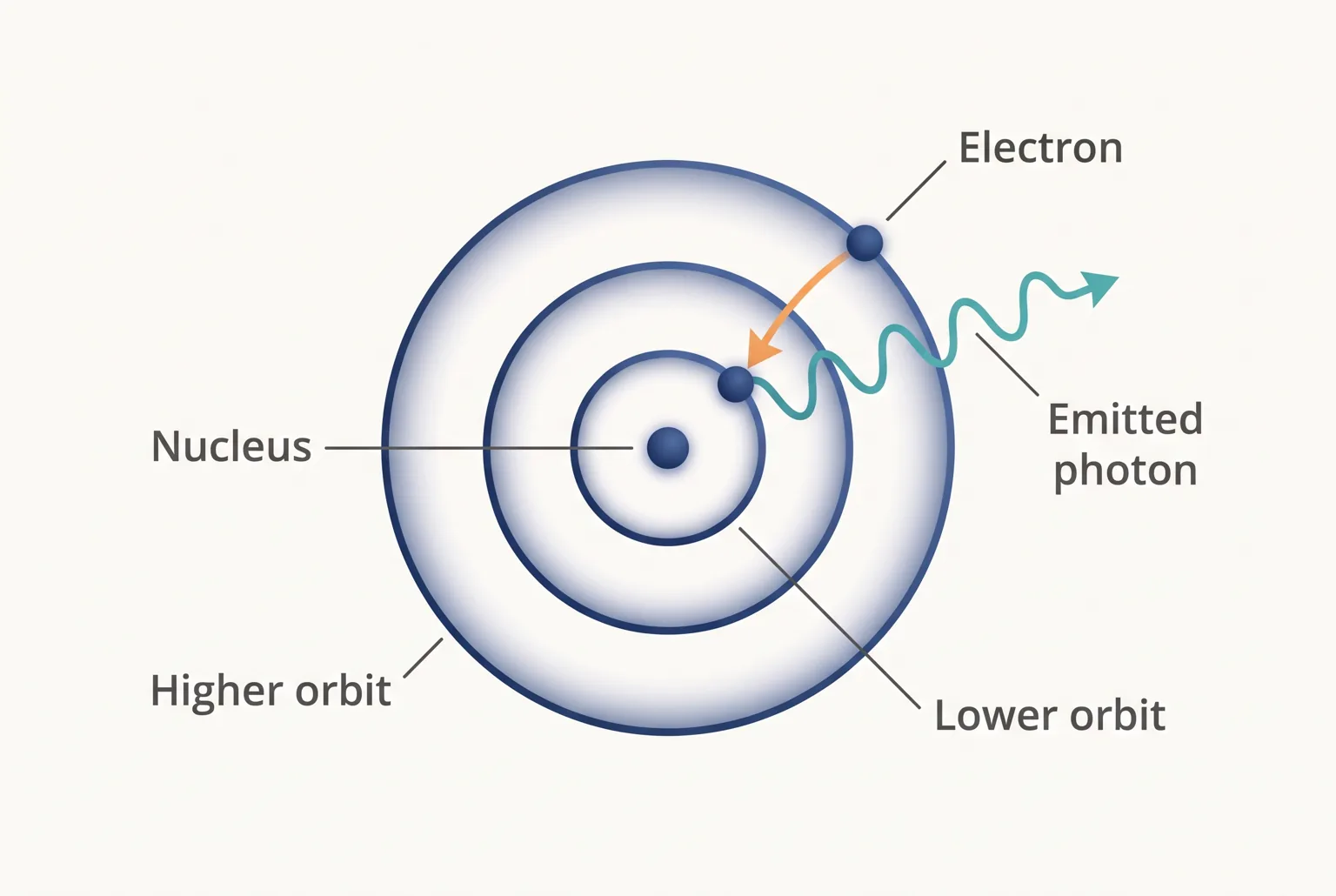
For absorption, the atom gains energy as it moves to a higher level; for emission, it loses energy as it moves to a lower one. In either case, the photon energy is the positive magnitude of the gap. Another distinction matters in the ground-state energy exercise: the negative level energy is total energy, not kinetic energy. In a circular Bohr orbit bound by Coulomb attraction, , so the positive kinetic energy and negative potential energy add to a negative total.
When the wavelength formula applies
For a single photon, , with the wavelength in vacuum. If you use Planck’s constant in joule-seconds, convert the energy gap from electronvolts to joules before calculating frequency or wavelength. The same equations give a useful check on direction: a larger energy gap means a higher frequency and a shorter wavelength.
In the hydrogen emission exercises, a spectral series groups transitions that end at the same lower level. The upper level varies, so the lines in a series do not all have the same wavelength. When using the Rydberg relation for emission, the upper principal quantum number must exceed the lower one. A series limit describes the wavelengths approached as the upper level increases without bound; it is not a transition from another finite bound level.
Exciting hydrogen and tracing its emission lines
The file treats two ways of exciting hydrogen. In photon absorption between bound levels, the photon energy must match the gap for the specified transition. In the electron-beam exercise, the incoming electron can transfer only part of its kinetic energy. Its available energy sets an upper bound on which levels can be reached; it need not deposit that entire amount in the atom.
Separate the excitation question from the emission question when you read the worked solution. First identify which upper levels the interaction can populate. Then consider possible downward transitions: an atom can return directly to a lower level or emit photons in successive steps through an intermediate level. The series name is determined by the destination of each emission step, not by the highest level reached during excitation.
Bohr orbits: Radius, speed and period
The orbit exercises connect three quantities that change differently with the principal quantum number. Within the circular Bohr model for hydrogen, radius scales as while speed scales as . Orbital period is the circumference divided by the orbital speed, . When checking a calculation, make sure the radius and speed refer to the same level. The period is the time for one model revolution, not the period of radiation emitted during a transition.
The Earth-orbit exercise uses as a formal analogy. It applies an angular-momentum condition to the supplied orbital data; it does not use the hydrogen energy-level formula to describe the Earth’s gravitational orbit.
Quick self-check before opening a worked solution
Write down what the question is asking you to compare or calculate before looking at the first worked step. For a model question, can you name the physical feature that changes and the observation it helps explain? For a transition question, can you label the initial and final levels and say whether energy enters or leaves the atom? For an orbit question, can you predict how the requested quantity should change with the level before doing the arithmetic?
When you compare your setup with the file, look for the first point of disagreement. A wrong level, a reversed subtraction or a missed unit conversion needs a different correction from an arithmetic slip.
Spotted an error? Report a correction. Practise this in the app: notes, formula sheets and mind maps.













































































































































































Loading comments…