Atoms: Class 12 CBSE Physics Assessment Guide and Key Ideas
CBSEPhysicsAtomic Physics
This guide to Chapter 12, Atoms, explains the ideas a CBSE Class 12 assessment tests: alpha-particle scattering, the distance of closest approach, the failure of the classical orbit and the hydrogen spectral series. It also covers Bohr energy levels, de Broglie's standing-wave explanation and how the topic sets are framed by marks.
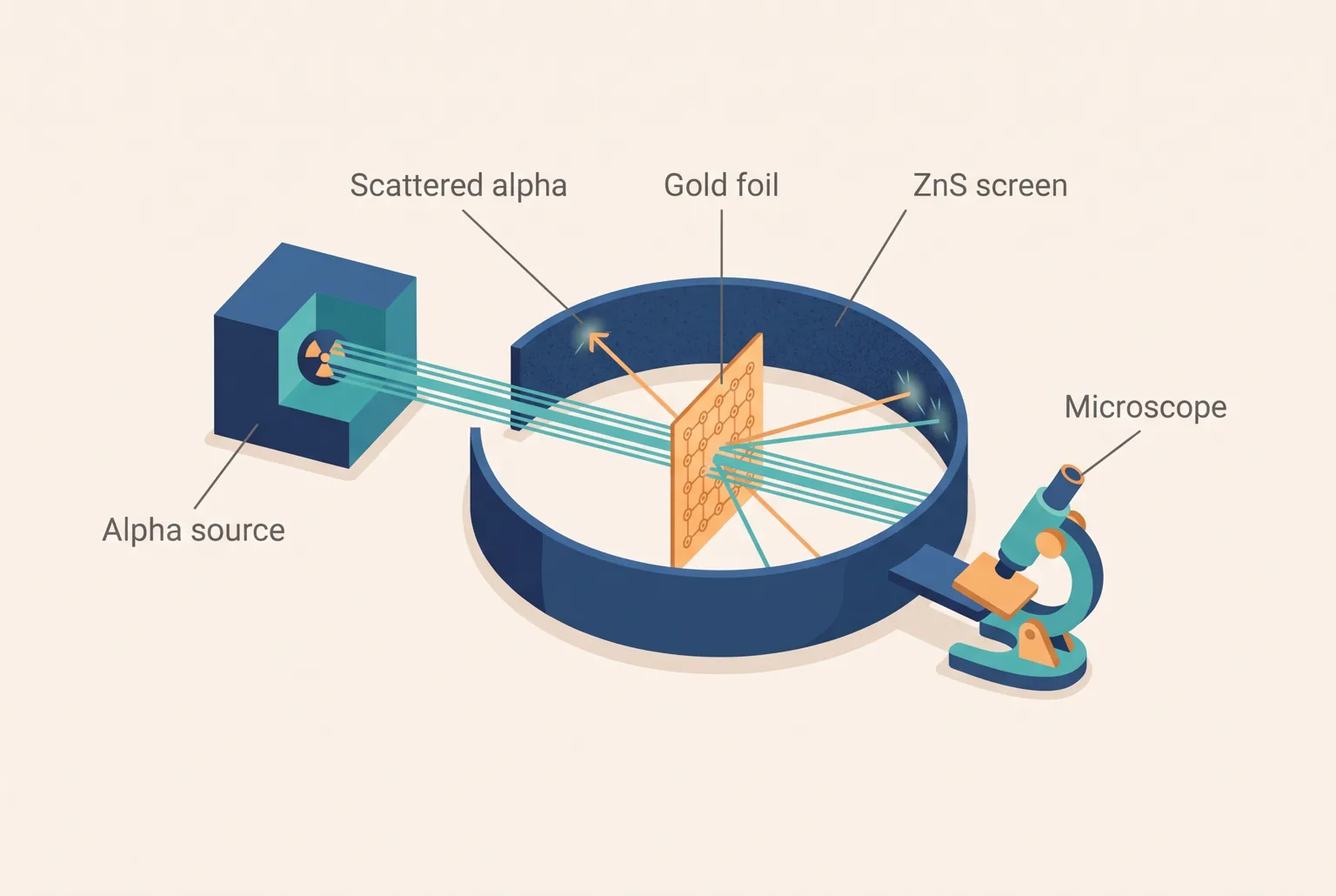
Impact parameter and distance of closest approach
The Geiger–Marsden experiment sent a collimated beam of alpha particles at a thin gold foil. A rotatable zinc-sulphide screen, viewed through a microscope, recorded each scattered particle as a flash of light.
Two observations carry the argument:
- Most alpha particles pass through almost undeflected, so the atom is mostly empty space.
- A very small fraction turns through large angles. Only a tiny, massive, positively charged centre can produce that strong a repulsion.
For a fixed nucleus and a fixed beam energy, an alpha particle's path depends on its impact parameter . This is the perpendicular distance of its initial line of motion from the centre of the nucleus. A small gives a close approach and a large deflection, while a large gives a small deflection.
In a head-on approach, the alpha particle momentarily stops at the distance of closest approach . At that point all its kinetic energy has become electrostatic potential energy. Since the alpha particle carries charge and the nucleus carries :
This gives , which is the basis of the ratio questions. The assessment supplies MeV fm, so you can keep in MeV and get in femtometres ( fm m).
The derivation assumes the target stays at rest. That is justified for heavy nuclei, which take up negligible recoil energy.

Atomic Physics | Class 12 | CBSE Assessment
In the StudentCurio app
122 Class 12 Physics questions on atoms, arranged by NCERT topic and matched to the 2025-26 CBSE syllabus, with step-by-step worked solutions. Five topic sections (alpha-particle scattering and Rutherford's nuclear model; atomic spectra; Bohr model of the hydrogen atom; line spectra of the hydrogen atom; de Broglie's explanation of Bohr's postulate), each with MCQs, 2-, 3- and 5-mark questions and a 4-mark case-based question, plus assertion-reason items.
Why the classical orbiting electron fails
In Rutherford's nuclear model, the Coulomb attraction supplies the centripetal force on the electron. That fixes the electron's kinetic energy at a given orbit radius .
Take the potential energy as zero at infinite separation. Then , and the total energy comes out negative. A negative total energy means the electron is bound: energy must be supplied to remove it to infinity.
Classical physics then runs into trouble. An orbiting electron is accelerating, and an accelerated charge radiates. The electron should therefore lose energy continuously and spiral into the nucleus. The source stresses two consequences of this picture:
- The atom would be unstable.
- It would emit a continuous range of frequencies.
Real atoms are stable and give discrete line spectra. That mismatch is the bridge to Bohr's model.
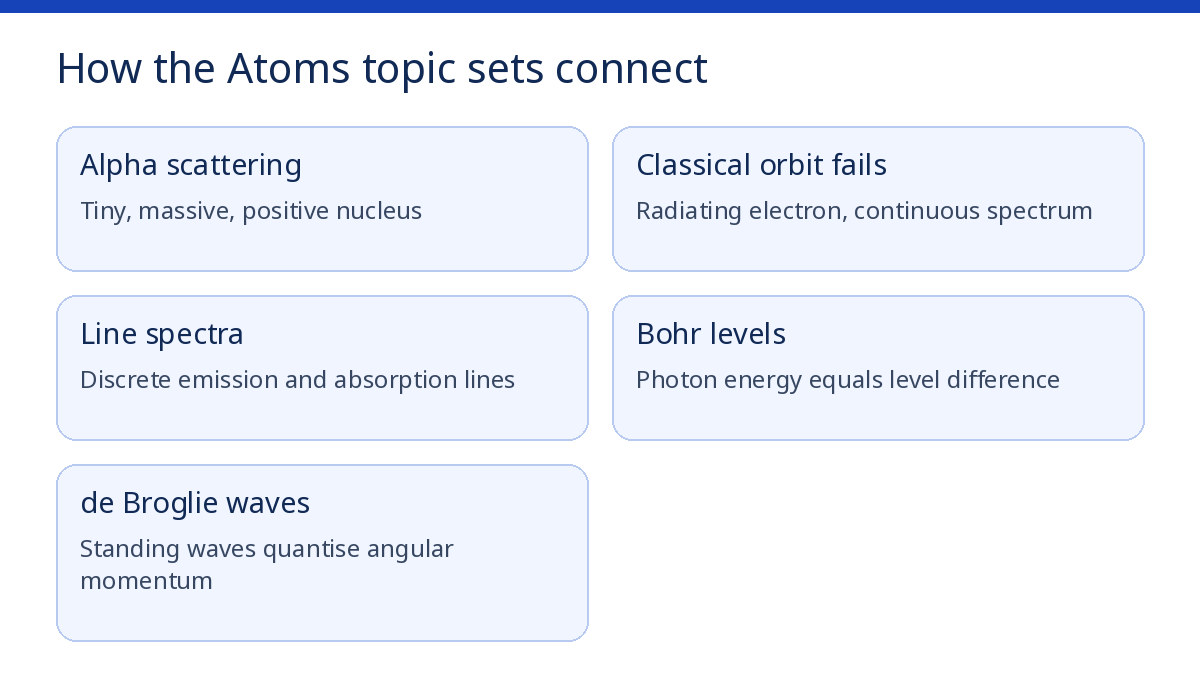
Emission, absorption and the hydrogen series
An excited atom emits a characteristic emission line spectrum. In an absorption spectrum, dark lines appear at wavelengths the atom takes up from incident light.
The questions ask you to explain why these dark lines sit at the same wavelengths as some of the bright emission lines. Both kinds of line come from transitions between the same fixed energy levels.
Hydrogen's lines fall into five series: Lyman, Balmer, Paschen, Brackett and Pfund. Each series is described by the Rydberg formula, using . Every line in a series ends on the same lower level. The Lyman series, for example, ends on .
The topic set expects you to:
- identify the series a given wavelength belongs to;
- place each series in the ultraviolet, visible or infrared region;
- find the longest and shortest wavelengths of a series;
- compare series limits as ratios.
The shortest wavelength, called the series limit, corresponds to a transition from . The longest wavelength comes from the adjacent upper level.
Bohr energy levels and transition energies
The cover diagram shows the hydrogen energy levels:
- eV for
- eV for
- eV for
- eV at the ionisation limit
A photon emitted in a transition carries away the difference between two levels.
For the Lyman-α line, the jump from to releases eV. Using eV nm gives nm, which matches the cover.
This level-difference reasoning connects the Bohr model topic (postulates, orbit radius, speed and energy levels) with the line-spectra topic (transitions, series wavelengths and hydrogen-like ions). Unit care matters throughout: keep energies in eV and use in eV nm, or convert consistently to joules and metres.
de Broglie's standing waves and Bohr's second postulate
Bohr's second postulate quantises the electron's angular momentum. De Broglie explained this by treating the orbiting electron as a wave.
A stable orbit is one in which the electron wave forms a standing wave. That happens when the circumference holds a whole number of wavelengths: . Combining this condition with the de Broglie wavelength leads to quantised angular momentum.
This topic set links the wave picture of matter to the allowed orbits of the Bohr model.
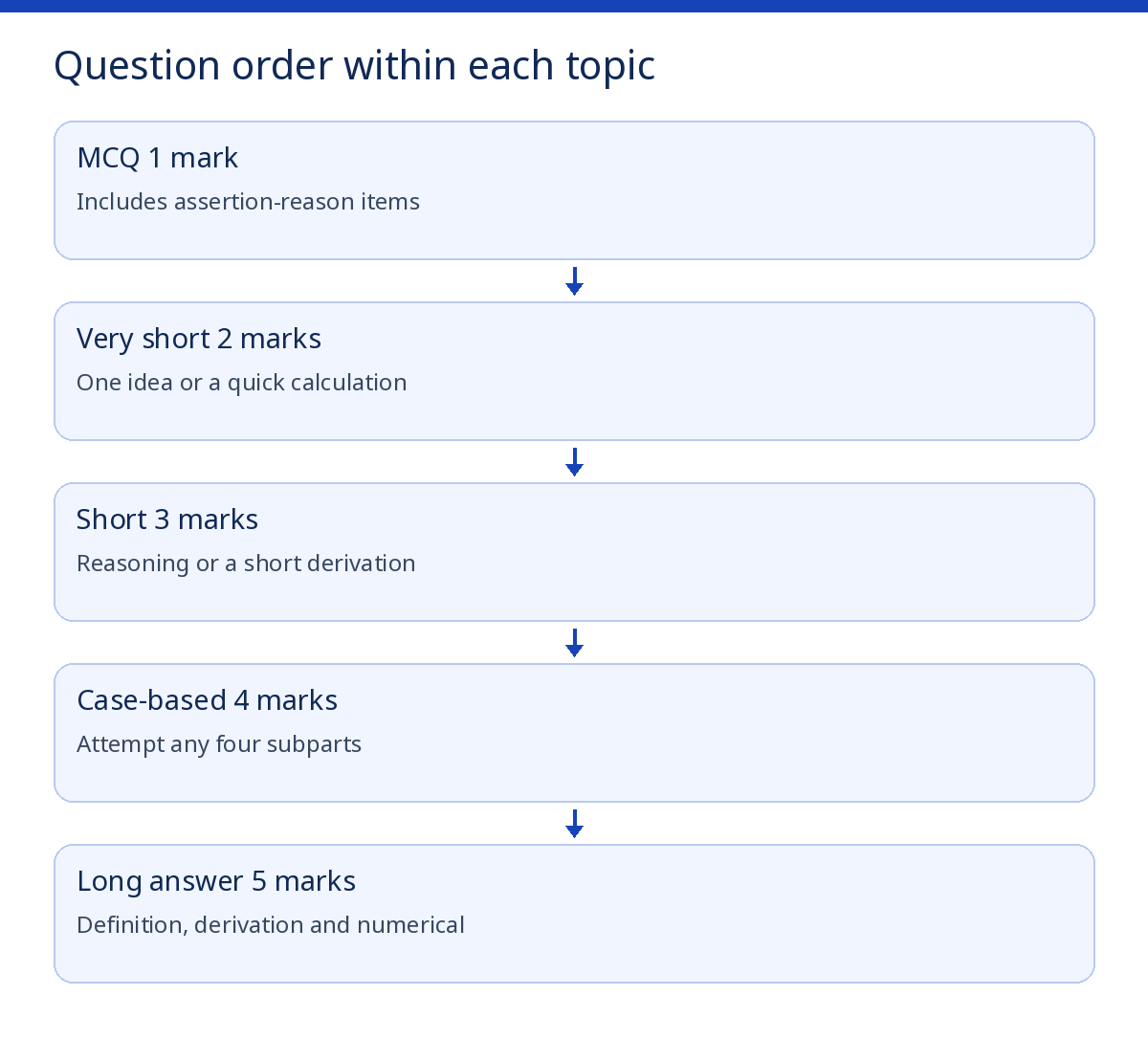
How each topic set is framed for board marks
The assessment follows the NCERT sections 12.2 to 12.6 and holds 122 questions numbered continuously:
- 19 on Rutherford scattering
- 17 on atomic spectra
- 41 on the Bohr model
- 29 on line spectra
- 16 on de Broglie's explanation
Within each topic, questions run in a fixed order: MCQs (1 mark), very short answer (2 marks), short answer (3 marks), a case-based question (4 marks) and long answer (5 marks). Assertion–reason items appear among the MCQs.
The case-based scattering question describes an actual experimental setup and asks you to attempt any four subparts. The 5-mark questions combine a definition, a derivation and a numerical substitution.
Each topic opens by listing the constants to use. Work each topic set in order before mixing topics, and attempt a whole section before opening its worked solutions. The solutions are written in numbered steps, so compare your answer step by step rather than only checking the final value.
Common mistakes the worked solutions correct
The worked solutions repeatedly correct a small set of errors:
- Sign of energy: the electron's total energy in an orbit is negative, but its kinetic energy can never be negative.
- Charge of the alpha particle: use , not , in the Coulomb energy.
- Mass versus charge: with , and fixed, scattering by a heavy nucleus depends on the Coulomb force, which depends on charge, not on nucleon mass.
- Role of electrons: an alpha particle is thousands of times heavier than an electron, so electrons barely deflect it. Large-angle scattering must come from the nucleus.
Quick self-check: Can you explain why a thin foil, rather than a thick one, makes each observed deflection interpretable? Can you also explain why the smallest approach distance sets an upper limit on nuclear size?
Frequently asked questions
Which NCERT topics does this Atoms assessment cover?
It covers sections 12.2 to 12.6: Rutherford scattering, atomic spectra, the Bohr model, hydrogen line spectra and de Broglie's explanation of Bohr's second postulate.
Which constants are supplied?
The constants are MeV fm, N m² C⁻², C, m⁻¹ and eV nm, each used where stated.
Spotted an error? Report a correction. Practise this in the app: notes, formula sheets and mind maps.













































































































































































Loading comments…