Alternating Current: CBSE Class 12 PYQs and Key Ideas
CBSEPhysicsAlternating Currents
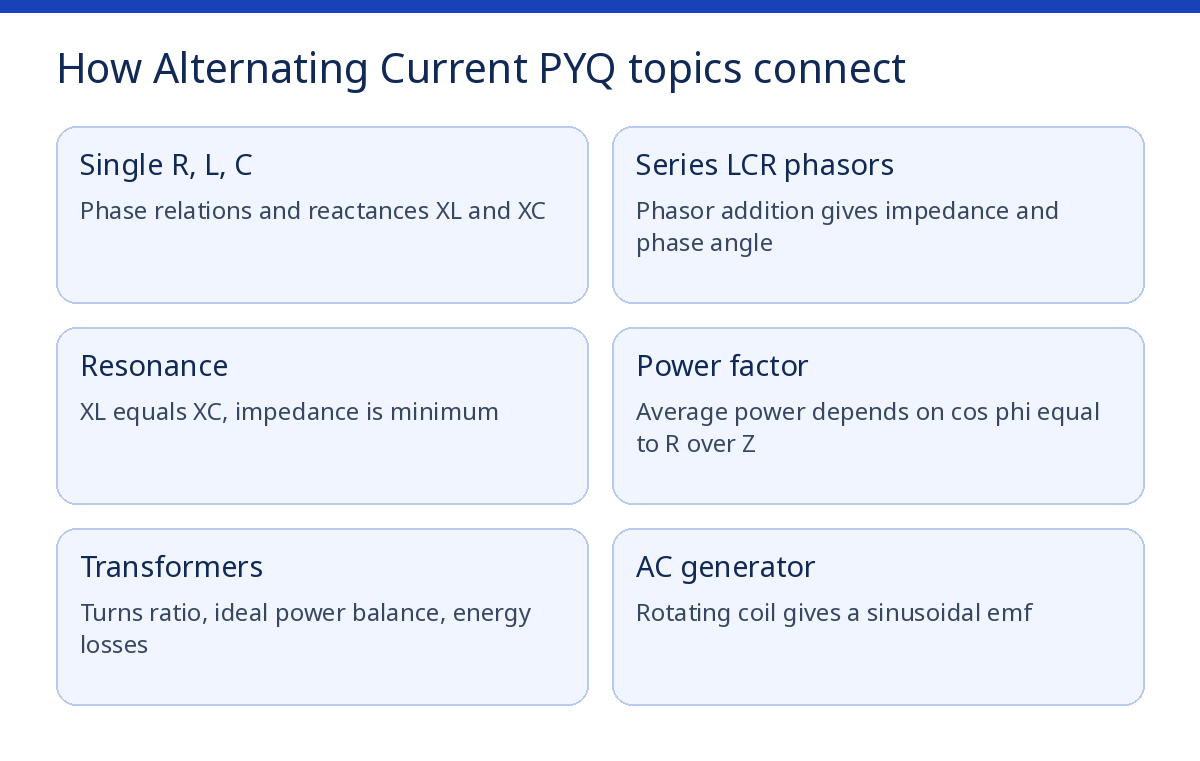
This guide explains the NCERT Class 12 chapter Alternating Current through the ideas its CBSE previous year questions test: phase relations in R, L and C, the series LCR phasor diagram, resonance, rms values and power factor, transformers and the ac generator. It also shows how the collection's 98 questions are indexed and gives a practice order through its subjective and MCQ blocks.
How 98 AC questions are spread across seven sub-topics
The collection's cover lists 98 previous year questions, with exam-year coverage printed as 2021 and 2023–2026. Questions keep their original serial order and exam labels, such as the year, the set number and whether the paper was a compartment paper.
A topic index groups them as follows:
- AC quantities and power: 17
- Pure resistor, inductor and capacitor circuits: 22
- Series LCR circuits and phasors: 20
- Resonance and frequency response: 10
- Transformers: 15
- Induction and generators: 1
- Mixed alternating-current PYQs: 13
The numbers show that most marks come from single-element circuits and the series LCR circuit. The "mixed" questions are usually long answers with an internal choice (OR). One option might be an LCR derivation and the other a transformer or generator. A few OR alternatives draw on neighbouring chapters, for example Lenz's law, self-inductance or an electron moving in a magnetic field.

Alternating Currents | Class 12 | Previous Year Paper
In the StudentCurio app
A comprehensive 92-page collection of solved previous year questions for CBSE Class 12 Physics, covering LCR circuits, resonance, power factor, transformers, and AC generators.
Phase and reactance in a single R, L or C element
Many questions connect one element to and ask you to identify the element from its phase. Some give a current such as . Others say the current "leads" or "lags" by .
The standard results are:
- In a resistor, voltage and current are in phase.
- In an ideal inductor, voltage leads current by , and the inductive reactance is .
- In an ideal capacitor, current leads voltage by , and the capacitive reactance is .
Graph-based stems ask how resistance, and change with frequency. Resistance does not depend on frequency. rises in proportion to . falls as .
The same reasoning explains questions about a bulb in series with a coil. The coil's reactance depends on both and the source frequency. Changing either one changes the current, and so changes the glow of the bulb. Questions that compare a coil's current on dc and on ac use this idea too.
Deriving series LCR impedance with a phasor diagram
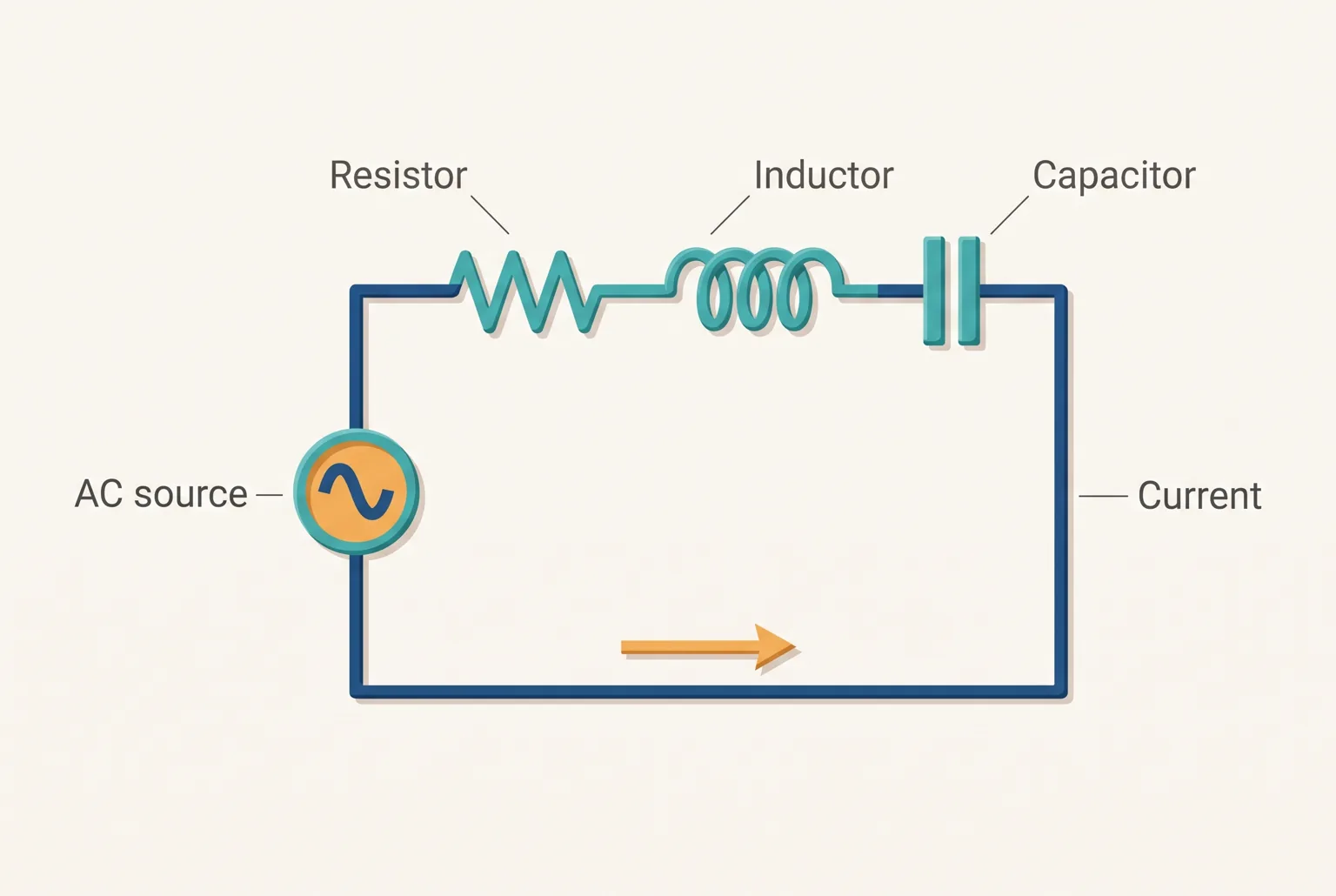
The most frequent long-answer task asks you to draw the phasor diagram for a series LCR circuit and derive its impedance and the phase angle. Examiners expect these steps:
- Draw the current phasor first, because the same current flows through every element in series.
- Draw along the current, leading it by , and lagging it by .
- Combine and , which point in opposite directions, then add the result to as vectors.
- Write the result and .
Some questions instead ask you to distinguish resistance, reactance and impedance. Reactance comes from L or C alone. Impedance is the combined opposition, including R.
Other questions ask whether the voltage across L or C can be larger than the source voltage. Others note that the rms voltages across the elements add up to more than the supply voltage. Both questions check whether you understand that these voltages must be added as phasors, not as plain numbers.
Resonance and how impedance varies with frequency
In a series LCR circuit, resonance occurs when . At this point the reactive terms cancel and reaches its minimum value, . The resonant angular frequency is , so it depends only on and .
The resonance questions in this collection are framed in four main ways:
- derive the condition for resonance
- name the factors that set the resonant frequency
- sketch how impedance or current varies with frequency
- find current or power at resonance in a variable-frequency circuit
Your sketch should show current peaking at , which is where the impedance is smallest.
rms values, average power and power factor
Questions on AC quantities and power often start by asking you to distinguish the peak value from the root mean square value. They then ask you to derive . The derivation averages over one cycle.
For power, the derivation leads to . Here is the power factor.
From this one expression you can reason through several common stems:
- when power is maximum or minimum
- why an ideal inductor dissipates no average power
- what conditions give wattless current
- what the power factor is for a purely inductive circuit compared with a purely resistive one
Transformers, turns ratio and energy loss
Transformer questions fall into two groups.
The descriptive questions ask for:
- a labelled diagram of a step-up transformer
- its working principle
- the ratio
- the causes of energy loss in a real transformer
The numerical questions give the turns and the input power or voltage. For an ideal transformer, use alongside the turns ratio.
Several stems test conceptual understanding rather than calculation. They ask whether a transformer can work with dc, whether a step-up transformer can be used as a step-down one, and whether stepping up voltage breaks conservation of energy. Another asks for two disadvantages of transmitting ac at low voltage and high current. You can answer this using the power relation above.
AC generator emf and question variations
Generator questions ask for the principle, a labelled diagram, the construction and the working, followed by the induced emf. For a coil of turns and area rotating at angular speed in a field , the result is , with peak value .
Related parts ask:
- at which instants in a period the emf is maximum
- what the flux is when the current is zero
- how the armature of commercial generators is made to rotate
A practice order through the Subjective and MCQ blocks
The contents page shows a Subjective block and an MCQ (Single Correct Answer) block. Each has a matching solutions section, and the file ends with source review notes. Links inside the PDF connect each question to its solution.
A sensible order follows the theory above:
- Start with single-element questions.
- Move on to LCR phasor derivations.
- Then work through resonance and power.
- Finish with transformer and generator questions.
- Save the mixed internal-choice questions for timed practice.
Attempt each derivation in writing before you open its solution. Then compare your phasor diagram and the order of your steps with the solution. Check the review notes for anything flagged about a question.
Frequently asked questions
Does this collection include MCQs as well as long answers?
Yes. The contents list a Subjective section and an MCQ (Single Correct Answer) section, and each has its own worked solutions.
Which sub-topic has the most questions?
The topic index places 22 questions under pure resistor, inductor and capacitor circuits. Series LCR circuits and phasors comes next with 20.
Spotted an error? Report a correction. Practise this in the app: notes, formula sheets and mind maps.













































































































































































Loading comments…