The d- and f-Block Elements: CBSE Class 12 PYQs and Solutions
CBSEChemistryThe d- and f-Block Elements
The d- and f-Block Elements (CBSE Class 12, Chapter 4) is tested through configuration reasoning, E° trends, colour and magnetism, oxoanion redox and f-block contraction. This guide explains those ideas and how the collection frames its subjective, case-based, MCQ and assertion-reason questions.
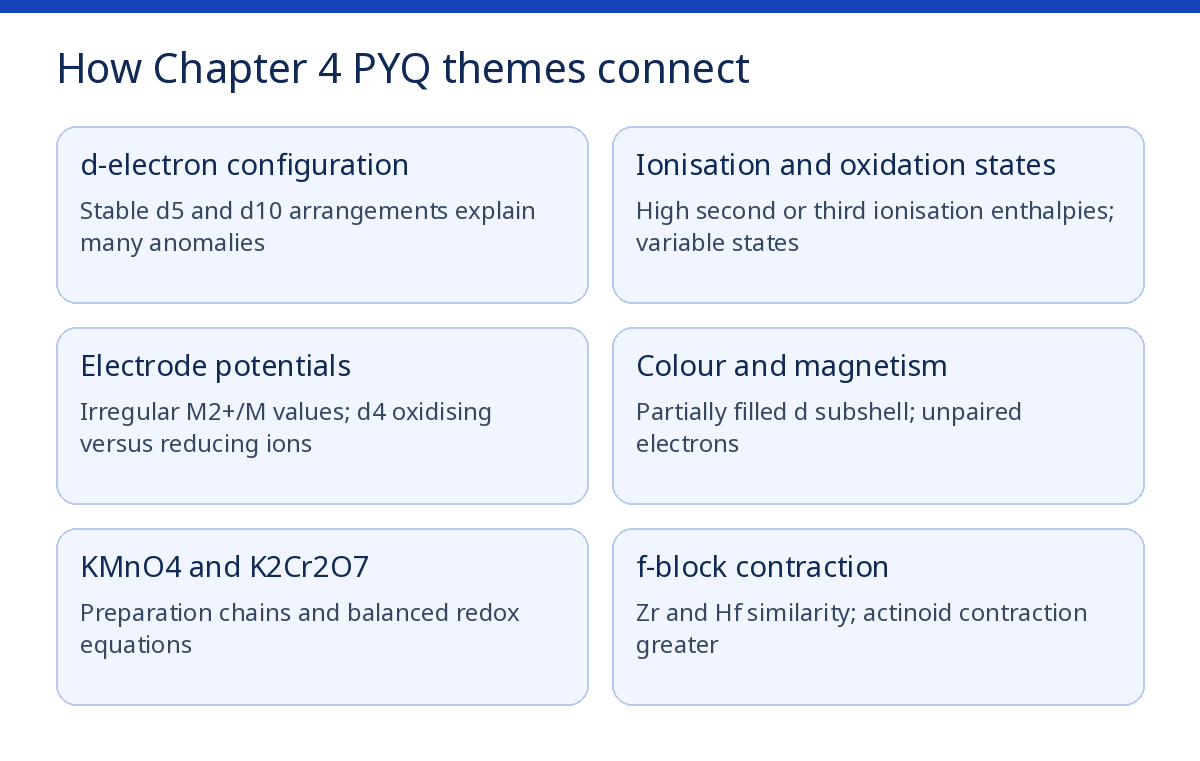
Eight themes that Chapter 4 board questions keep testing
The collection carries exam-year labels from 2022 to 2026. Its topic finder sorts the questions into eight themes:
- catalysis, alloys and interstitial compounds
- chromium compounds and dichromate
- colour and magnetic behaviour
- electrode potentials and redox stability
- electronic configurations and oxidation states
- lanthanoids and actinoids
- manganese compounds and permanganate
- physical properties and metallic bonding
The longest lists belong to three themes: electrode potentials, electronic configurations, and the lanthanoids and actinoids. Many questions carry several tags because a single board question can combine an argument with a lanthanoid part.
The file numbers this chapter as Chapter 4, following the current CBSE sequence. Older NCERT editions call it Chapter 8.

The d- and f-Block Elements | Class 12 | Previous Year Paper
In the StudentCurio app
A comprehensive 146-page collection of solved previous year questions (PYQs) for CBSE Class 12 Chemistry, covering transition and inner-transition elements. It includes MCQs, case-based problems, and long-form subjective questions with detailed step-by-step solutions.
Explaining ionisation enthalpies through stable d configurations
Many subjective stems are short "Why?" questions. They ask why the second ionisation enthalpies of Cr and Cu are exceptionally high, why the third ionisation enthalpy of Mn is very high, or which 3d element does not show variable oxidation states.
The common tool is the electron configuration of the ion formed, not just that of the atom. Removing an electron from a half-filled or completely filled arrangement costs extra energy, because these arrangements are especially stable. Cr is , Cu is and Mn is .
A full-mark answer usually follows three steps:
- Write the relevant configuration.
- Name its stability.
- Link that stability to the energy needed.
The definition questions about Zn, Cd and Hg work the same way. The case-based passage describes transition metals as having partially filled d orbitals in the free elements or their cations. Test each element's configuration against that phrase.
Reading $E^\circ$ trends across the 3d series
One 2026 question prints values for V, Cr, Mn, Fe, Co, Ni and Cu: −1.18, −0.91, −1.18, −0.44, −0.28, −0.25 and +0.34 V. It then asks three things: why the trend is irregular, why Cu is exceptionally positive, and why Mn is highly negative.
In the NCERT treatment, is the net result of three energy terms:
- enthalpy of atomisation
- ionisation enthalpies
- hydration enthalpy of the ion
Irregularities appear where these terms do not change smoothly. Stable (Mn) and (Zn) configurations are the usual starting points.
For couples, compare the configurations on both sides. One question quotes +1.57 V for the Mn couple. The pair also appears repeatedly: Cr is reducing and Mn is oxidising. Ask which change produces the more stable configuration. Cr is and Mn is .
Colour, paramagnetism and catalysis from (n−1)d electrons
The 2024 case passage links the involvement of electrons to four features: variable oxidation states, paramagnetism, catalytic properties and coloured ions.
Colour. Stems ask which of Cu, Sc, Fe, Ti and Zn are coloured. Colour needs a partially filled d subshell. Count the d electrons in each ion; and ions lack d–d transitions.
Magnetism. Paramagnetism comparisons, such as Mn versus Ti, depend on the number of unpaired electrons.
Catalysis and physical properties. Other stems ask why transition metals are good catalysts, why VO acts as a catalyst, and why they form interstitial compounds with H, B, C and N. A separate group deals with metallic bonding: high enthalpies of atomisation and melting points, Cr versus Mn, and the softness of Zn, Cd and Hg.
Balancing permanganate and dichromate equations by electron count
"Complete and balance" questions recur across the labelled years. They pair MnO or CrO with reductants such as Fe, I, CO, SO, S, HS or Sn.
Start from the acidic-medium half-equations:
Scale the reductant's half-equation until the electrons cancel. Then check atoms and charge. This method explains printed coefficients such as .
Watch the medium. Some stems ask for both acidic and alkaline reactions with I, or ask why permanganate titrations avoid HCl. Do not reuse the acidic half-equation for an alkaline or neutral reaction.
Preparation chains. These are framed as identification puzzles:
- Chromite fused with NaCO in air gives a yellow chromate. Acidification, then reaction with KCl, leads to an orange dichromate.
- Pyrolusite fused with KOH in air gives a dark green manganate, which leads to purple permanganate.
The orange-to-yellow change with alkali shows that the chromate–dichromate balance depends on pH.
Lanthanoid and actinoid contraction and their consequences
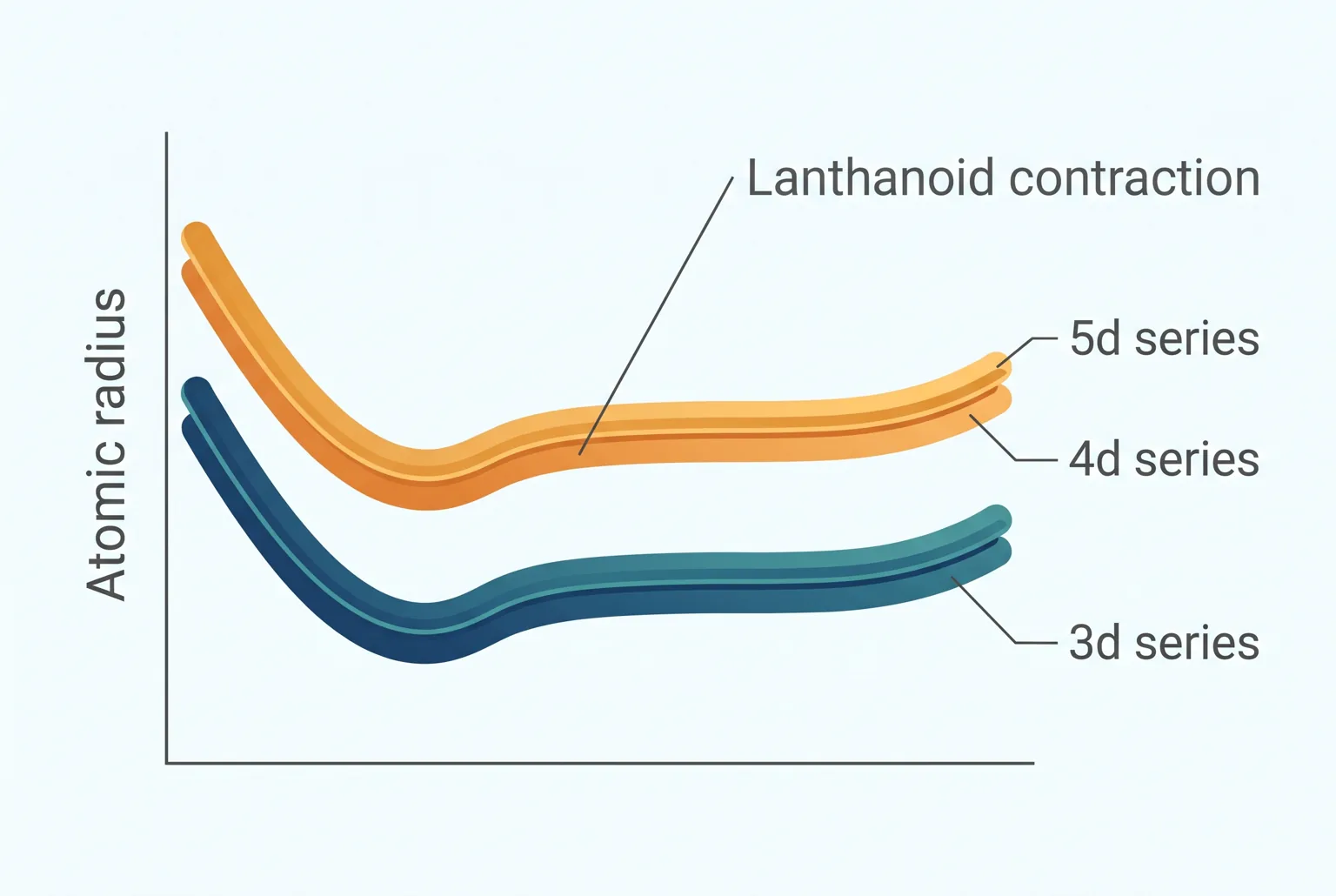
The 2026 case passage states the key fact. Atomic radii increase much more from 3d to 4d than from 4d to 5d. The second and third series are almost the same size because of lanthanoid contraction. Questions turn this into Zr–Hf similarity, a definition, or "write two consequences".
Actinoid stems ask why actinoid contraction is greater from element to element than lanthanoid contraction. They also ask why actinoid chemistry is more complicated; one question notes that actinoids show a wide range of oxidation states.
Other lanthanoid parts cover:
- Ce as an oxidising agent, and the easy oxidation of Ce(III) to Ce(IV)
- members showing the +2 and +4 states
- why lanthanoids are hard to separate
- what Misch metal is
Practising the subjective, case-based and assertion-reason sets
The type finder lists:
- 68 subjective questions
- 3 case-based questions
- 60 single-correct MCQs
- 35 assertion-reason questions
- 1 multiple-correct MCQ
Subjective questions often offer an internal "OR" choice. Case-based items give a reading passage followed by "Give reasons" parts.
The original material had answer keys but no complete written solutions. Every worked solution in this edition is therefore labelled "Added solution". Marks appear only where printed. Apparent errors in the original questions are kept and explained, and any corrected equation is identified.
A workable order:
- Take one theme at a time using the topic finder.
- Write full subjective answers before opening the solutions.
- Then attempt the assertion-reason and MCQ blocks, which test the same reasoning more quickly.
Quick self-check: Can you name the configuration behind each Mn anomaly? Can you state the medium before balancing any permanganate equation?
Frequently asked questions
Is this chapter Chapter 4 or Chapter 8?
The collection follows the current CBSE Class 12 Chemistry sequence, where The d- and f-Block Elements is Chapter 4. Older NCERT editions may number it as Chapter 8.
Are the worked solutions taken from the original papers?
No. The supplied material contained answer-key entries and online links but no complete written solutions. The full solutions in this edition are labelled as added solutions.
Spotted an error? Report a correction. Practise this in the app: notes, formula sheets and mind maps.















































































































































Loading comments…