2025 CBSE Class 12 Chemistry Previous Year Paper
CBSEChemistry2025 Previous Year Paper
Paper code: 56/4/3 · 2025Practise with the complete 2025 CBSE Class 12 Chemistry main examination paper, Q.P. Code 56/4/3, Set 3. Use the worked solutions to check how you chose a rule, interpreted a reaction or justified an answer across the five sections.
This set is one of the year's papers. See every set from 2025, grouped by series.
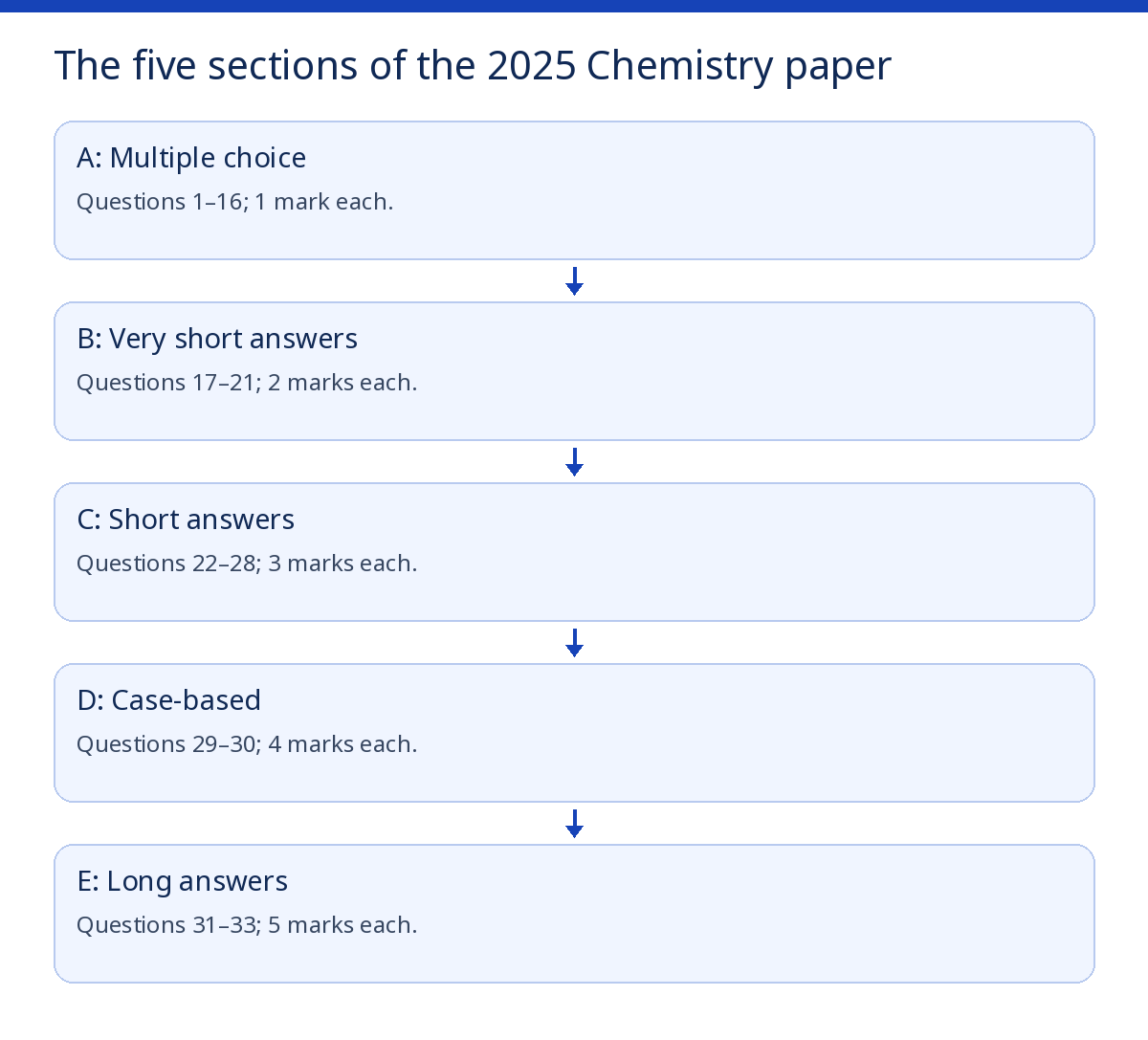
Paper format: what to expect in each section
This English-version Chemistry theory paper is a full, year-wise previous paper, not a chapter worksheet. It carries 70 marks, allows three hours of writing time and contains 33 questions. The printed instructions also give a separate 15-minute reading period and do not allow a calculator.
- Section A: Questions 1–16 are one-mark multiple-choice questions, including assertion–reason items.
- Section B: Questions 17–21 are two-mark very short answers.
- Section C: Questions 22–28 are three-mark short answers.
- Section D: Questions 29–30 are four-mark case-based questions.
- Section E: Questions 31–33 are five-mark long answers.
All question numbers are compulsory. There is no overall choice, but some questions outside Section A offer an internal choice. During the timed attempt, answer only one branch where an OR is printed. Save the unused branch for later practice.

Chemistry 2025 | Class 12 | Previous Year Paper | Code 56/4/3
In the StudentCurio app
The complete 2025 CBSE Class 12 Chemistry main examination paper (Q.P. Code 56/4/3) with worked solutions. It includes questions across physical, inorganic and organic chemistry, including case-based and long-answer questions.
Physical chemistry: choose the equation from the conditions
The paper asks you to interpret how cell voltage changes, calculate the voltage of a voltaic cell under nonstandard conditions, and connect osmotic pressure to an apparent molar mass. In electrochemistry, distinguish the standard cell potential from the potential under the stated conditions. If you use the Nernst equation, balance the cell reaction before deciding the electron count and writing the reaction quotient. Both depend on how you write that reaction.
The kinetics questions shift between a given rate law, concentration data and temperature dependence. Before calculating, ask what the question holds fixed. A change in concentration can change the rate without changing the rate constant at fixed temperature for the same reaction under otherwise unchanged conditions. Keep the time unit consistent when reporting a rate constant, and do not read the experimental reaction order directly from the coefficients of an overall balanced equation.
Inorganic chemistry: make the explanation fit the property
The inorganic questions cover transition-metal ions, contraction across the inner transition series and coordination compounds. The prompts ask for different kinds of reasoning. An explanation about a change in ionic size needs a different argument from one about whether an ion tends to gain or lose electrons. An answer that simply restates the observation does not supply that argument.
The long-answer coordination question brings together ligand strength, spin, magnetism and isomerism. For an octahedral crystal-field question, work from the metal's oxidation state to its d-electron count, then consider the splitting and how the electrons occupy the resulting levels. Count unpaired electrons before making a claim about magnetism. For an isomerism prompt, check what the question asks you to represent: naming the type of isomerism is not a substitute for drawing the corresponding structures when both are requested.
Organic chemistry: follow the reagents and draw the structures
Organic questions ask you to follow reaction sequences, explain differences in reactivity, identify compounds from chemical tests and complete conversions. In a sequence, write the structure after each arrow before moving on. The conditions printed over the arrow are part of the question: aqueous and alcoholic potassium hydroxide appear in different sequences, so treating both as simply “KOH” can hide the distinction the question is testing.
When identifying an unknown, use the molecular formula and the full set of test results rather than relying on one positive result. A negative test can rule out a candidate that otherwise seems to fit. In the comparison questions, keep basicity, boiling point and water solubility separate. They describe different properties; a ranking justified for one does not establish the ranking for another. Check the requested direction of each order before writing it.
Case-based questions: separate the passage from the task
The two case-based questions focus on ideal solutions and nucleic acids. The solutions case moves from a discussion of ideal behaviour to prompts about Raoult’s law and deviations. Read whether the subpart wants a law stated, a deviation explained or an example supplied. If a prompt asks for both an example and a reason, make the connection explicit rather than leaving the example to stand as the explanation.
The biomolecules case uses a passage about sugars and their derivatives to lead into questions about nucleic-acid components and structure. Match the level of your answer to the noun in the prompt: a base, a nucleoside, a nucleotide and a nucleic acid are not interchangeable. For a structural comparison, stay with the feature asked for instead of replacing it with a general description of biological function.
Quick self-check: find the first step you would change
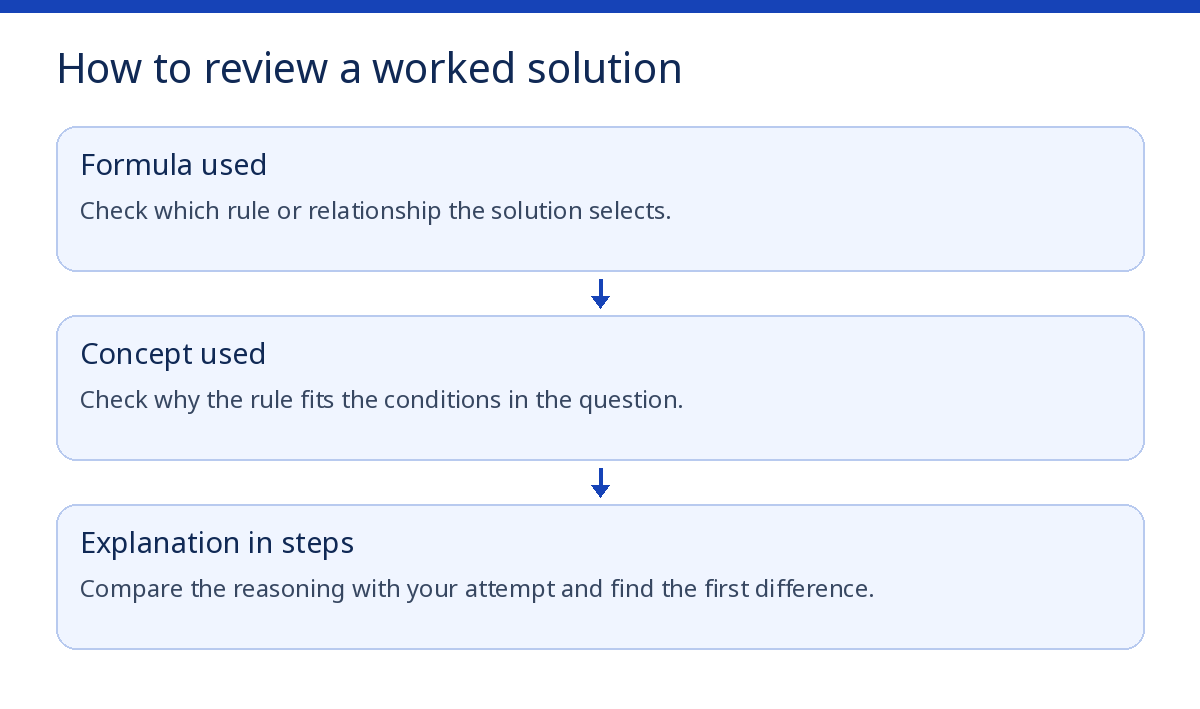
Attempt the paper before opening the solutions. The file preserves the question layout, options and diagrams, and the cover provides a question-number index for review. The worked explanations separate the formula used, the concept used and the steps. Compare your work in that order: did you choose the right rule, did its conditions match the prompt, and did you apply it consistently?
For assertion–reason items, decide whether each statement is true before deciding whether the reason actually explains the assertion. For written answers, identify the first point where your reasoning diverged from the explanation, rather than recording only that the final answer differed. Then revisit an unused internal choice. Can you decide what principle or reaction to use before looking at the worked steps? That is a better check of understanding than recognising a solution you have just read.
Spotted an error? Report a correction. Practise this in the app: notes, formula sheets and mind maps.















































































































































Loading comments…