CBSE Class 12 Chemistry 2022 Term II Previous Year Paper
CBSEChemistry2022 Previous Year Paper
Paper code: 56/2/1 · 2022This full CBSE Class 12 Chemistry theory paper is from the 2022 Term II main board examination. Use Set 1 (paper code 56/2/1) to practise the two-hour, 35-mark format, then use the worked solutions to check the reasoning behind your answers.
This set is one of the year's papers. See every set from 2022, grouped by series.
Read the 2022 Term II format before you start
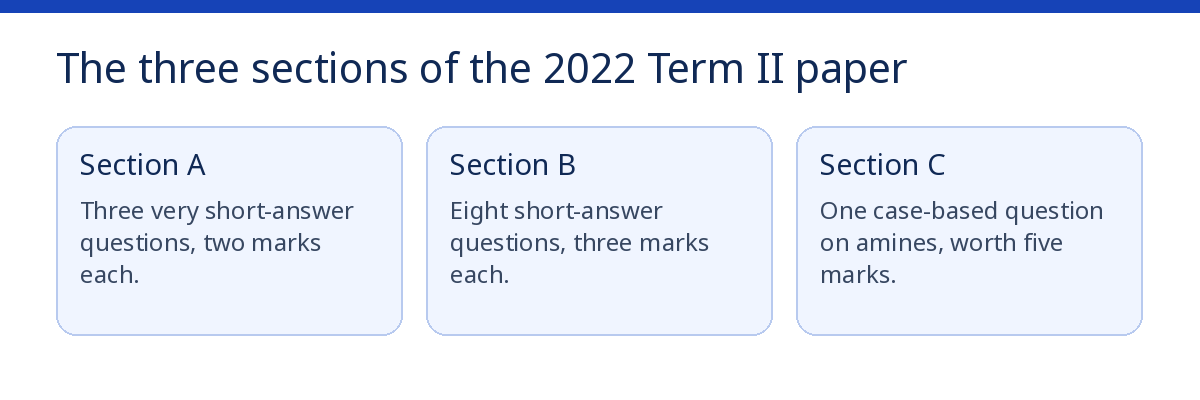
The English question paper has 12 questions across three sections. Section A contains three very short-answer questions worth two marks each. Section B contains eight short-answer questions worth three marks each. Section C contains one five-mark case-based question, built around a passage on amines. These are the conditions of this particular board paper, not a statement about the format of a current CBSE examination.
All numbered questions are compulsory, but that does not mean attempting every alternative. Some questions have an internal OR, and one conversion question asks for a specified number of items from a list. During a mock attempt, follow the choice instruction at each question rather than counting every printed alternative as extra work. The original instructions also specify 15 minutes of reading time without writing answers, and prohibit calculators and log tables.

Chemistry 2022 | Class 12 | Previous Year Paper | Code 56/2/1
In the StudentCurio app
A regular CBSE Class 12 Chemistry main examination paper from 2022 Term II, with worked solutions. It covers questions across organic chemistry, chemical kinetics, ionic dissociation, coordination compounds, electrochemistry, colloids and transition elements.
Two kinetics questions, two different uses of rate
One kinetics question relates the formation and disappearance rates of different species in a balanced reaction. The key distinction is between the rate for an individual species and the reaction rate, which is normalised by the species' stoichiometric coefficient. A reactant's concentration derivative is negative as it is consumed, but its rate of disappearance is expressed as a positive quantity. Keeping that distinction clear helps you check both the sign and the coefficient in your setup.
The other kinetics question concerns a first-order process and asks about half-life. Here the governing relationship comes from the order of the reaction, not from the coefficients in a balanced equation. The integrated first-order expression uses the amount remaining relative to the initial amount, so a percentage decomposed must first be translated into a fraction remaining. A constant half-life is a feature of first-order kinetics; do not assume it for a reaction of unspecified order.
Before calculating: identify the reference condition
The conductivity question connects ionic contributions at infinite dilution with an estimate of dissociation for a weak electrolyte. Distinguish molar conductivity at the stated concentration from limiting molar conductivity. Their ratio estimates the degree of dissociation in the dilute-solution model used here; the two conductivities must be expressed in the same units for that ratio to be dimensionless.
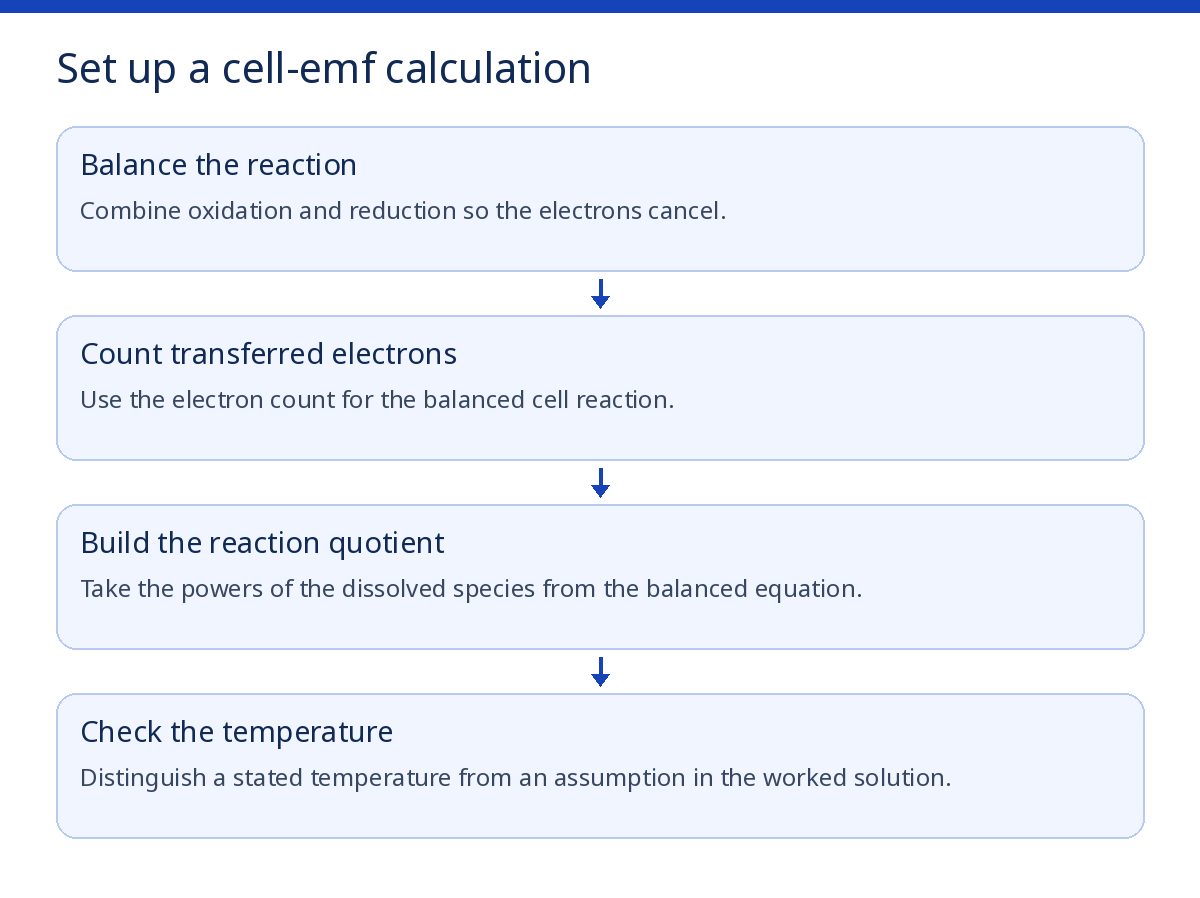
In the cell-emf question, the listed ion concentrations signal that the potential under the stated conditions must be distinguished from the standard cell potential. Balance the cell reaction before deciding the electron count and writing the reaction quotient. The worked solution uses the base-ten form of the Nernst equation at an assumed 298 K because the question does not explicitly give a temperature. Treat that temperature as an assumption, not printed data. Some signs and symbols in the extracted potential data are unclear, so the numerical table is not reproduced here.
What inorganic and surface chemistry ask you to justify
The coordination-compound alternatives exercise different skills. One connects the metal ion's electron count and ligand environment to electron pairing, hybridisation and magnetism in the valence bond model. The other moves between naming, ligand donor behaviour and a stability comparison. When revising ligand types, ask whether the distinction concerns alternative donor sites or the number of sites that bind simultaneously. For stability, distinguish a chelation argument in the intended comparison from an unconditional claim about every medium.
The transition-element questions include explanations of catalytic behaviour, the transition-element classification criterion and similarities in atomic radii. A separate question asks you to interpret a pattern in standard electrode potentials. That pattern reflects several energy contributions, including atomisation, ionisation and hydration, rather than one periodic trend alone. The surface chemistry alternatives likewise call for different kinds of reasoning: comparing sols by shared properties, explaining colloidal motion, or interpreting the temperature dependence of adsorption at equilibrium.
Follow functional groups through the organic questions
The organic questions range from conversions and named preparations to product prediction, acidity comparisons, distinguishing tests and carbonyl derivatives. In a conversion, identify the starting and target functional groups before choosing reagents. In a distinguishing test, the justification is different: identify the structural feature that makes the compounds behave differently and specify what observation would distinguish them. For a derivative, check that the structure represents the new linkage rather than simply copying the original carbonyl group.
The amines case brings basicity, identification tests and reaction sequences into a single passage. Read each subpart for what it actually asks: a reason, a comparison, a test or a set of structures. Keep electron availability, the presence of nitrogen-bound hydrogen and the role of the reaction medium separate. They are related ideas, but they do not explain every aspect of amine behaviour in the same way. Use the original diagrams in the file where the extracted reaction layout is incomplete.
After the mock: find the first step that went wrong
The file links question numbers to worked solutions and presents the formula, concept and explanation in steps. Check your attempt against those steps before looking at the final result. For a calculation, locate the first point of disagreement: the balanced equation, the choice of model, the setup or the arithmetic. For an explanation, check whether you connected the relevant structural feature or chemical condition to the requested observation.
The file also works through the printed OR choices. Once you have finished checking the route you chose under timed conditions, try the unused route separately. A choice between a naming question and an electronic-structure question, for instance, can reveal which skill needs practice without changing how you attempted the original paper.
Spotted an error? Report a correction. Practise this in the app: notes, formula sheets and mind maps.















































































































































Loading comments…