CBSE Class 12 Chemistry 2023 Paper: Set 56/3/3
CBSEChemistry2023 Previous Year Paper
Paper code: 56/3/3 · 2023Practise the full 2023 CBSE Class 12 Chemistry main board paper, Set 56/3/3. Use the original English question layout for a timed attempt, then review your reasoning with the worked solutions.
This set is one of the year's papers. See every set from 2023, grouped by series.
Know the format before you start
This year-wise resource pairs the 2023 CBSE Class 12 Chemistry theory paper with worked solutions. The paper carries 70 marks, with three hours of writing time and a separate 15-minute reading period. The printed instructions do not allow calculators.
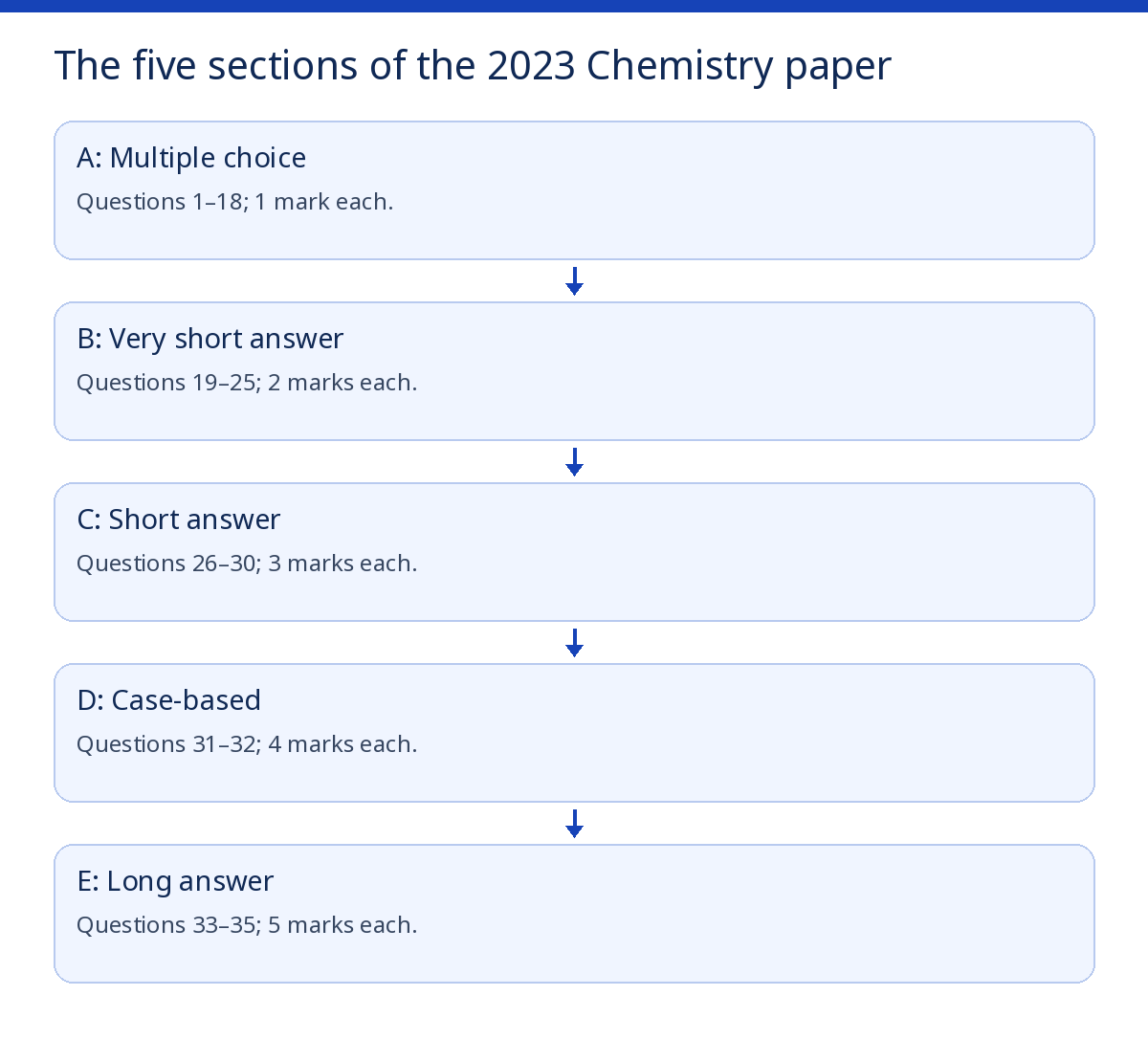
Section A has 18 one-mark MCQs, including assertion–reason items. Section B has seven two-mark very short answers, and Section C has five three-mark short answers. Section D has two four-mark case-based questions, while Section E has three five-mark long answers. There is no overall choice. Internal alternatives appear in Sections B through E, so check whether an OR applies to the whole question or only to a particular subpart.

Chemistry 2023 | Class 12 | Previous Year Paper | Code 56/3/3
In the StudentCurio app
Complete 2023 CBSE Class 12 Chemistry main examination paper (Set 56/3/3) with worked solutions. It covers questions across multiple Chemistry chapters and helps students practise the board paper and review solution methods.
Physical chemistry: When the calculation method applies
Physical chemistry appears in both calculations and explanations. Kinetics questions draw on half-life, reaction order and the effect of temperature on reaction rate. The solutions chapter brings in ideal and non-ideal mixtures, azeotropes and freezing-point depression. Electrochemistry includes molar conductivity, corrosion, fuel cells and cell emf.
Identify the model before substituting numbers. The relationship between half-life and initial concentration depends on the reaction order, and an Arrhenius calculation requires absolute temperatures in kelvin. When a kinetics prompt describes how much reactant has been consumed, distinguish that amount from the amount remaining: it is the remaining concentration that goes into the integrated rate law. In a freezing-point calculation that specifies solute association, account for the change in the number of dissolved particles. When reviewing a cell-emf calculation, check how you assigned oxidation and reduction before looking for an arithmetic error.
Organic chemistry: Match the response to the task
The organic questions ask you to use reaction knowledge in different ways: select reagents, draw products, plan conversions, write equations and explain a mechanism. Topics include haloalkanes and haloarenes, alcohols and phenols, carbonyl compounds, carboxylic acids and amines. In a conversion, read the starting material and target together. Identify the functional group that has to change, then check whether the proposed sequence preserves or changes the carbon skeleton as required. If the question asks for both a structure and an IUPAC name, check that you have supplied both and that they describe the same compound.
A reaction equation shows the overall change; a mechanism explains the steps by which it occurs. Practise that distinction when you reach the alcohol dehydration question. Biomolecules call for a different kind of structural reasoning: when comparing two linkages, explain which units they connect rather than merely naming molecules in which they occur.
Inorganic chemistry: Separate bonding, geometry and magnetism
The inorganic questions cover coordination compounds and the d-block. They draw on ligand binding, isomerism, oxidation states, electronic configurations and the relation between unpaired electrons and magnetic behaviour. The coordination case brings several of these ideas together: one prompt uses precipitation evidence, another asks about isomerism, and another asks for predictions using Valence Bond Theory.
Distinguish what is bonded to the metal from what lies outside the coordination sphere. The distinction matters when interpreting evidence about ions in solution. It also helps you tell two kinds of isomerism apart: linkage isomerism concerns which donor atom binds to the metal, while ionisation isomerism concerns an exchange between a coordinated ligand and a counterion. For geometry and magnetism, establish the metal's oxidation state and d-electron count before applying the requested bonding model. The d-electron count alone does not necessarily establish how many electrons are unpaired in a complex.
Quick self-check: Test the claim and read the case
For assertion–reason items, ask three questions before choosing a response: Is the assertion true? Is the reason true? If both are true, does the reason actually explain the assertion? A reason can be a true statement on the same topic without explaining the particular claim.
For the case-based questions, ask instead: What does the passage tell me, and what must I supply from chemistry? The haloalkane and coordination passages introduce concepts, but their subparts ask you to apply them to particular structures, conditions or observations. For a subpart that asks you to predict or explain, check whether you can point to the relevant evidence and name the principle that connects it to your response.
Use the worked solutions for a second pass
For a mock attempt, leave the solutions closed. Use the reading period to locate internal choices and identify where questions call for more than one output. Attempt one branch at each printed OR. Save the unused branches for later practice; the resource includes worked solutions for both alternatives.
Afterwards, use the question-number links to compare your method with the formula, concept and step-by-step explanation in the file. Locate the first step where your reasoning diverged. Distinguish a wrong choice of model from an error in reading the prompt, applying a condition or carrying out the calculation. Then retry the question without the explanation in view. This guide omits option-level judgments for Questions 2, 8, 9 and 13 because the solution notes flag wording or option issues. Treat those items as prompts for discussion rather than straightforward scoring checks. If a symbol, charge or sign is unclear in extracted text, consult the printed notation before drawing a conclusion.
Spotted an error? Report a correction. Practise this in the app: notes, formula sheets and mind maps.















































































































































Loading comments…