CBSE Class 12 Chemistry 2023 Previous Year Paper: Set 2
CBSEChemistry2023 Previous Year Paper
Paper code: 56/2/2 · 2023Practise with the full 2023 CBSE Class 12 Chemistry main examination paper, Set 2 (56/2/2). Use it to rehearse the 70-mark theory exam and see whether your mistakes come from choosing the wrong concept, misreading the question or leaving out part of the answer.
This set is one of the year's papers. See every set from 2023, grouped by series.
What this 2023 paper contains
This year-wise file presents the English version of the CBSE Class 12 Chemistry theory paper from the 2023 main board examination. It contains 35 questions and allows three hours for writing. The printed instructions also specify a separate 15-minute reading period and prohibit calculator use. Keep the question-paper code, 56/2/2, with your notes so that you can match each attempt to the right set when you review it.
The paper draws on physical, inorganic and organic chemistry, with biomolecules also appearing in the assessment. Because the topics are mixed rather than grouped into chapter exercises, you have to identify the relevant idea from the wording, data or structure in front of you.

Chemistry 2023 | Class 12 | Previous Year Paper | Code 56/2/2
In the StudentCurio app
The complete 2023 CBSE Class 12 main Chemistry examination paper covers questions across organic, inorganic and physical chemistry. It also includes a worked solution to a question on Gabriel phthalimide synthesis, helping students practise the board-paper format and review solution methods.
How the five sections differ
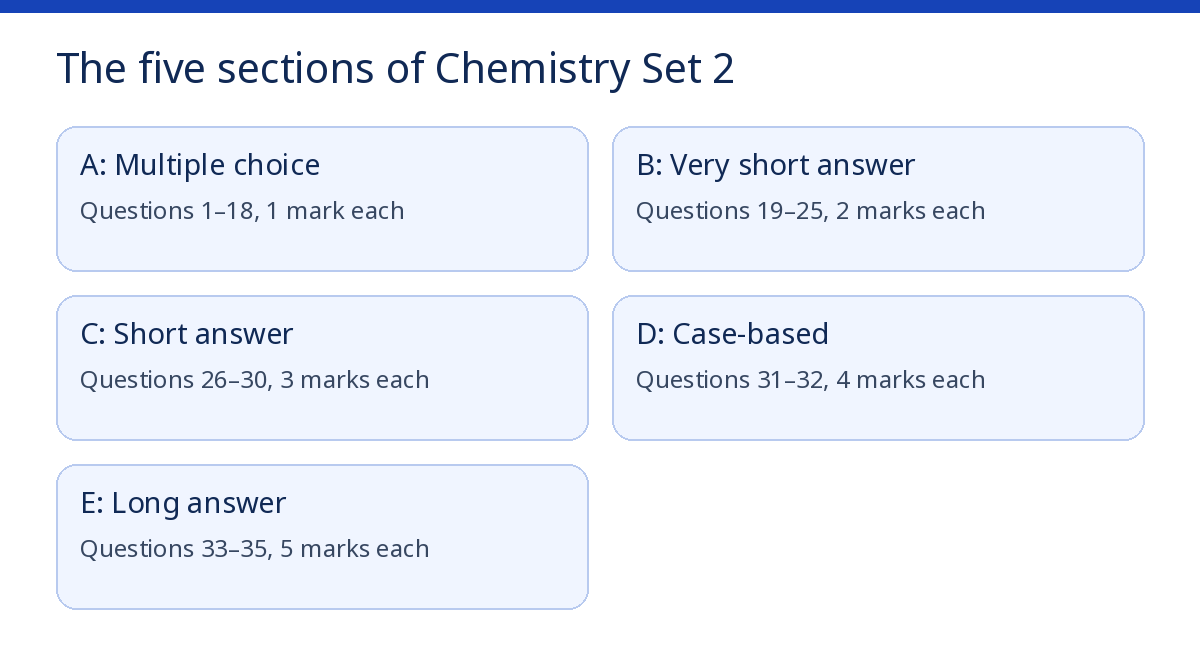
Section A has 18 one-mark multiple-choice questions, including assertion–reason items. Section B has seven two-mark very short answers, and Section C has five three-mark short answers. Section D has two four-mark case-based questions, while Section E has three five-mark long answers.
There is no overall choice. Where an internal choice is printed, read both alternatives and check whether it applies to the whole question or only to a subpart. In the case-based section, for example, the choice appears within a subpart, so it does not replace the rest of the case. In the long-answer section, use the printed mark splits to check that you have addressed each requirement: a reason, a chemical equation and a comparison are different tasks, even when they sit under the same question number.
Physical chemistry: choose the model before calculating
The physical chemistry questions cover solutions, chemical kinetics and electrochemistry. The solutions questions move between vapour pressure for an explicitly ideal liquid mixture and freezing-point depression in a dissociation problem. In kinetics, the paper asks about reaction order, pseudo-first-order behaviour and the effect of temperature on a rate constant. Electrochemistry ranges from cells and conductance measurements to a calculation connecting cell potential, standard Gibbs energy change and equilibrium.
Good to remember: Conductivity and molar conductivity describe related but different quantities. Before using a value, check which one the question gives and which one it requests. Likewise, an ideal-mixture calculation starts from the stated ideality assumption; a colligative-property problem involving dissociation requires attention to the number of dissolved particles. In a timed attempt, write the governing relation before substituting values so you can tell a model-selection error from an arithmetic slip.
Inorganic chemistry: keep charge, naming and structure separate
Coordination chemistry appears through nomenclature, ligand types, isomerism and magnetic behaviour. These prompts test different things: a name identifies the constituents of a compound, an isomer drawing shows their arrangement, and an explanation of magnetic behaviour requires attention to electron configuration. When checking a coordination formula, distinguish ligands within the coordination sphere from counter-ions outside it. When considering coordination number, count donor atoms attached to the metal rather than simply counting ligand molecules.
The paper also asks about transition metals, lanthanoids and actinoids. Notice the difference between explaining a trend and completing a reaction. An explanation needs a reason tied to the specific species or property; a completed ionic equation needs both atoms and charge to balance.
Organic chemistry and biomolecules: read the task verb
Organic questions include halo compounds, alcohols, phenols, ethers, carbonyl compounds and amines. Some ask for a classification or a reaction product; others ask for a mechanism, a chemical test or a conversion. The amines question names Gabriel phthalimide synthesis as one of the reactions to write. The case-based questions bring in carbonyl reactivity and biomolecules, with the latter drawing on carbohydrates, vitamins and proteins.
Common mistake: Writing only an overall reaction when the prompt asks for a mechanism leaves out how the transformation occurs. A chemical-test prompt calls for a different kind of detail: name the test and make clear which observation would distinguish the compounds rather than stopping at the reagent name. In the case-based section, check each subpart for its own task instead of treating the passage as a single question.
Quick self-check after a timed attempt
Use the reading period to locate internal choices and notice where the paper asks for an equation, drawing or explanation. Write your answers before opening the worked-solution pages. The visible solutions separate the concept or formula from the explanation in steps, which makes them useful for finding where your reasoning first diverged rather than simply checking a final answer.
After reviewing, ask: Could I explain why my method applies here? Mark one item where you chose the wrong concept and one where you knew the chemistry but did not give what the prompt asked for. Reattempt both without looking. If the method now works but the written response still misses a condition, observation or subpart, you know what to check next time.
What this guide leaves out
This overview does not reproduce the Hindi text layer, the flagged formula or notation in Q2, Q26(a) and Q33(a), or the disputed wording or answer choices in Q12 and Q16. It also leaves out Q31’s opening carbohydrate definition and Q33(a)’s worked numerical results. Gabriel phthalimide synthesis is confirmed as a topic asked in the paper, but the supplied pages do not verify its worked solution. These limits do not affect practice with the rest of the paper.
Spotted an error? Report a correction. Practise this in the app: notes, formula sheets and mind maps.















































































































































Loading comments…