2025 CBSE Class 12 Chemistry Supplementary Paper: Set 2
CBSEChemistry2025 Previous Year Paper
Paper code: 56/S/2 · 2025Use this full 2025 CBSE Class 12 Chemistry supplementary paper to practise the five-section theory exam, then use the worked solutions to check which concepts you chose, how you applied them, and whether you explained your reasoning.
This set is one of the year's papers. See every set from 2025, grouped by series.
What Set 2 asks you to do
This year-wise resource contains the English version of the 2025 supplementary theory paper, Set 2, with question-paper code 56/S/2. The paper carries 70 marks, allows three hours for writing, and specifies a 15-minute reading period during which candidates do not write answers. Calculators are not allowed.
The 33 questions are divided into five sections. Section A has 16 one-mark multiple-choice questions, including four assertion–reason items. Section B has five two-mark very short answers, and Section C has seven three-mark short answers. Section D has two four-mark case-based questions, while Section E has three five-mark long answers. There is no overall choice: all questions are compulsory, but some questions or subparts in Sections B to E give an internal choice. In a timed attempt, follow the printed OR rather than answering both branches.

Chemistry Supplementary 2025 | Class 12 | Previous Year Paper | Code 56/S/2
In the StudentCurio app
A complete 2025 CBSE Class 12 Chemistry supplementary examination paper with questions and worked solutions across multiple chapters, including Chemical Kinetics, Electrochemistry, organic chemistry, Biomolecules and Solutions. It helps students practise the board-paper format and review solution methods.
Chemical Kinetics: Keep order and molecularity separate
The paper tests kinetics through a first-order half-life item, an initial-rate data table, and a short-answer question about temperature and catalysts. For a first-order reaction, , so the half-life does not depend on the initial concentration. The rate constant then has inverse-time units: if the half-life is expressed in seconds, use .
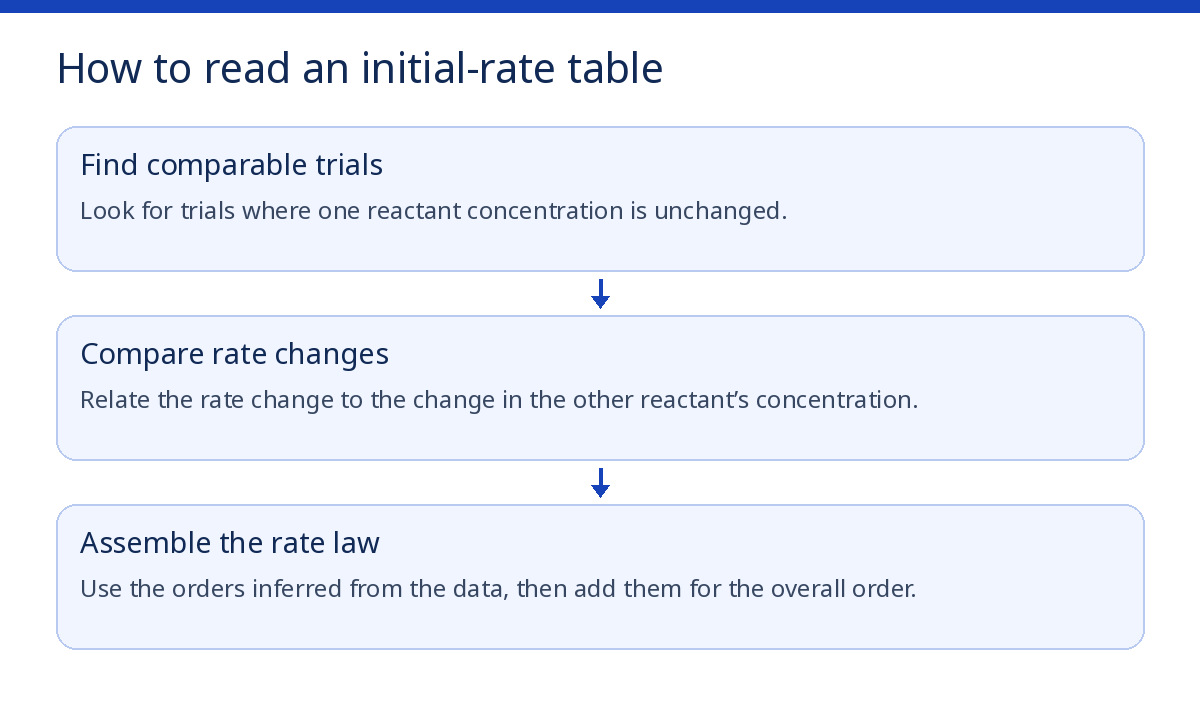
For the initial-rate table, start by comparing trials where one reactant concentration stays fixed while the other changes. That isolates the effect of the changing concentration on the measured rate. If both concentrations change, account for what you already know about one reactant before isolating the effect of the other. Common mistake: reading the rate-law exponents from the balanced equation. Reaction order comes from the rate law; molecularity counts the reacting entities involved in a single elementary step.
Electrochemistry: Identify the quantity before doing the maths
The electrochemistry questions move between standard electrode potentials, cell emf, electrolysis, fuel cells and the effect of dilution on molar conductivity. For the cell-emf calculation, distinguish the supplied standard emf from the emf at the listed concentrations. The Nernst equation connects the two. Before substituting, identify the direction of the cell reaction and the number of electrons transferred; those choices determine the reaction quotient and how it enters the calculation.
For electrolysis, use the species present and the specified electrode material to reason about what can be discharged. The electrode rules themselves do not change: oxidation takes place at the anode and reduction at the cathode. For the dilution question, check the symbol: denotes molar conductivity, not conductivity. Dilution can affect the two quantities differently.
Solutions: Check the conditions before choosing a law
The Solutions questions cover Henry’s law, osmotic pressure, vapour pressure, deviations from Raoult’s law and boiling-point elevation. They ask about different quantities: a gas’s mole fraction in a liquid, a liquid mixture’s composition, or the effect of dissolved particles on a property. Marking exactly what the question asks for helps you choose the right relationship.
When the comparison applies: in the form , a smaller Henry’s law constant means a larger dissolved mole fraction when the gas partial pressure and temperature are held fixed. For a calculation using Raoult’s law, the simple mole-fraction-weighted sum of pure-component vapour pressures describes an ideal liquid mixture at the stated temperature. The separate prompt about deviation asks you to think about what changes when the mixture does not behave ideally.
Organic Chemistry: Track the structure through each step
The organic questions range from identifying bond types and interpreting reagent behaviour to explaining acidity, comparing substitution with elimination, and planning conversions. Before naming a reaction, mark the functional group or bond that can change. For a bond-classification question, inspect the carbon directly bonded to the halogen; a double bond elsewhere in the molecule does not establish the hybridisation of that carbon.
For a longer conversion or identification sequence, track the carbon skeleton separately from the functional group. Ask whether a proposed step changes the number of carbons, changes the functional group, or does both. Chemical-test questions ask for a different kind of reasoning: name the test and state the contrasting observations that distinguish the two compounds. Naming a reagent alone does not explain how you would tell them apart.
Case-based questions: Separate the given evidence from recall
Section D uses a passage about diet and diabetes as context for Biomolecules questions, and an absorption table as context for coordination chemistry. In the first case, distinguish the passage’s background from the chemistry being assessed: a question asking for a definition or function needs a direct response, not a summary of the passage. Elsewhere in the paper, the comparisons of protein structures and starch components call for structural distinctions rather than lists of unrelated facts.
In the coordination case, distinguish the wavelength absorbed from the colour observed. A table-reading prompt uses the stated entries; a crystal-field prompt instead requires the model or condition named in the question. The paper also tests coordination nomenclature, isomerism and magnetic behaviour outside the case study.
Use the worked solutions to diagnose your first attempt
Attempt the paper before opening the worked solutions. The file provides question-number navigation, and the solution pages distinguish the formula, the concept and the explanation in steps. When your method differs, locate the first point of disagreement: did you misread a symbol, use a rule outside its conditions, or leave out the reason requested by the question? For questions with internal choice, attempt one branch under timed conditions and use the other later as separate practice.
This guide omits the disputed answer choices and conclusions for Q2, Q13 and Q14. The resource’s notes flag a non-unique single-choice item, a mechanism assumption, and an assertion–reason item whose choices do not cover the analysis. Keep those flagged items separate from your review of ordinary conceptual and calculation errors.
Spotted an error? Report a correction. Practise this in the app: notes, formula sheets and mind maps.















































































































































Loading comments…