CBSE Class 12 Chemistry 2026: Main Exam Paper Guide
CBSEChemistry2026 Previous Year Paper
Paper code: 56/3/3 · 2026The English-language 2026 CBSE Class 12 Chemistry main examination paper (56/3/3) is a complete three-hour, 70-mark paper with worked solutions. Use it to practise the board exam format and then check where your reasoning, calculations or written explanations need work.
This set is one of the year's papers. See every set from 2026, grouped by series.
How the 2026 paper is organised
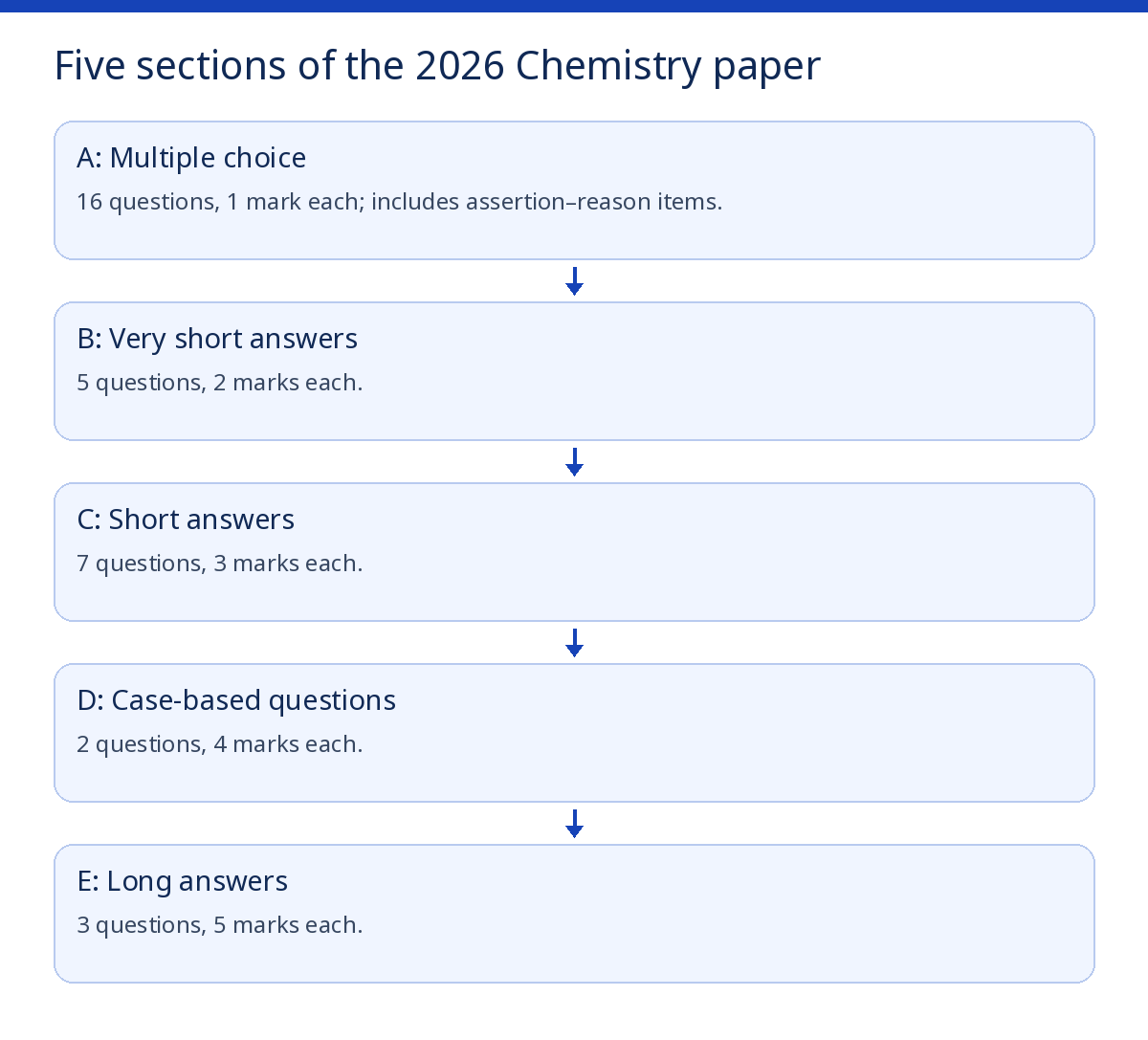
This year-wise resource contains 33 questions across five sections. Section A has sixteen one-mark multiple-choice questions, including assertion–reason items. Section B has five two-mark very short answers, and Section C has seven three-mark short answers. Section D contains two four-mark case-based questions, while Section E contains three five-mark long-answer questions.
All question numbers are compulsory, but some questions outside Section A offer an internal choice. In a timed attempt, answer only one branch wherever an OR choice is printed; during review, the other branch can serve as fresh practice. Work without a calculator, as the paper requires. For assertion–reason items, make two separate judgements about the truth of the statements before deciding whether the reason actually explains the assertion.

Chemistry 2026 | Class 12 | Previous Year Paper | Code 56/3/3
In the StudentCurio app
Complete CBSE Class 12 Chemistry main examination paper for 2026, with questions and worked solutions spanning topics such as organic chemistry, electrochemistry, solutions, biomolecules and coordination compounds. Useful for practising board-style questions and reviewing solution methods.
Physical chemistry: choose the rule before calculating
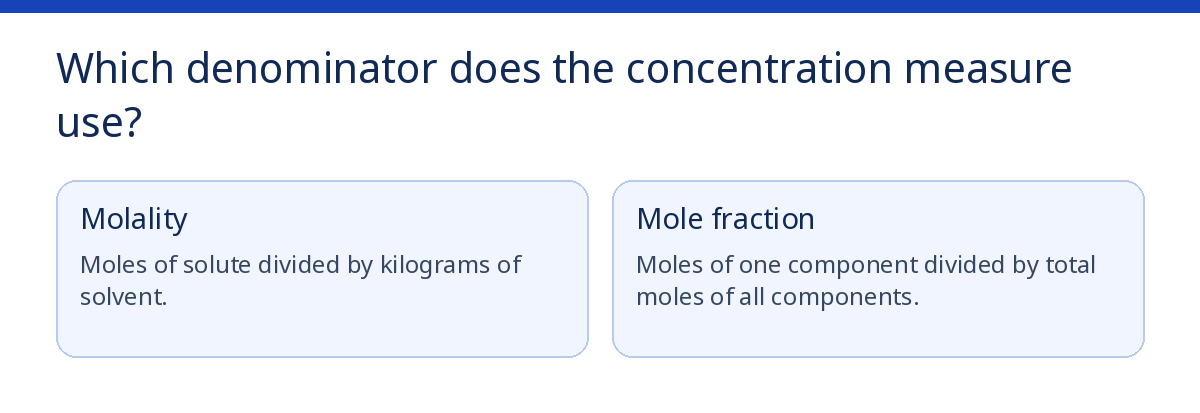
The paper tests several ways of using information about solutions: converting between concentration measures, interpreting vapour-pressure data and calculating a freezing-point change. Start by identifying what each quantity measures. Molality uses kilograms of solvent, whereas mole fraction uses the total moles of all components as its denominator. For vapour pressure, distinguish the measured total from the value predicted by Raoult’s law for an ideal mixture. Agreement at one composition is not proof of ideality across the entire composition range.
The kinetics questions switch between rate laws, half-life data and radioactive decay. In review, check whether you used the exponents in the stated rate law or simply read coefficients from an overall equation. Those coefficients do not generally determine the rate law for a reaction that proceeds through multiple steps.
Electrochemistry: keep units and conditions separate
Electrochemistry appears through conductivity curves, limiting molar conductivity, electrode potential and distinctions between cells. The conductivity curve question is a useful check on whether you know why extrapolating data for a strong electrolyte is not the same task as finding the limiting value for a weak one. For a weak electrolyte, dilution changes the extent of dissociation appreciably, so the concentration dependence cannot be treated in the same way.
In the long-answer alternatives, distinguish conductivity, given in , from limiting ionic molar conductivity, given in . For cell potentials, note whether the question refers to standard conditions or supplies a specific concentration. A correctly copied potential is not necessarily the potential under the conditions asked for.
Inorganic chemistry: separate charge, bonding and behaviour
The coordination questions move from Werner’s terminology and compound naming to comparisons of metal complexes. Keep oxidation state separate from coordination number: the former follows from charge accounting, while the latter counts donor atoms attached directly to the metal. The distinction matters when a ligand binds through more than one donor atom. When reviewing a name, first separate the species inside the coordination brackets from any counter-ions in the full formula.
For comparisons of magnetic behaviour, do not stop at the identity of the metal. Check its oxidation state and then consider how the ligand environment affects electron pairing. In the transition-metal questions, practise matching each explanation to the property being compared; an argument about colour is not automatically an argument about ionisation enthalpy or melting point.
Organic chemistry: read conditions and weigh the clues
Organic questions range from substitution and amine chemistry to synthetic conversions, carbonyl reactions and identification by chemical tests. For a conversion, read the substrate, reagent and stated conditions together before deciding which reaction family applies. This is particularly helpful in the alcohol questions: the class of alcohol matters, and for a primary alcohol the oxidising conditions matter when distinguishing an aldehyde from a carboxylic acid as the target.
In the compound-identification question, a positive test narrows the possibilities, but a negative test can rule out a candidate that otherwise looks plausible. When checking your reasoning, ask whether the proposed structure fits the molecular formula, the reaction sequence and all the reported observations, rather than treating the first familiar test as decisive.
Case-based questions: distinguish the passage from the task
The two case passages cover different kinds of reading. The biomolecules passage groups information about proteins, nucleic acids and vitamins; the organic passage connects alcohol oxidation, ether reactions and phenol chemistry. Read the subpart before deciding which details to use. A request for a structural distinction calls for a feature that separates two classes, while a request for a reaction calls for the chemical change rather than a general property.
Use the printed marks to notice where a subpart asks for more than one thing. In the biomolecules case, for instance, identifying building units and comparing protein structures are distinct tasks; a response can cover one and still leave the other unfinished.
Review the first step where your answer diverged
After the timed attempt, use the question-number links to move from your response to the corresponding worked solution. The resource separates the formula, concept and explanation into labelled parts. Compare the concept first: if you chose the wrong relationship or reaction family, copying the later steps will not fix the underlying error. If the principle was right, look instead for a unit conversion, charge, sign, omitted condition or missing explanation.
Then try an unused internal-choice branch without looking at its solution. This checks whether you can make the same kinds of decisions with a different prompt. The guide leaves out option-level discussion of the flagged electrolysis and carbohydrate hydrolysis items rather than treating their wording as a basis for scoring.
Spotted an error? Report a correction. Practise this in the app: notes, formula sheets and mind maps.















































































































































Loading comments…