CBSE Class 12 Chemistry 2022 Term II: Solved Board Paper
CBSEChemistry2022 Previous Year Paper
Paper code: 56/1/3 · 2022Practise with the full 2022 CBSE Class 12 Chemistry main examination paper, code 56/1/3. This year-wise resource pairs the English Term II question paper with worked solutions, so you can attempt it under the original time limit and then review the reasoning behind each response.
This set is one of the year's papers. See every set from 2022, grouped by series.
Use the paper in its original Term II format
This was a two-hour, 35-mark paper. The file preserves the English question layout, including diagrams and printed OR choices. Its cover links to solutions by question number, and the solution pages separate the formula, concept and explanation where applicable. That structure lets you find the step you missed without rereading an entire solution.
For a timed attempt, use the question pages first and answer one branch wherever an OR choice is offered. Afterward, use the worked solutions to identify whether you misread the question, chose an unsuitable rule or made an error after choosing the right method. Try the unused branches separately for extra practice. The timing and marks describe this historical Term II paper, not a current board-paper pattern.

Chemistry 2022 | Class 12 | Previous Year Paper | Code 56/1/3
In the StudentCurio app
This is a solved 2022 CBSE Class 12 Chemistry main examination paper (code 56/1/3, Term II). It includes questions across organic and inorganic chemistry, electrochemistry, chemical kinetics, adsorption and colloids, helping students practise board-style questions and review worked answers.
Amines: separate basicity, solubility and reaction purpose
The amine questions ask you to compare aqueous basicity and water solubility, which are not interchangeable. In water, basicity depends on both the availability of the nitrogen lone pair and the solvation of the protonated amine. Solubility also depends on how the molecule interacts with water: a larger hydrophobic portion can work against dissolution. When a question switches from basicity to , check which quantity you are ranking. A larger corresponds to a smaller because .
The reaction questions distinguish preparation from identification. Gabriel synthesis uses alkylation of phthalimide followed by release of a primary amine. The carbylamine reaction tests for primary amines, while the Hofmann bromamide reaction makes a primary amine with one fewer carbon atom than the starting amide. When reviewing a conversion, track the carbon skeleton as well as the functional group.
Carbonyl chemistry: ask what each clue establishes
The paper uses qualitative tests to connect observations with structure. A positive 2,4-DNPH test supports the presence of an aldehyde or ketone but does not distinguish between those classes. A methyl ketone can give a positive iodoform test, but a positive result is not exclusive to methyl ketones. When the paper asks for a test that distinguishes two compounds, check whether the proposed test gives different observations for that particular pair.
The paper also asks why compounds differ in their tendency to undergo nucleophilic addition. Compare the electrophilicity of the carbonyl carbon and how easily a nucleophile can approach it. In carboxylic acids, resonance donation from the hydroxyl oxygen reduces carbonyl electrophilicity, so the usual aldehyde or ketone addition pattern does not carry over. The isolated vigorous-oxidation example is omitted from this guide.
When conductivity and cell formulas apply
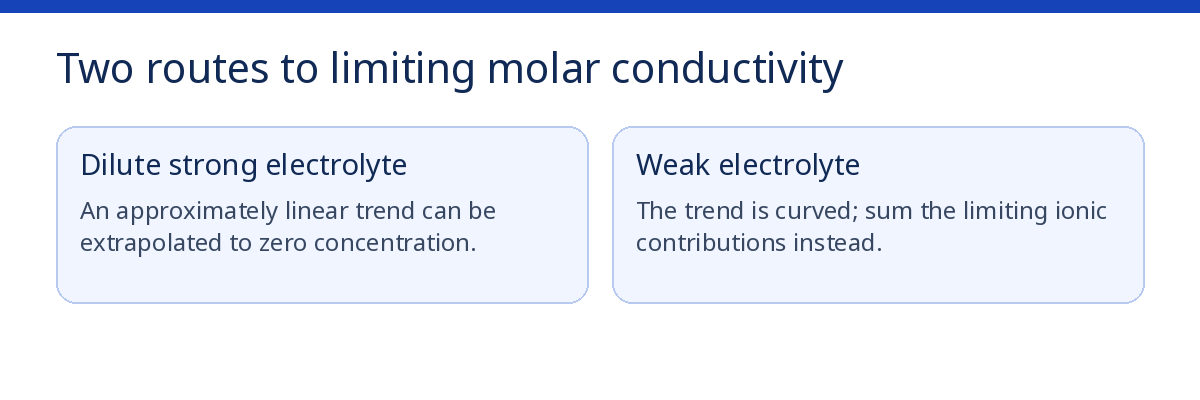
For a dilute strong electrolyte, a plot of molar conductivity against the square root of concentration is approximately linear. Extrapolating that trend to zero concentration gives the limiting molar conductivity. The weak-electrolyte curve does not support the same straight-line method because its degree of ionisation changes substantially on dilution. Instead, use Kohlrausch’s law to sum limiting ionic contributions, counting each ion according to its coefficient in the electrolyte formula. The extracted conductivity equation is garbled and is not reproduced here.
For the relation , take from the electrons transferred in the balanced cell reaction, not from a single ion’s charge in isolation. If you use in coulombs per mole, express the molar Gibbs energy change in joules per mole to obtain the cell potential in volts. The minus sign provides a useful check: a positive standard cell potential corresponds to a negative standard Gibbs energy change.
Common mix-ups in chemical kinetics
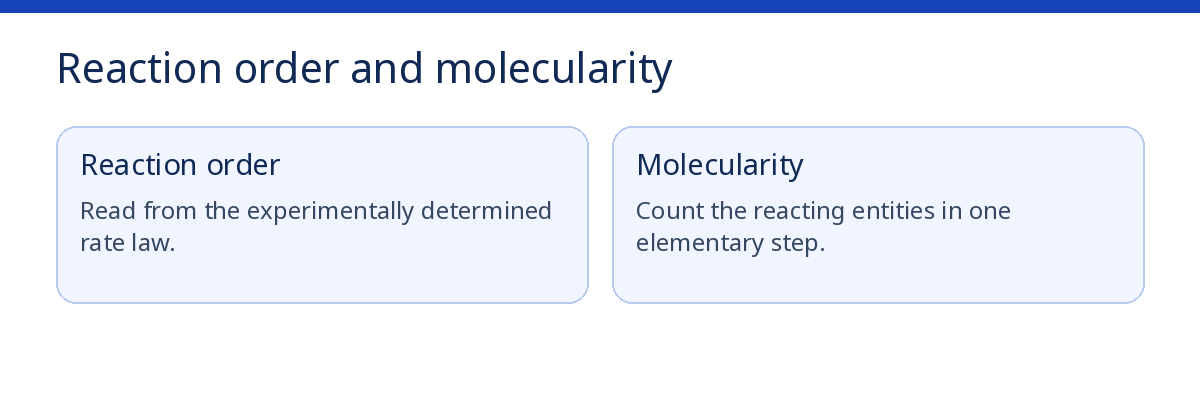
Reaction order comes from the experimentally determined rate law. Molecularity counts the reacting entities in one elementary step. A complex reaction may have a measurable overall order, but it has no single overall molecularity. Before counting particles from an equation, check whether it describes one elementary event or the net result of several steps.
The other kinetics task uses first-order half-life and the integrated rate law. In that law, the concentration in the denominator is the amount remaining, not the amount consumed. Convert a stated fraction completed into the fraction remaining before setting up the ratio. The relation is specific to first-order kinetics; do not transfer it to a reaction of unspecified order.
Coordination complexes and transition-metal trends
For coordination compounds, keep ligand charge, number of donor atoms and location relative to the coordination sphere separate. Coordination number counts donor atoms attached to the metal, not simply the number of ligand molecules. The chloride precipitation example tests the distinction between chloride coordinated to the metal and chloride outside the coordination sphere. For magnetic behaviour, establish the metal ion’s electron count, then consider the ligand field and whether electrons remain unpaired.
The transition-element questions call for a cause, not just a trend. Lanthanoid contraction helps explain the similar sizes of zirconium and hafnium, while the proximity of the outer s and d energy levels helps explain variable oxidation states. For comparisons of ions in water, hydration matters: a trend in aqueous stability cannot be justified by electron configuration alone.
Quick self-check: adsorption versus colloidal behaviour
Can you compare physisorption and chemisorption by the forces involved rather than by memorising two labels? Physisorption involves van der Waals attraction and can form multilayers; chemisorption involves chemical bonding and is usually more specific. Treat these as comparisons with conditions, not as claims that every adsorbate behaves identically.
For the colloid material, ask what each term describes. Lyophilic refers to an affinity between the dispersed material and the dispersion medium. Macromolecular refers to the dispersed entities themselves being large molecules of colloidal size. Coagulation describes particles aggregating after losing stability. If you can distinguish affinity, particle size and loss of stability, you can explain the terms rather than merely recall examples.
Spotted an error? Report a correction. Practise this in the app: notes, formula sheets and mind maps.















































































































































Loading comments…