CBSE Class 12 Chemistry 2026 Previous Year Paper Guide
CBSEChemistry2026 Previous Year Paper
Paper code: 56/4/3 · 2026Practise with the full English-language CBSE Class 12 Chemistry 2026 main board paper, set 56/4/3. Use its worked explanations to review not just what you wrote, but which concept, condition or calculation your answer depended on.
This set is one of the year's papers. See every set from 2026, grouped by series.
What the 2026 paper asks you to do
This year-wise file pairs the complete question paper with a worked-solutions section. The paper allows 3 hours for 70 marks and does not permit a calculator. It contains 33 questions across five sections: Section A has sixteen one-mark multiple-choice questions, including assertion–reason items; Section B has five two-mark very short answers; and Section C has seven three-mark short answers. Section D has two four-mark case-based questions, and Section E has three five-mark long answers.
All questions are compulsory, but some questions outside Section A offer internal choices. In a timed attempt, answer only the branch that applies where an OR is printed. During review, you can try the other branch separately: it may test a different skill, such as interpreting evidence about a coordination compound rather than explaining its bonding. This distinction lets you practise the actual paper format without leaving useful revision material untouched.

Chemistry 2026 | Class 12 | Previous Year Paper | Code 56/4/3
In the StudentCurio app
This complete CBSE Class 12 Chemistry main examination paper includes questions and worked solutions across organic, inorganic and physical chemistry, including biomolecules, electrochemistry, chemical kinetics and coordination compounds. It helps students practise the board-exam format and review solution methods.
Physical chemistry: when the conditions matter
The solutions questions use both association and dissociation. Before calculating a colligative property, identify whether the solute stays as separate molecules, associates, or dissociates under the stated assumption. These properties depend on the number of dissolved particles, not simply the amount of solute weighed out. For boiling-point elevation, uses molality, not molarity. Treat complete dissociation or complete association as a condition of the particular question, not a default for every solution.
In electrochemistry, distinguish the actual cell potential from the standard cell potential. The Nernst equation adjusts the standard value using the reaction quotient, so first write the reaction in the direction corresponding to the potential you are evaluating. The paper also uses conductivity and molar conductivity. When comparing these quantities in a calculation, track their different units: conductivity in is not interchangeable with molar conductivity in .
Chemical kinetics: common mistakes with order and molecularity
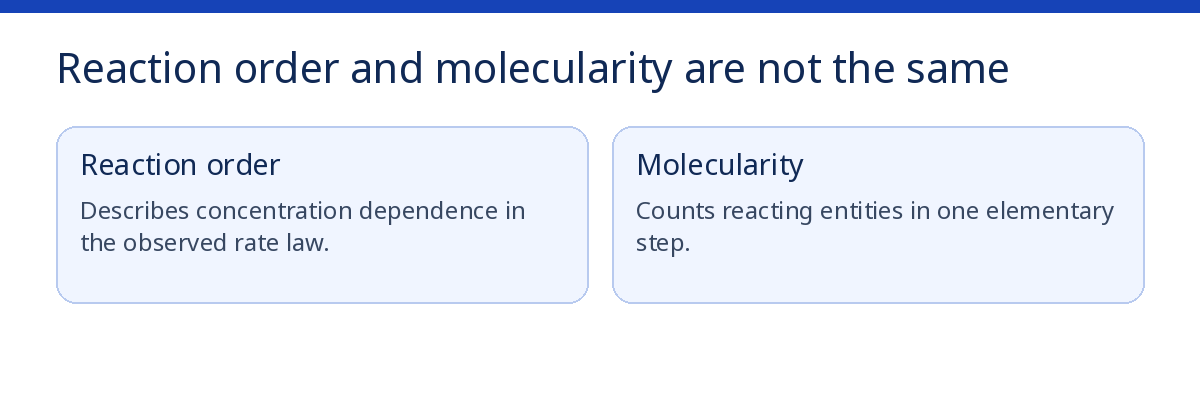
The kinetics questions move between interpreting a rate law, recognising concentration-independent behaviour and reading a proposed mechanism. A common mistake is to take the coefficients in the balanced overall equation as the exponents in the rate law. Reaction order describes how the observed rate depends on concentration. Molecularity counts the reacting entities in one elementary step; it is not assigned to a multistep overall reaction.
A related distinction is between a genuinely first-order rate law and pseudo-first-order behaviour. If one reactant is in sufficiently large excess, its concentration changes so little over the interval considered that it can be treated as effectively constant. The rate can then appear first order in the other reactant. When reviewing a mechanism question, label each statement as being about an elementary step or the observed overall rate. That check is more useful than memorising a rule about the slowest step without its assumptions.
Inorganic chemistry: separate charge, bonding and evidence
Coordination chemistry appears in several forms: naming complexes, interpreting crystal-field splitting, reasoning about isomerism, and connecting bonding with magnetic behaviour. Begin by keeping oxidation state and coordination number separate. Oxidation state follows from charge bookkeeping; coordination number counts directly bound donor atoms. A ligand that attaches through two donor atoms contributes two to that count even though it is one ligand.
The paper also asks you to reason from chemical evidence. In a precipitation-based coordination question, distinguish ions available to react in solution from groups bound within the coordination sphere before discussing bonding. For magnetic behaviour, check whether your model predicts unpaired electrons rather than inferring magnetism from the charge alone. The long-answer section extends inorganic revision to transition elements and the lanthanoids and actinoids, so keep observations about a particular ion separate from trends across a series.
Organic chemistry and biomolecules: follow the evidence
Organic chemistry questions ask for product structures, mechanisms, conversions and explanations of reactivity. Start each conversion by noting what must change: the functional group, the carbon skeleton or the substitution pattern. Then check each reagent against that purpose. Conditions matter because a product justified for one substrate or reagent sequence is not automatically justified for a related one. In the alcohols and phenols case, keep oxidation and dehydration separate from acidity and aromatic substitution; each calls for a different kind of explanation.
The biomolecules questions approach structure in two ways. The protein items distinguish amino-acid sequence from the ways a chain folds or chains assemble. The glucose case brings together evidence from chemical reactions and observations that a simple open-chain model does not fully explain. When reading that passage, mark which observations support a functional-group claim and which motivate a cyclic representation. That division helps you write from the evidence rather than merely restating the passage.
Quick self-check before opening the worked solutions
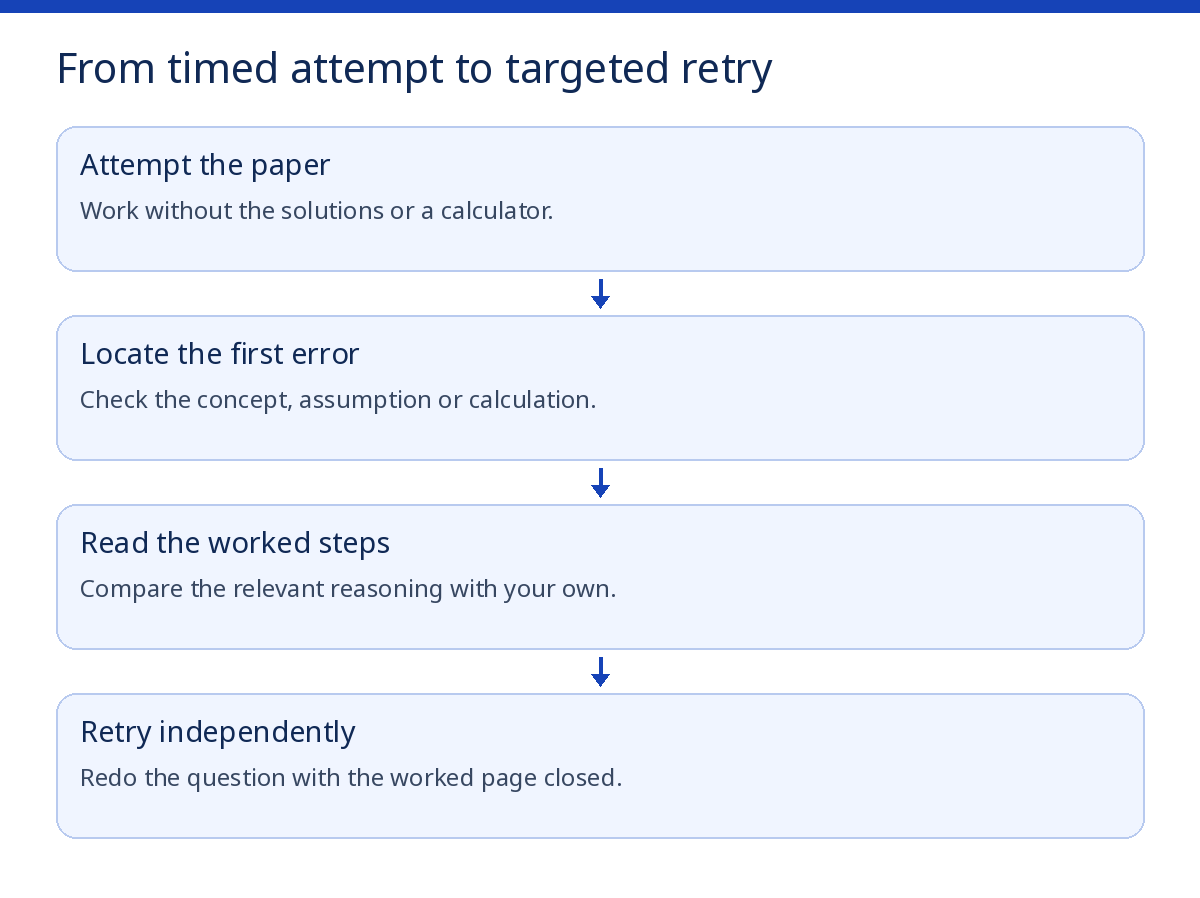
Use the question paper first, without the worked pages. For an assertion–reason item, decide whether each statement is true before checking whether the reason explains the assertion. For a numerical or written response, leave enough working to locate the first step where your reasoning went off track. After the attempt, compare that step with the resource’s formula used, concept used and explanation in steps labels.
Ask yourself: Was the error in choosing the principle, noticing a condition, or carrying out the calculation? If you recognised the formula but missed an assumption, write that assumption beside the question and retry it without the worked page. For a case-based response, check that your explanation uses evidence relevant to the specific subpart. This guide omits the disputed Q14 worked explanation and does not rely on Q15’s assertion–reason judgement.
Spotted an error? Report a correction. Practise this in the app: notes, formula sheets and mind maps.















































































































































Loading comments…