CBSE Class 12 Chemistry 2022 Supplementary Paper
CBSEChemistry2022 Previous Year Paper
Paper code: 56/6/3 · 2022Use this complete, solved CBSE Class 12 Chemistry supplementary paper to practise the 2022 Term II format. The guide shows what each section tests and how to use the worked solutions to check your reasoning without reading the answers first.
This set is one of the year's papers. See every set from 2022, grouped by series.
What the 2022 paper looks like
This year-wise file contains the English question paper for the 2022 CBSE Class 12 Chemistry supplementary examination, Q.P. code 56/6/3, followed by worked solutions. The printed paper allows two hours for 35 marks and specifies a separate 15-minute reading period. It does not allow calculators or log tables. Use these conditions if you want to recreate this sitting, rather than assuming that its Term II format applies to another year.
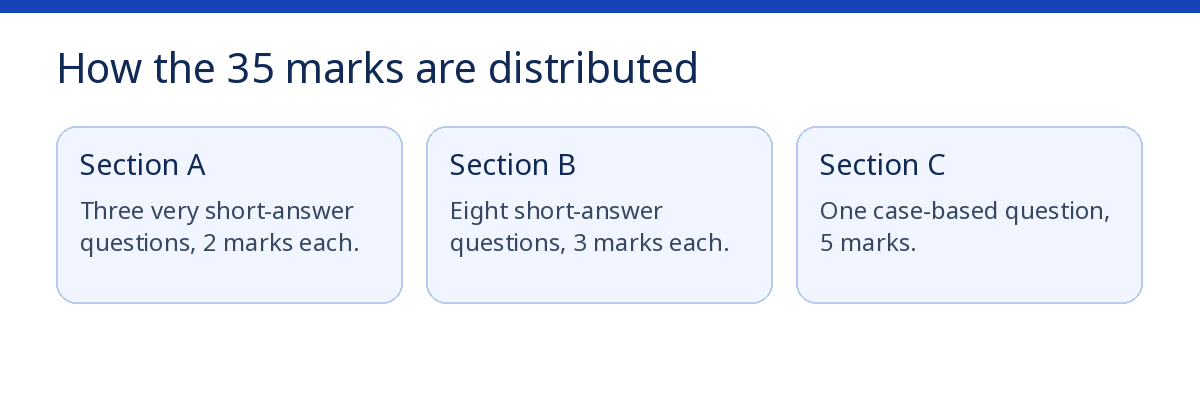
Section A has three very short-answer questions worth two marks each. Section B has eight short-answer questions worth three marks each. Section C has one five-mark case-based question. All 12 numbered questions are compulsory, but some offer internal choices. The instruction to answer any two subparts in one question is different from choosing between two printed OR branches.

Chemistry Supplementary 2022 | Class 12 | Previous Year Paper | Code 56/6/3
In the StudentCurio app
A solved CBSE Class 12 Chemistry supplementary examination paper from 2022, covering topics including transition elements, chemical kinetics, electrochemistry, amines, coordination compounds and carbonyl compounds. Helps students practise board-exam questions and review worked solutions across chapters.
How the short questions switch between skills
Section A moves from organic structure and physical properties to electrochemistry and kinetics. That makes it a useful check on whether you can switch from reading a displayed structure to explaining a measurement or interpreting a rate-law clue. In a boiling-point comparison, consider the interactions between molecules rather than the strength of the covalent bonds within them. For a naming task, read the positions of the groups on the original structure before attempting the name.
Section B adds a colloid diagram, electronic configurations, a kinetics plot, a conductivity calculation, amine reactions and coordination chemistry. Notice what each prompt asks you to produce. A definition needs the feature that distinguishes the term; a comparison needs a reason tied to the species shown; a diagram-based response needs evidence from the figure.
Before using a rate or conductivity equation
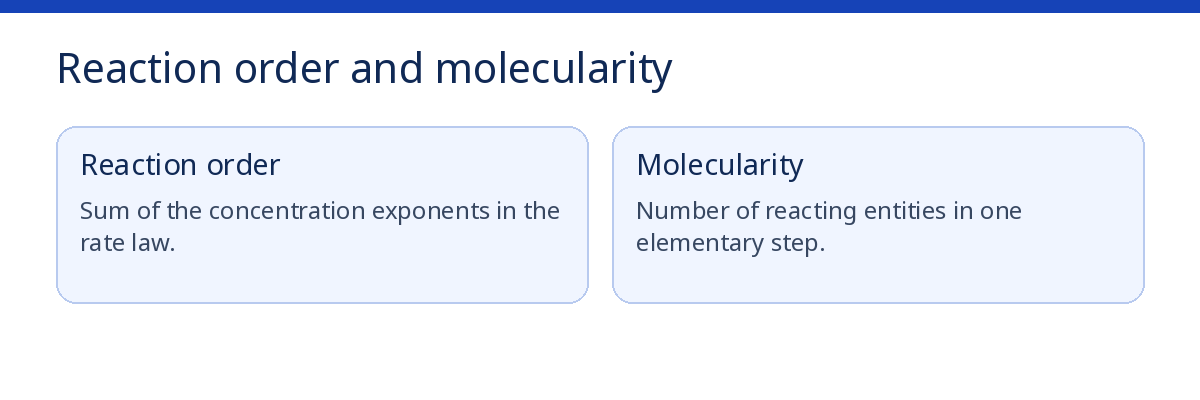
In the kinetics questions, identify the reaction order before selecting an integrated rate law. When interpreting a plot, read both axes before using the shape of the graph or its slope. In a decomposition calculation, distinguish the fraction that has reacted from the fraction of reactant still present. Also keep order separate from molecularity: order comes from the rate law, whereas molecularity counts the reacting entities in a single elementary step. An overall multistep reaction does not have a single molecularity.
For electrochemistry, distinguish conductivity from molar conductivity, and distinguish molar conductivity at the stated concentration from its limiting value. The conversion gives molar conductivity in when conductivity is in and concentration is in . Check those units before substituting.
A useful connection: configuration, charge and magnetism
The transition-element and coordination questions both ask you to reason from electronic configuration, but the species matters. A neutral atom, a gaseous ion and a metal ion in a complex are not interchangeable. Write down which species the question specifies before counting electrons. If a problem requests a spin-only magnetic moment, base that calculation on the number of unpaired electrons; do not treat the result as including any orbital contribution.
For a coordination compound, separate the ligands bonded to the metal from the counterions outside the coordination sphere. That distinction lets you check charge balance when moving from a name to a formula. When discussing magnetic character, consider how the ligands affect electron pairing rather than assuming that a complex behaves like the corresponding free ion.
Read the reaction conditions in the organic questions
The amines questions move between classifying a structure, explaining a preparation route and comparing basic strength. For classification, focus on the groups attached directly to nitrogen. For basicity, ask whether the lone pair is available to accept a proton and pay attention to the specified medium. In water, hydration of the protonated amine matters alongside electron donation, so counting alkyl groups is not enough to justify a ranking.
The Section C passage brings together aldehydes, ketones and carboxylic acids. Its subparts ask you to distinguish compounds, interpret transformations and apply reaction conditions. For an aldol prompt, locate the carbon next to the carbonyl carbon before checking for a hydrogen on it. For a chemical test, plan to state the distinguishing observation as well as naming the test.
Use the worked solutions to diagnose errors
Attempt the paper from the question pages first. During the reading period, identify the internal choices and note which prompts require a calculation, a structure or an explanation. On your timed attempt, answer only the alternatives the paper requires. Afterward, try the unused OR branches separately; the file includes worked solutions for both branches.
The file arranges its solutions under Formula used, Concept used and Explanation in steps. Start with the concept to see whether you chose the right principle, then compare the steps to find where your reasoning diverged. For example, a conductivity error could come from choosing the wrong quantity or from converting units incorrectly. Likewise, a coordination formula can contain the right ligands but put a counterion in the wrong place.
Where to consult the original question pages
Use the PDF’s question pages for diagrams, structures and reaction schemes rather than relying on extracted text alone. The extraction does not fully display the wording of Q2(b) or the reaction clues in Q12(d)(i), so this guide does not reconstruct those prompts. It also leaves out the melting-point ranking in Q10(b) because the worked solution distinguishes a traditional classroom answer from a different tabulated ranking. You can still use the rest of that question to practise distinguishing an electronic-configuration explanation from a claim that depends on comparing measured values.
Spotted an error? Report a correction. Practise this in the app: notes, formula sheets and mind maps.















































































































































Loading comments…