CBSE Class 12 Chemistry 2026 Board Paper With Solutions
CBSEChemistry2026 Previous Year Paper
Paper code: 56/1/3 · 2026Practise with the full English-language 2026 CBSE Class 12 Chemistry main board paper, set 56/1/3. Use the worked solutions after your timed attempt to check not just what you wrote, but whether you chose a method that fits the conditions in the question.
This set is one of the year's papers. See every set from 2026, grouped by series.
Know the layout before you start the clock
This year-wise resource is a full board paper, not a chapter worksheet. It carries 70 marks, allows three hours and does not permit a calculator. The paper has 33 compulsory questions. There is no overall choice, although some questions outside Section A offer an internal choice. In a timed attempt, answer one of the printed alternatives where a choice is given; save the other for review.
Section A has 16 one-mark multiple-choice questions, including assertion–reason items. Section B has five two-mark very short answers, and Section C has seven three-mark short answers. Section D has two four-mark case-based questions. Section E has three five-mark long answers. Check the marks attached to each subpart, especially when the task changes from giving a reason to writing an equation or drawing a structure.

Chemistry 2026 | Class 12 | Previous Year Paper | Code 56/1/3
In the StudentCurio app
A complete CBSE Class 12 Chemistry main examination paper with worked solutions, covering physical, inorganic and organic chemistry topics. It helps students practise board-exam questions and review solution methods.
Physical chemistry: identify what the data represent
The solutions questions move from deviations from Raoult’s law to a boiling-point calculation involving solute association. These call for different kinds of reasoning: one asks you to connect interactions between molecules to vapour-pressure behaviour, while the other depends on how association changes the effective number of dissolved particles. Before choosing a relation, decide whether you are explaining non-ideal behaviour or calculating a colligative effect.
Kinetics tests the same care with quantities. In the gas-phase decomposition problem, the table reports total pressure, not the reactant’s partial pressure. If you use a first-order rate law, the quantity you substitute must track the reactant. Use the balanced equation to see how the amounts of reactant and products change before interpreting the pressure data.
Common mix-ups in electrochemistry
Keep conductivity and molar conductivity separate. Conductivity describes the solution’s ability to conduct electricity; molar conductivity relates that property to the amount of dissolved electrolyte through its concentration. A statement about dilution is incomplete if you have not identified which quantity it describes.
The paper also distinguishes standard electrode potentials from the emf of a cell at specified concentrations or pressures. Standard potentials give a starting point, not necessarily the emf under the stated conditions. In a Nernst-equation calculation, write the balanced cell reaction before setting up the reaction quotient and identifying the number of electrons transferred. Pure solids are omitted from the quotient. When linking emf to Gibbs energy, keep standard quantities paired with standard quantities.
Inorganic chemistry: count donors, then track electrons
Coordination chemistry appears in naming, ionisation isomerism, chelation and a case study on bonding and magnetism. When reading a complex formula, distinguish coordination number from oxidation state and from the number of ligand molecules. A ligand that binds through more than one donor atom contributes more than one to the coordination number.
For the case study, keep the roles of the two models clear. Valence bond theory is used to discuss hybridisation, geometry and magnetic behaviour; crystal field theory considers how ligands split the metal’s d-orbital energies and how electrons occupy those levels. Geometry alone does not establish whether a complex is paramagnetic. Elsewhere, the paper asks you to interpret transition-metal electrode potential trends and write permanganate equations for different media. Treat the specified medium as part of the reaction conditions.
Organic chemistry: read conditions as part of the reaction
The organic questions cover aromatic substitution, amines, carbonyl compounds and nucleophilic substitution in haloalkanes. They ask for several kinds of evidence: a reagent can narrow down which group reacts, a rate law can distinguish between pathways, and a chemical test can constrain the structures consistent with a molecular formula. In the longer questions, check every clue against a proposed structure rather than stopping after the first match.
Medium matters as much as reagent identity. An aqueous basicity comparison concerns how well the protonated forms are stabilised in water as well as the availability of the nitrogen lone pair. Biomolecules bring a different distinction: evidence for a functional group in an open-chain representation should not be transferred automatically to a cyclic derivative. The ambiguously worded glucose-pentaacetate assertion–reason item is left out of this guide.
Use the worked solutions to find your first wrong turn
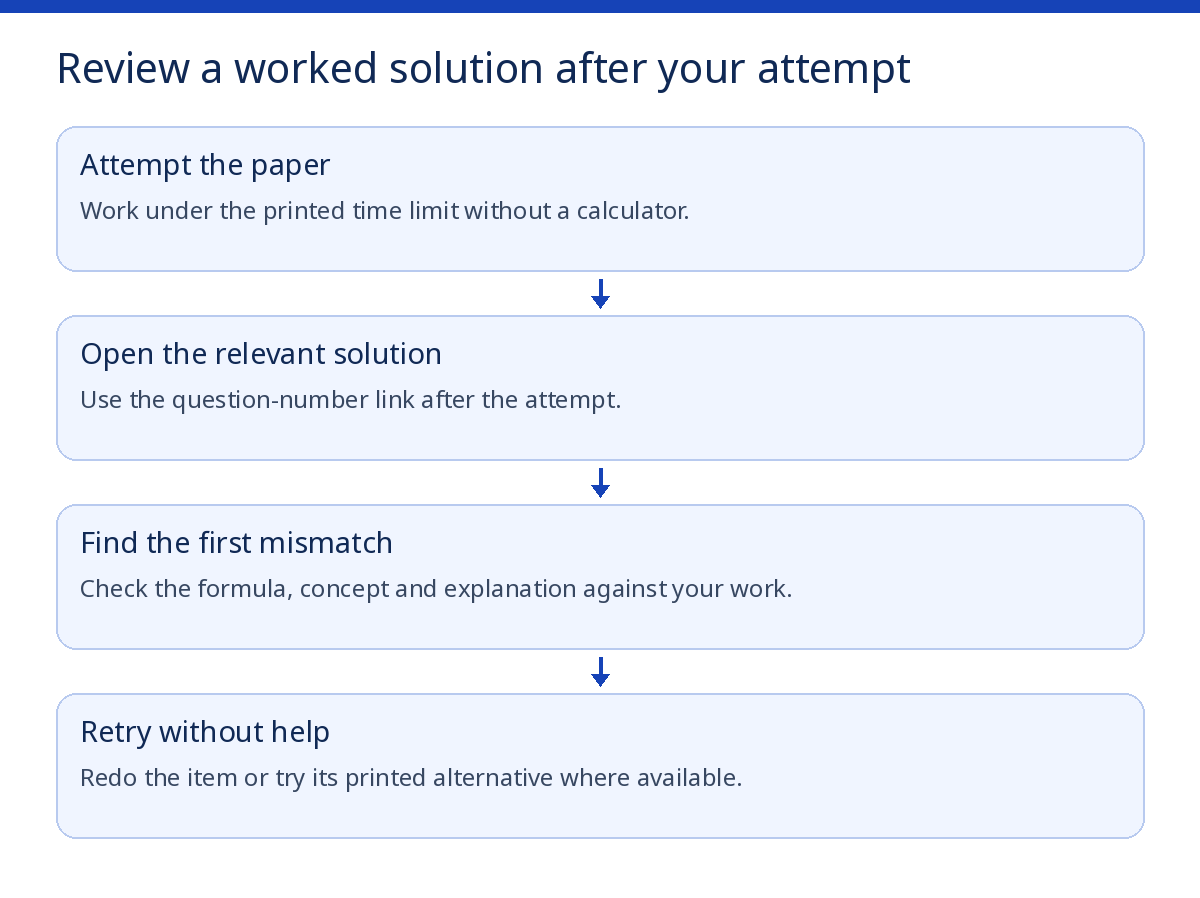
Attempt the paper before opening the worked solutions. Then use the question-number links to review the items where you hesitated, changed an answer or left a subpart blank. The solution layout separates the formula, concept and explanation in steps. Compare those with your own reasoning in that order: did you choose the wrong relation, overlook a condition or make an error after a sound setup?
For an assertion–reason item, judge each statement separately before asking whether the reason explains the assertion. For a case-based item, identify what the passage supplies and what the subpart expects you to bring from the course. After reviewing an internal choice, try the alternative without looking at its solution. That gives you another way to test whether you understood the method rather than remembered the steps.
Spotted an error? Report a correction. Practise this in the app: notes, formula sheets and mind maps.















































































































































Loading comments…