CBSE Class 12 Chemistry 2022 Term II Paper with Solutions
CBSEChemistry2022 Previous Year Paper
Paper code: 56/4/2 · 2022Practise with the full CBSE Class 12 Chemistry 2022 main examination paper (56/4/2), then use the worked solutions to check how you chose a rule, read a graph or justified a chemical trend.
This set is one of the year's papers. See every set from 2022, grouped by series.
What this 2022 paper contains
This is a year-wise previous paper for CBSE Class 12 Chemistry theory, not a chapter test. It is the English version of Set 2 from the 2022 main examination, in the Term II format. The printed paper allows two hours for 35 marks and specifies a separate 15-minute reading period. Use those details to practise this particular paper rather than assuming they describe a later board examination.
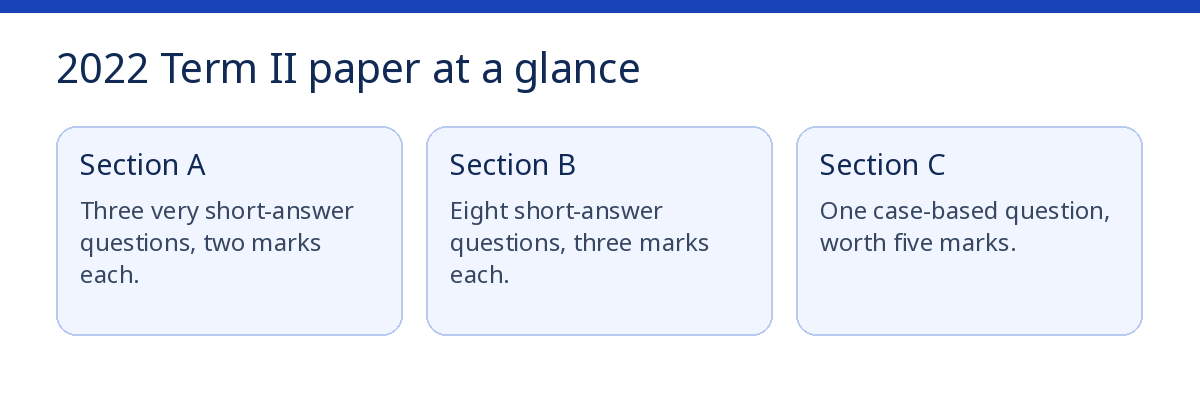
Section A has three very short-answer questions worth two marks each. Section B has eight short-answer questions worth three marks each. Section C has one five-mark case-based question. All 12 numbered questions are compulsory, but where an internal choice is printed, follow that choice. The two-hour attempt should be done without a calculator or log tables, as specified on the paper.

Chemistry 2022 | Class 12 | Previous Year Paper | Code 56/4/2
In the StudentCurio app
Complete CBSE Class 12 Chemistry main examination paper for 2022 (code 56/4/2), with worked solutions. It includes questions across topics such as amines, transition elements, electrochemistry, adsorption and chemical kinetics, helping students practise board-exam questions and review solution methods.
From organic structures to written explanations
The organic chemistry questions ask for several kinds of responses: reasons for differences in reactivity and acidity, reaction equations, systematic names and routes from one compound to another. In the carbonyl and carboxylic acid questions, first notice what property is being compared. A reason about how readily a carbonyl compound reacts is not interchangeable with a reason about acid strength. For acidity, the useful comparison is the stability of the conjugate bases, not just a description of the starting molecules.
The amines questions shift between reactions at nitrogen, reactions on the aromatic ring and methods of preparing amines. During review, distinguish an equation question from a conversion question. For a conversion, trace the carbon skeleton from starting material to target before choosing a method. Then check whether the reagents and conditions you wrote support that change.
Quick self-check: Which species are you describing?
The transition-element questions move among neutral atoms, ions and bulk metals. Electronic configuration helps explain some properties of atoms and ions, whereas alloy formation and enthalpy of atomisation concern metals and their bonding. Before writing a reason, identify the species or material whose property you are explaining. An argument about an isolated ion does not by itself explain a trend in metallic bonding.
Apply the same check to coordination compounds. Determine the metal oxidation state before assigning a d-electron count. If you are reasoning about magnetism, use the geometry and splitting information given to decide how the electrons occupy the orbitals. If the question is about ions in solution, distinguish ligands within the coordination sphere from counterions outside it. These tasks start from the same formula but ask you to read different information from it.
When the equation applies: Electrochemistry and adsorption
Electrochemistry appears in two different forms: limiting molar conductivity and cell emf under stated conditions. In the conductivity question, pay attention to what happens as concentration approaches zero and why strong and weak electrolytes need not behave alike on the plot. In the emf question, the Nernst equation accounts for non-standard conditions. Start with the balanced cell reaction so that the electron count and the powers in the reaction quotient follow from the same equation. Check whether a tabulated potential is written for reduction or oxidation before using its sign.
The adsorption question uses a graph to test whether you can connect an empirical equation to its plotted form. The Freundlich relationship applies at fixed temperature over an empirical pressure range. Read both axis labels before interpreting the line: a slope on logarithmic axes does not have the same meaning as a slope on the original variables.
Common mix-ups in the kinetics case study
The final question combines a passage on reaction rates with short conceptual prompts and a first-order calculation. Keep reaction rate separate from the rate constant: the first describes how fast the reaction proceeds at a given composition, while the second is the coefficient in the rate law under specified conditions. When a rate law is supplied, use its exponents to determine the order rather than assuming the coefficients in an overall balanced equation give that information.
For the first-order time calculation, distinguish the amount that has reacted from the amount still present. The integrated rate law uses the initial amount relative to the amount remaining, so percentage completion must first be translated into a remaining fraction. Check that the time unit in your answer agrees with the unit used for the rate constant.
Use the worked solutions to diagnose the first error
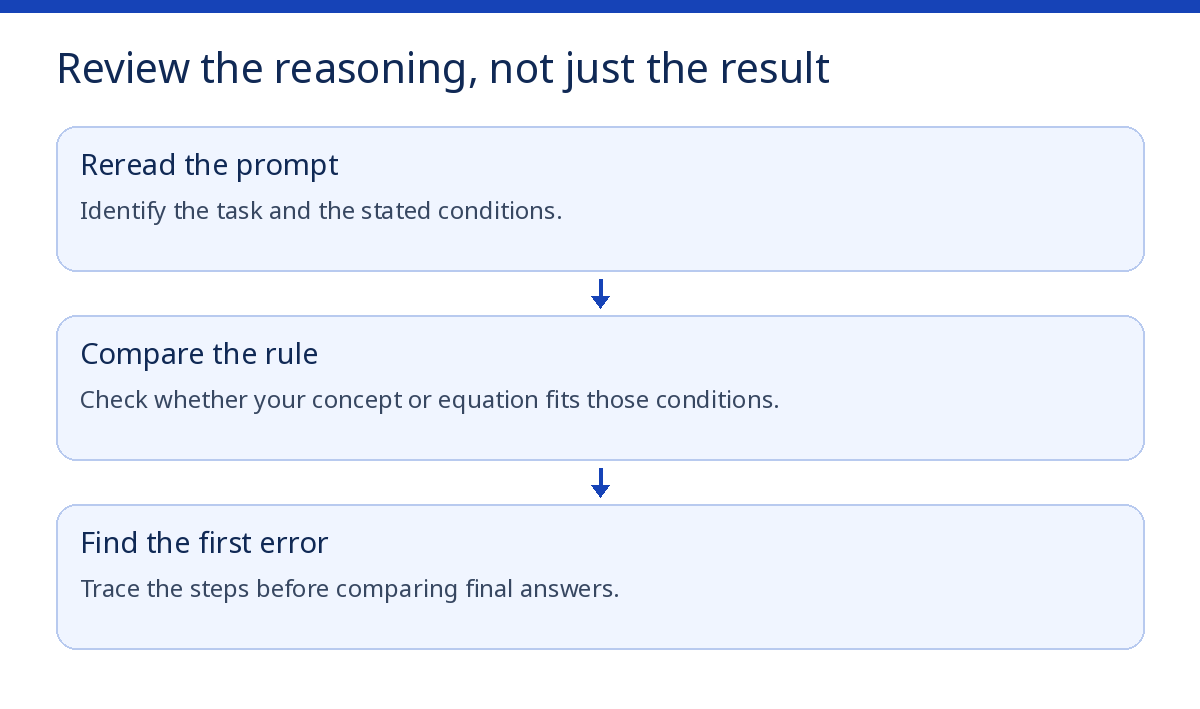
Attempt the paper before opening the solutions. During the reading period, identify internal choices and notice which prompts ask for a reason, an equation or a calculation. In the timed attempt, answer only the choices required. Afterward, try the unused alternatives separately: the file provides worked solutions for the subparts and both sides of the printed OR choices.
The solution pages separate the formula used, the concept used and the explanation in steps. When your response differs, find the first point of divergence: a misread condition, an unsuitable rule or an error in applying it. This guide leaves out the detailed compound-identification example, the numerical cell-emf example and the numerical data for the alternate kinetics calculation because the extracted text does not reliably preserve parts of their wording or notation.
Spotted an error? Report a correction. Practise this in the app: notes, formula sheets and mind maps.















































































































































Loading comments…