Class 12 NCERT Solutions: The d- and f-Block Elements
CBSEChemistryThe d- and f-Block Elements
This CBSE Class 12 Chemistry file contains worked solutions to 10 NCERT in-text questions and 38 exercises. Use it to connect electron configurations with oxidation states, redox behaviour and magnetism, and to compare the chemistry of lanthanoids and actinoids.
Find the right question before opening its solution
The file presents The d- and f-Block Elements as Chapter 4. An edition note explains that the chapter is numbered 8 in the supplied textbook edition: exercise 8.31 there corresponds to exercise 4.31 in this file. Match the question wording as well as the number, since the in-text and exercise lists both begin at 4.1.
The in-text questions isolate ideas such as ionisation enthalpy, electrode potential and contraction. The exercise index groups questions by topic, so you can move from configurations to redox equations or directly to the f block. Each entry opens a prompt and its worked solution. When reviewing a previous attempt, look for the first place your reasoning differs from the solution, not just whether the final line matches.

The d- and f-Block Elements | Class 12 | NCERT Solutions
In the StudentCurio app
Worked NCERT in-text and exercise solutions cover transition-metal oxidation states, configurations, redox behaviour and magnetic properties, along with lanthanoid and actinoid comparisons. Helps Class 12 students review key concepts and practise chapter questions.
Start with the ion, not just the neutral atom
Electronic configuration is the starting point for several kinds of question in this chapter. For a cation, subtract the positive charge number from the atomic number to find the total electron count. Then check that the noble-gas core and the electrons written outside it add up to that total. When forming cations of the first transition series, remove any occupied electrons before removing electrons. The order used to form the ion is not simply the order in which you first learned to fill the subshells.
The configuration also helps distinguish a d-block element from a transition element. The latter must have an incomplete d subshell in its atom or in at least one of its cations. A filled d subshell in the neutral atom alone does not settle the classification.
Good to remember: configuration is only part of stability
The proximity in energy of the outer s and d levels helps explain why transition metals can use different numbers of electrons in bonding. But explaining why an oxidation state is possible is different from explaining why it is stable under particular conditions. A half-filled or filled subshell may favour a state, while bonding, lattice energy and solvation also affect which state persists. A state found in a solid therefore need not persist as a simple ion in water.
The same distinction helps with questions on ionisation enthalpy. A general trend across the series does not tell you the cost of every individual electron removal. Compare the configurations before and after each ionisation: the first removal can produce a relatively stable arrangement that the second removal would disrupt.
Common mistakes: confusing potential signs and pH effects
Read the half-reaction before interpreting a tabulated standard reduction potential. The listed sign is for reduction as written. When calculating a standard cell potential from two reduction potentials, subtract the value for the couple undergoing oxidation from the value for the couple undergoing reduction. Balancing the number of electrons by multiplying a half-equation does not multiply its potential.
The chromate, dichromate and permanganate exercises also show why you should identify the role of the medium before balancing an equation. A change in pH can shift an equilibrium without changing a metal's oxidation state; it is not automatically a redox reaction. By contrast, when writing an oxidant's reduction half-equation, use the products appropriate to the stated medium. Check both atom balance and total charge after combining the half-equations.
When the spin-only formula applies
The spin-only magnetic moment depends on the number of unpaired electrons, not the total number of d electrons. For unpaired electrons, the estimate is , where is the Bohr magneton. The formula accounts for spin and does not include an orbital contribution.
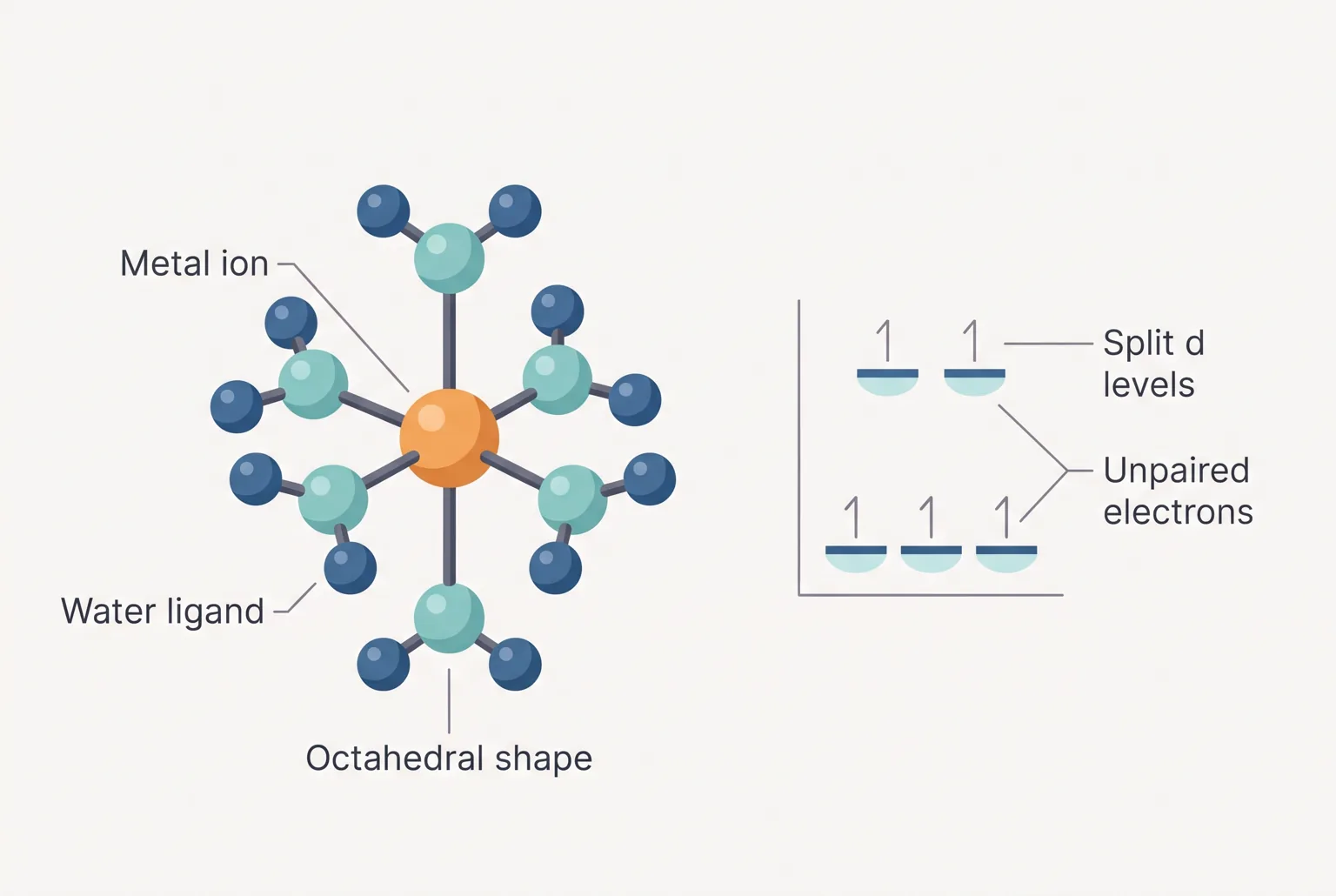
The worked aqueous-ion example shows why orbital filling comes before substitution. First find the ion's electron configuration, then use the ligand environment and the applicable spin arrangement to decide which electrons pair. The file treats the octahedral aqua ion in that example as high spin; do not assume that every complex with the same d-electron count has the same number of unpaired electrons. When checking your work, compare the orbital diagram before comparing the numerical moment.
Compare like with like in the f block
The f-block questions connect electron filling, ionic size and oxidation states. In the chapter's explanation of lanthanoid contraction, nuclear charge increases across the series while added f electrons shield that increase poorly. To identify the size trend, compare ions of the same oxidation state at the same coordination number. Otherwise, the comparison can mix the effect of contraction with differences in charge or coordination.
The consequences make the trend worth learning: successive lanthanoid ions have similar sizes and chemical behaviour, which helps explain why they are difficult to separate. The resource also compares lanthanoid and actinoid contraction in terms of how effectively 4f and 5f electrons shield the increasing nuclear charge. Treat the comparison as a general trend across the series, not a claim that every neighbouring pair changes by the same amount.
Use the exercise index to test your explanations
After reviewing a worked in-text question, choose an exercise that uses the same idea in a different setting. For instance, follow a question on oxidation-state stability with one on disproportionation. Before opening the solution, identify what evidence your explanation needs: electron configuration, the chemical environment or the direction of electron transfer. In a disproportionation reaction, look for both oxidation and reduction of the same starting species.
For another comparison, pair a question on magnetic moment with one on the colour of hydrated ions. Both concern electrons in orbitals, but the evidence is different: magnetism depends on unpaired electrons, while colour requires absorption at a visible wavelength. The file discusses both transitions between split d levels and charge transfer as sources of colour.
Spotted an error? Report a correction. Practise this in the app: notes, formula sheets and mind maps.















































































































































Loading comments…