Alcohols, Phenols and Ethers: CBSE Class 12 Case Guide
CBSEChemistryAlcohols, Phenols and Ethers
This CBSE Class 12 Chemistry assessment uses short passages, reaction schemes and linked solutions to test how you apply ideas from Alcohols, Phenols and Ethers. Use this guide to spot the structural features, reaction conditions and observations that matter in each case.
What the case-based assessment contains
The PDF contains 13 case studies, 50 numbered questions and 11 OR alternatives. It includes multiple-choice, short-answer, and assertion-and-reason items. The clickable index takes you to either a case or its solutions, and links let you return from a solution to the original question. The file is arranged with questions first and step-by-step solutions later. It does not contain a separate chapter-practice section.
In a case, separate the information supplied in the passage from the inference the question asks you to make. A passage might give you a reagent and a starting structure, while the question asks you to recognise the kind of change those conditions produce. Marking that distinction helps you see whether an error came from misreading the evidence or choosing the wrong reaction rule.

Alcohols, Phenols and Ethers | Class 12 | CBSE Case-based Assessment
In the StudentCurio app
Case-based questions and worked solutions cover alcohol reactions and identification tests, phenol acidity and reactions, and ether synthesis, properties and cleavage. Helps Class 12 CBSE students practise applying organic chemistry concepts in structured assessment questions.
Start with the atom bonded to oxygen
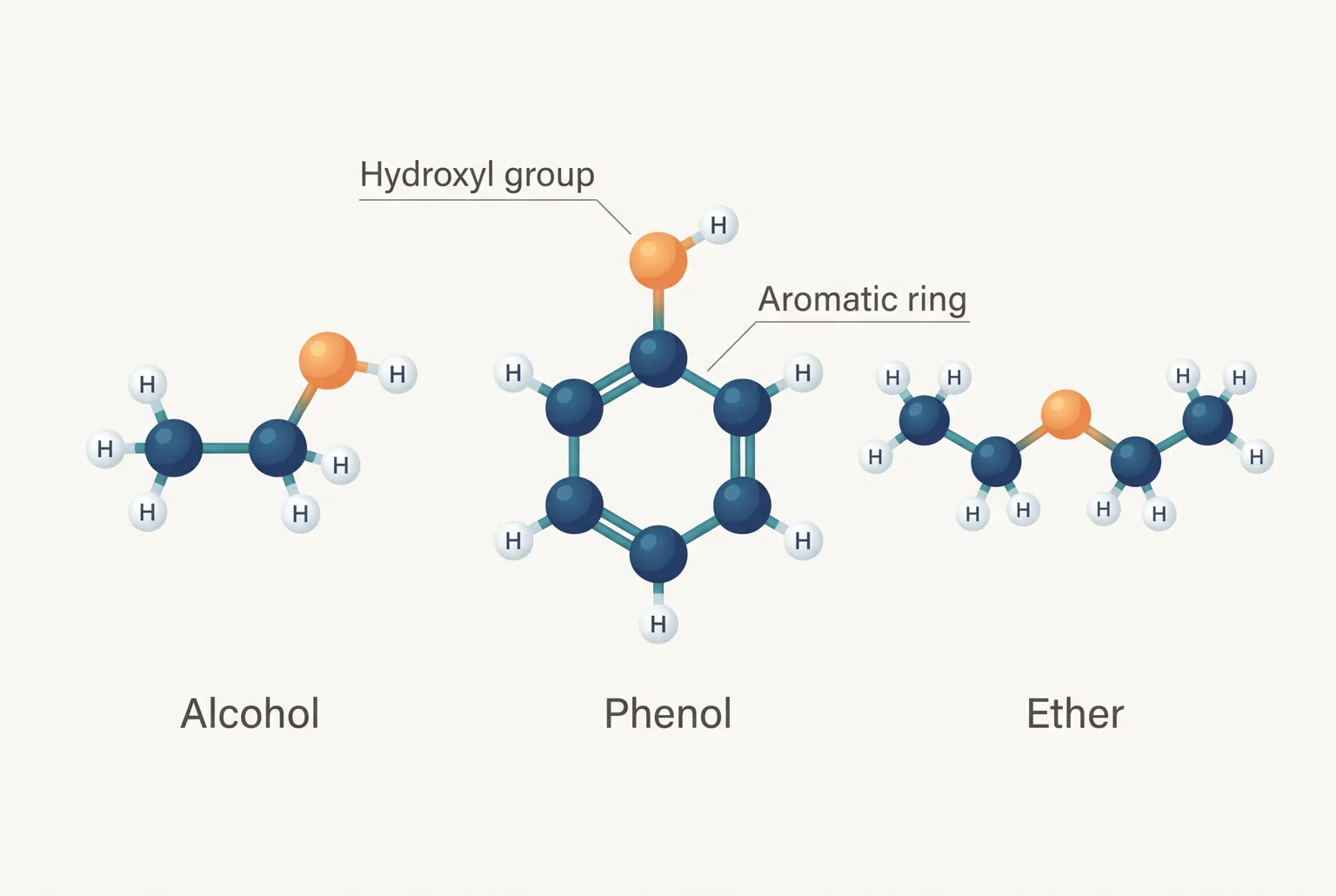
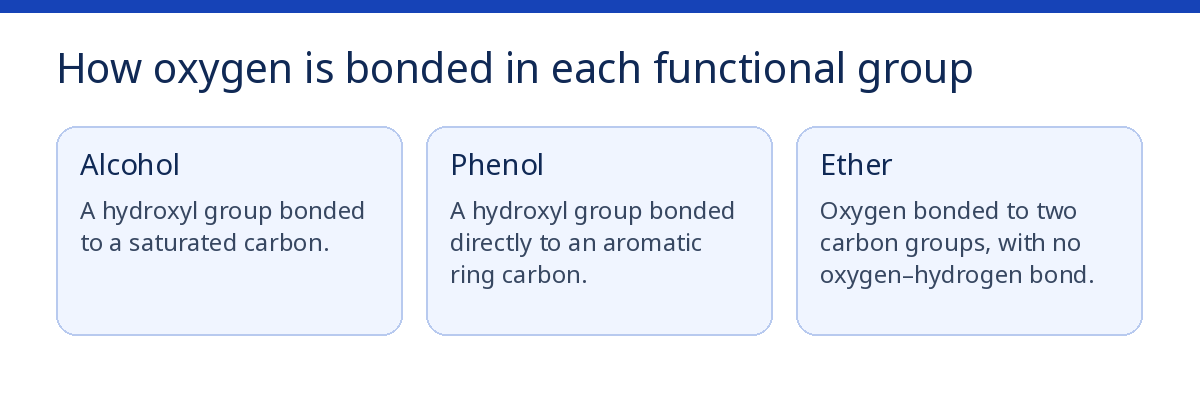
An alcohol has a hydroxyl group bonded to a saturated carbon, whereas in a phenol the hydroxyl group is bonded directly to an -hybridised aromatic carbon. An ether has oxygen bonded to two carbon groups rather than an O–H bond. The word directly matters: an aromatic ring elsewhere in the molecule does not make a hydroxyl group phenolic.
The phenol cases look at preparation from cumene and chlorobenzene, as well as reactions of the aromatic ring. Keep the direction of the change clear: a preparation route makes phenol, whereas electrophilic substitution uses phenol as a starting material and changes the ring. The hydroxyl group activates that ring towards electrophilic substitution and directs incoming groups preferentially to the ortho and para positions, relative to itself.
When the conditions change the product
The hydration case brings together alkenes and alkynes. Alkene hydration adds water across a carbon–carbon double bond to give an alcohol. For an unsymmetrical alkene under acid-catalysed hydration, Markovnikov orientation helps you reason about where the hydroxyl group ends up. Do not transfer the alcohol-product rule to an alkyne merely because the question also uses the word hydration.
The dehydration case shows why a reaction name alone may not identify the product. The passage contrasts two routes from ethanol with concentrated sulfuric acid: intermolecular dehydration at gives an ether, while intramolecular dehydration at – gives an alkene. Read these temperatures as conditions for the displayed ethanol reactions, not as universal cutoffs for every alcohol. The case also includes rearrangements, so the starting carbon skeleton is not always enough to identify the product.
Compare acidity through the conjugate base
When an alcohol or a phenol loses a proton from its hydroxyl group, the resulting ions are an alkoxide and a phenoxide, respectively. The aromatic ring allows the negative charge in phenoxide to be delocalised by resonance. An ordinary alkoxide lacks that stabilisation, which helps explain why phenol is more acidic than typical alcohols.
In the substituted-phenol case, ask how a group affects the stability of phenoxide and whether its position allows it to act through resonance as well as through induction. Electron-withdrawing groups generally increase phenol acidity, while electron-donating groups generally decrease it. Before comparing compounds, underline whether the question asks for acid strength or . Their rankings run in opposite directions: a stronger acid has a lower .
Ether synthesis and cleavage ask different questions
The Williamson synthesis case deals with forming a carbon–oxygen bond. In the standard reaction, an alkoxide displaces a leaving group from an alkyl halide by an pathway. The structure on the halide side therefore matters: methyl and primary substrates favour substitution, while a tertiary alkyl halide instead favours elimination with a strongly basic alkoxide.
Cleavage asks which carbon–oxygen bond breaks. With hot HI or HBr, a simple ether can initially give an alcohol and an alkyl halide. For an unsymmetrical dialkyl ether reacting by , attack favours the less hindered carbon. An ether with a tertiary alkyl group can follow a different pathway, so do not apply that preference mechanically. Also check whether the acid is in excess: an alcohol formed in the first step can react further under suitable conditions.
Distinguish identification clues from physical properties
The alcohol oxidation, Lucas test and diethyl ether cases use reactions or observations to distinguish compounds. In oxidation, classify the alcohol and read the conditions together: a suitably controlled oxidation of a primary alcohol can stop at an aldehyde, further oxidation can give a carboxylic acid, and oxidation of a secondary alcohol gives a ketone. The Lucas test case focuses instead on differences in alcohol reactivity. In a sequence of identification clues, check that your proposed structure accounts for all the observations, not just the first one.
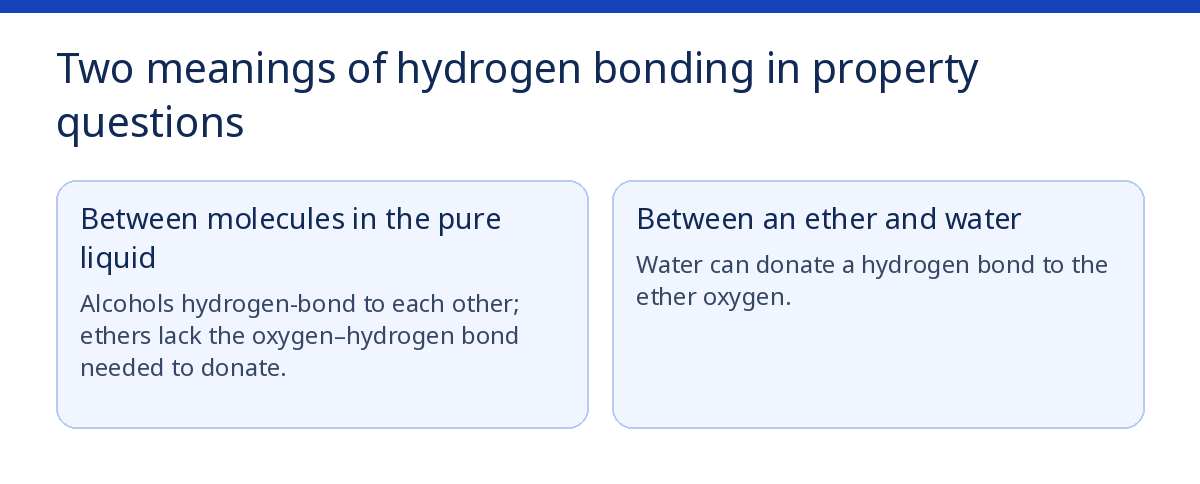
The physical-properties case asks a different kind of question. Alcohol molecules can hydrogen-bond to each other. Ethers lack an O–H bond, so they cannot do that with one another, but their oxygen can accept a hydrogen bond from water. Keep those two interactions separate when comparing boiling points and aqueous solubility.
Quick self-check before opening a solution
Try stating your reasoning in one sentence before following the solution link: which structural feature, reagent or observation rules out a competing interpretation? In an assertion-and-reason item, check whether each statement is true before asking whether the reason actually explains the assertion. On returning to the question, see whether you can recover that reasoning without relying on the answer options.
This guide omits the flagged notation in the phenol definition, the disputed clause in its bond-length explanation, and the inconsistent product label in the linked aromatic conversion case. Those details are not needed to practise the independently supported concepts in the assessment.
Spotted an error? Report a correction. Practise this in the app: notes, formula sheets and mind maps.















































































































































Loading comments…