CBSE Class 12 Chemistry 2026: Solved Board Question Paper
CBSEChemistry2026 Previous Year Paper
Paper code: 56/3/2 · 2026Practise with the full English-language 2026 CBSE Class 12 Chemistry main examination paper, set 56/3/2. Use the worked solutions after your attempt to check how you chose a method, applied it and explained your reasoning.
This set is one of the year's papers. See every set from 2026, grouped by series.
What the 2026 paper asks you to do
This year-wise resource pairs the full board question paper with worked solutions. The exam allows three hours for 70 marks and does not permit a calculator. Its 33 questions are arranged in five sections: 16 one-mark multiple-choice questions, five two-mark very short answers, seven three-mark short answers, two four-mark case-based questions and three five-mark long answers. The last four questions in Section A use the assertion–reason format.
There is no overall choice. Some questions outside Section A offer an internal choice, so in a timed attempt, follow the printed OR rather than answering both alternatives. For revision, you can return to the branch you skipped. The resource supplies worked explanations for both branches, which lets you compare the skills tested by each without changing how you sit the paper.

Chemistry 2026 | Class 12 | Previous Year Paper | Code 56/3/2
In the StudentCurio app
A solved CBSE Class 12 Chemistry board examination paper, with questions and worked answers spanning organic, physical and inorganic chemistry. Useful for practising board-style questions and reviewing solution methods.
Physical chemistry: identify the quantity before calculating
The paper tests solution concentration, boiling and freezing behaviour, chemical kinetics and electrochemistry. When reviewing the concentration questions, write down what belongs in the denominator before substituting values. Molality uses the mass of the solvent in kilograms; mole fraction uses the total amount of substance in the mixture, in moles. In kinetics, keep concentration changes linked by reaction stoichiometry separate from the concentration exponents in a rate law. They describe different relationships, even when both appear in the same chapter.
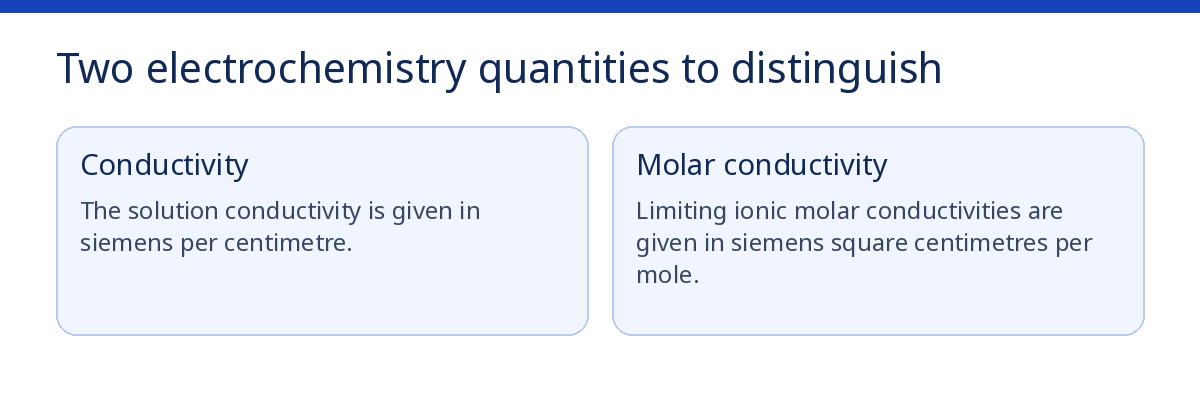
Electrochemistry shifts between calculations, cell reactions and written explanations. One useful unit check is to distinguish conductivity, printed in the paper in , from molar conductivity, for which the given limiting ionic values are in . When comparing your calculation with the solution, check that your intermediate and final quantities have the right units, not just that the numbers look similar.
Inorganic chemistry: separate charge, structure and behaviour
The coordination chemistry questions move from Werner’s terminology and IUPAC naming to hybridisation and magnetic behaviour. When reading a formula, distinguish the ligands inside the coordination brackets from the counterions outside them. Oxidation state comes from charge balance, whereas coordination number counts donor atoms attached to the metal. Keeping those two tasks separate helps when you move from interpreting a formula to naming the compound or explaining a property.
The transition-element questions ask for comparisons as well as equations: you may have to justify a property or represent an oxidising action in a specified medium. In review, distinguish a missing explanation from an incorrect prediction. For an ionic equation, check atoms and net charge separately, and keep the stated reaction medium in view.
Organic chemistry: connect each conclusion to evidence
The organic questions cover substitution, alcohols and phenols, amines, diazonium chemistry and carbonyl compounds. Some ask you to predict a product from a given starting material; others reverse the task and ask you to infer a structure from reactions and test observations. For an identification question, organise the clues before settling on a structure. A proposed compound must account for negative observations as well as positive ones. When the prompt asks for an equation, a compound name alone does not show the transformation.
Section D changes how the information is presented. One case concerns alcohols, phenols and ethers; the other concerns biomolecules, including proteins and nucleic acids. Read each subpart for the specific task it sets. Naming a reagent, explaining a property and comparing structures require different responses, even when they share the same introductory passage.
When the boiling-point rule applies
Before using boiling-point elevation, check whether the added substance can be treated as nonvolatile. The usual dilute-solution expression assumes a nonvolatile solute. A volatile component, by contrast, contributes to the total vapour pressure, so the nonvolatile-solute expression cannot determine the boiling point of that mixture. The distinction matters when a qualitative question asks you to explain a change rather than calculate its size.
Boiling occurs when the total vapour pressure reaches the external pressure. Use that criterion to connect an explanation about vapour pressure to the temperature change. It also helps you distinguish a question about adding a nonvolatile solute from one about a mixture that deviates from Raoult’s law.
Quick self-check before opening a worked solution
For an assertion–reason item, ask three questions: Is the assertion true? Is the reason true? If both are true, does the reason actually explain the assertion? For a longer response, ask whether you supplied what each subpart requested: a reason, an equation, a comparison or a calculation. Check that the condition you relied on is stated wherever it affects your conclusion.
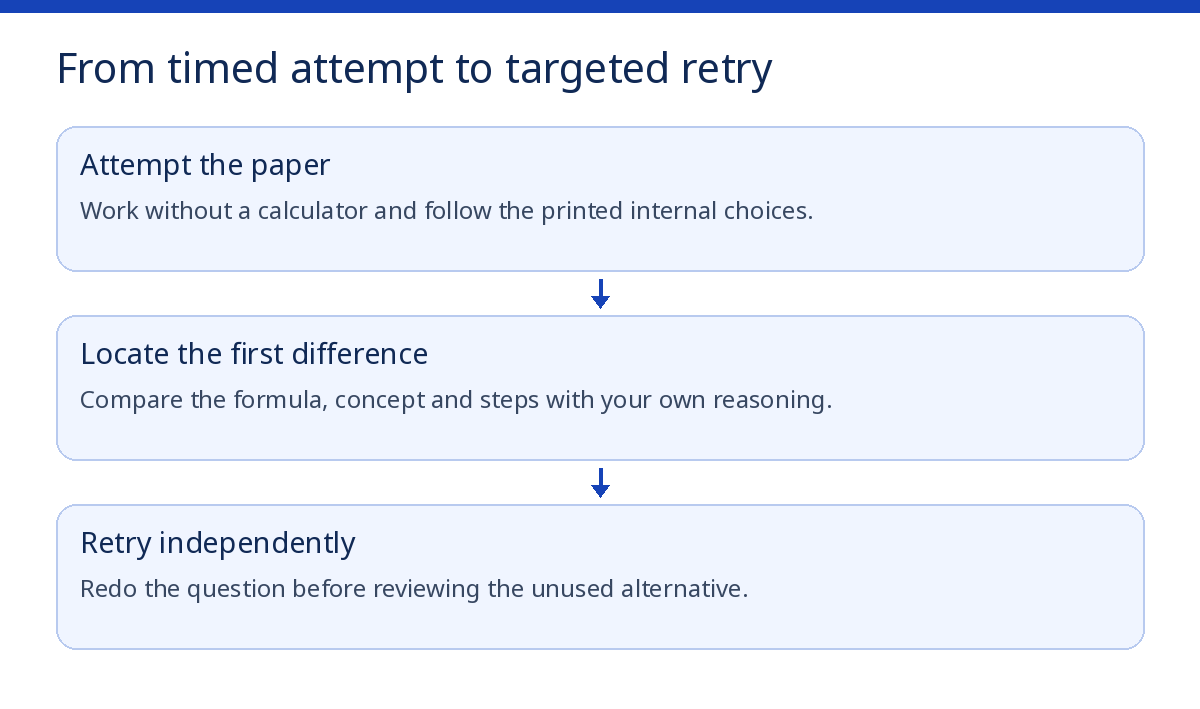
After the timed attempt, use the worked pages’ formula, concept and step-by-step explanation to locate the first point where your reasoning diverged. That tells you whether to revisit the underlying idea, correct a sign or unit, or make your explanation more explicit. Retry the question without the worked page before moving to the unused OR branch. Two individual Section A answer discussions are omitted from this guide: one item is flagged as ambiguous by the resource, and another worked entry is internally inconsistent.
Spotted an error? Report a correction. Practise this in the app: notes, formula sheets and mind maps.















































































































































Loading comments…